
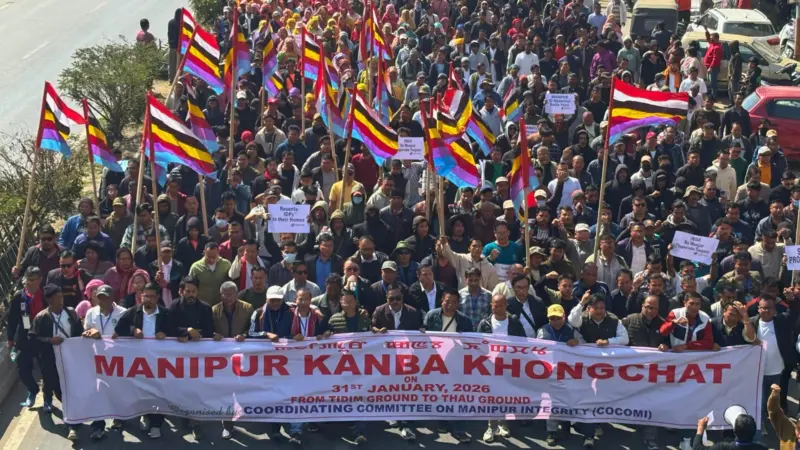

Manipur has been grappling with sustained ethnic conflict between the Meitei and Kuki communities, leading to extensive loss of life and deep social fragmentation.
Since May 2023, the crisis has extended beyond physical destruction to erode shared identities, trust, and a sense of belonging.
These developments are not abrupt but are rooted in enduring contestations over land, identity, and political recognition. The escalation of violence reflects a long-standing failure of political leadership to engage with these structural fault lines in a timely and sensitive manner.
The human cost of this conflict has been severe. Widespread displacement has uprooted thousands, villages have been reduced to ruins, and religious spaces, including churches and temples, have not been spared. Reports of sexual violence further expose the gendered vulnerabilities embedded within the conflict.
While the immediate flashpoint emerged from protests against the Meitei demand for Scheduled Tribe status, a range of underlying factors intensified mistrust. Policies such as the 'war on drugs' campaign in hill regions, the branding of Kukis as narco-terrorists, and eviction drives targeting tribal communities contributed to a climate of suspicion that eventually spiralled into open hostility.
The continued instability and inability to restore order point to a deeper crisis of governance. Despite judicial scrutiny and central interventions, no sustainable resolution has been achieved.
Even the imposition of President's Rule under Article 356, following the resignation of the Chief Minister, has failed to produce meaningful outcomes.
The assumption of office by Yumnam Khemchand Singh has been accompanied by renewed assurances of peace, yet these claims remain largely unconvincing in the absence of tangible progress.
A closer look at the state's response points to a largely reactive mode of governance, marked by fragmented, short-term interventions in place of a sustained and coherent strategy. In Manipur, measures such as repeated internet shutdowns illustrate an emphasis on immediate control, often justified in terms of curbing misinformation.
However, these interventions tend to deepen the isolation of already affected communities and fail to engage with the underlying causes of the conflict, thereby limiting their effectiveness in fostering any lasting resolution.
Recent incidents further underline the fragility of the situation. A suspected explosive attack in Bishnupur district, which claimed the lives of two children and injured their mother in a Meitei-dominated area near Churachandpur district, highlights the persistence of violence and the everyday insecurity faced by civilians.
Such episodes not only deepen ethnic divides but also expose the limitations of existing institutional safeguards.
Although civil society organisations and local communities have actively engaged in relief and peace-building efforts, the responsibility for restoring stability cannot be transferred onto them.
The fragmented and inadequate responses from both central and state authorities raise serious concerns about accountability and political will, particularly as violence continues despite repeated assurances.
More broadly, the crisis reveals a disconnect between political projection and administrative commitment. Assertive leadership narratives at national and international levels stand in contrast to the limited and inconsistent engagement with crises within the country.
Despite the strategic importance of India's northeastern region, issues in states like Manipur often fail to receive sustained attention, suggesting that political visibility does not necessarily translate into governance priority.
Within this framework, the notion of performative solidarity becomes crucial. State responses appear increasingly reliant on symbolic gestures-public statements, condemnations, and assurances-that project concern without ensuring substantive transformation.
While such expressions may hold representational value, they remain insufficient in the absence of institutional depth and long-term policy engagement.
For instance, the deployment of security forces, while projecting state presence, has not prevented recurring violence, raising questions about whether such measures are aimed at resolution or merely at managing visibility.
This selective articulation of concern also reflects an uneven recognition of suffering. While humanitarian issues beyond national borders often evoke strong and immediate responses, similar urgency is not consistently extended to internal crises such as Manipur.
In such contexts, the language of care risks becoming instrumental, shaping perceptions without delivering outcomes. Consequently, certain forms of suffering gain prominence, while others remain marginal within the national discourse.
The crisis, therefore, extends beyond ethnic conflict to expose systemic limitations in governance. It highlights a pattern where responses remain ad hoc, accountability remains diffused, and commitments are rarely translated into sustained action.
A more meaningful approach would have required engaging with the deeper historical and political context, addressing the legacy of insurgency, the presence of parallel governance structures, and enduring concerns over unequal political representation.
Issues such as alleged cross-border migration from Myanmar and anxieties over demographic change also demanded careful and balanced handling.
Equally important is the mistrust among the Kuki community, shaped in part by perceptions of exclusionary and biased state policies. The absence of an inclusive and nuanced response has only reinforced divisions and intensified the conflict.
Moving forward, it is imperative for both central and state governments to move beyond narrow political considerations and adopt a more grounded, people-centric approach.
Protecting vulnerable populations must become an immediate priority, particularly in a context marked by identity-driven violence and insecurity. This requires shifting from symbolic assurances to concrete, justice-oriented interventions.
At the societal level, there is also a need for introspection. Lasting peace cannot emerge from cycles of retaliation and mutual hostility. Reconciliation depends on dialogue, restraint, and a collective willingness to rebuild fractured relationships.
Finally, conflict resolution must go beyond an overdependence on militarisation. While security measures may offer temporary stability, they cannot replace the need for trust-building and institutional reform.
A durable peace process demands transparency, accountability, and inclusive platforms where grievances can be openly addressed. Only through such sustained and sincere efforts can the foundations for long-term stability be meaningfully established.
Views expressed are that of the author and do not reflect EastMojo's stance on this or any other issue. The author is Assistant Professor, Dept. of Political Science, NEFTU, Aalo, Arunachal Pradesh.