
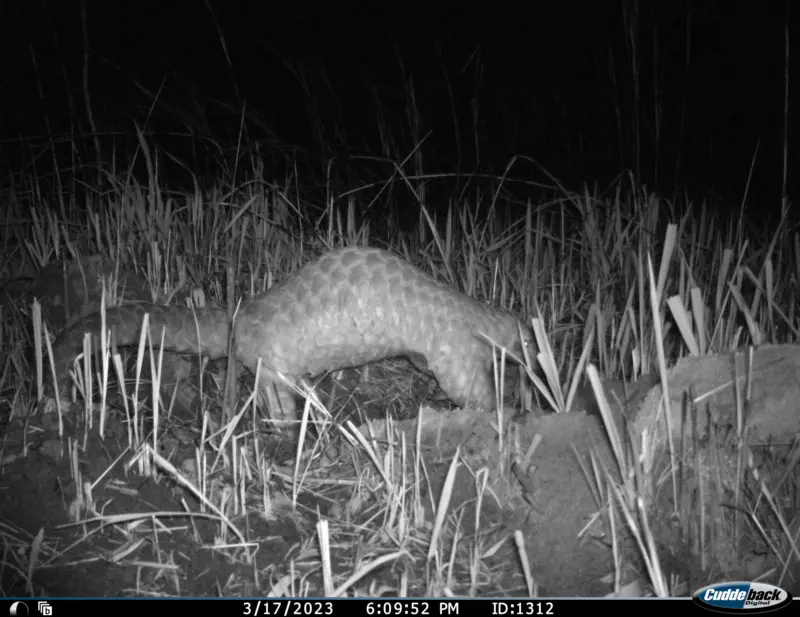

Guwahati: In the dense alluvial grasslands and forest patches of Arunachal Pradesh's Daying Ering Wildlife Sanctuary, a quiet transformation in wildlife research is taking place.
Here, local researchers are combining Indigenous Knowledge with ecological monitoring tools such as camera trapping. For the first time, these researchers have camera-trapped the resident population of the Critically Endangered Chinese pangolin (Manis pentadactyla) in this region-thanks to the Indigenous ecological knowledge of the Adi people.
The study, published in Oryx by Cambridge University Press, was led by Chiging Pilia and Odan Ratan of the Nature Conservation Foundation, and co-supervised by Drs. Aparajita Datta and Sahil Nijhawan. It underscores how Indigenous ecological wisdom can complement modern conservation tools such as camera traps-especially for nocturnal and burrowing animals that often elude scientific surveys.
Asian pangolins face one of the highest extinction risks among mammals, driven by habitat loss, including the expansion of monoculture plantations, and by hunting for the illegal wildlife trade.
In Northeast India-once considered a stronghold for the Chinese pangolin-rampant trafficking of live pangolins and their scales has decimated populations. Despite being legally protected, researchers note that little scientific information exists on their distribution and population status in Arunachal Pradesh.
To bridge this gap, the research team turned to the Adi community, who have lived for generations in the Siang River Basin. The Adis, known for their deep animist traditions and ecological awareness, shared their knowledge of Sipit (the local name for pangolin)-its burrow characteristics, feeding habits, and subtle signs of presence, such as claw marks, faecal pellets, or tail drag lines.
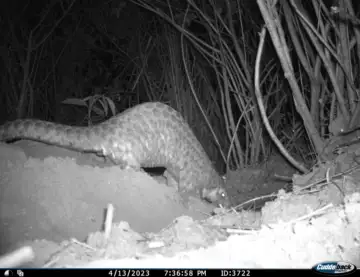
Using these local cues, researchers walked 31 kilometres inside the sanctuary, identifying 51 signs of pangolin activity-44 burrows and seven feeding sites. They then installed nine camera traps, seven of which were placed based on the Adi people's knowledge of burrow microhabitats. Over 232 trap-nights between March and May 2023, six of these locally guided camera sites successfully captured 41 photographs of pangolins across 12 independent events-a detection rate of 5.1 per 100 trap-nights.
This rate is among the highest recorded for pangolin studies globally, outperforming similar efforts across Asia and Africa where camera placements relied solely on conventional scientific methods. "Our results show that the chances of detecting pangolins increase significantly when we incorporate Indigenous ecological knowledge," the paper notes.
For the Adi people, this partnership with researchers is both cultural and practical. Pangolins feature prominently in their ancestral stories and daily life.
 MR=A.2,AD=3/13/2023,RD=29,LI=99,LF=59,GH=0,BT=12,BL=5691,BP=90%,CM=Motion,CF=Disabled,IR=100%,P0=1,P1=2,P2=1,P3=3,P4=3,P5=1,P6=1,P7=0,P8=22,P9=37,PA=4,PB=37
An Adi elder explained that the direction of pangolin footprints can reveal its movement-if they lead away from a burrow, the animal has just entered it. Another belief holds that seeing a pangolin during the day is an ill omen. Yet these beliefs coexist with a profound respect for the animal as a symbol of perseverance.
The findings come at a time when global conservationists are urging more collaboration with local communities, especially in biodiversity hotspots like the Eastern Himalayas. Much of Arunachal Pradesh remains forested, and nearly two-thirds of its land is under de facto Indigenous community management-a unique model of community-led conservation.
The study's authors argue that integrating Indigenous and local knowledge with modern field techniques offers a cost-effective and ethical path to monitoring endangered species. "This is particularly vital for elusive, nocturnal, and heavily hunted species like pangolins," the paper emphasizes.
The research was carried out with Free, Prior, and Informed Consent from the Adi Ba:ne Kebang-the traditional council of the Adi people-and with permission from the Arunachal Pradesh Forest Department.
Beyond its scientific significance, the study signals a paradigm shift in how conservation science views Indigenous communities-not merely as informants or guides, but as equal partners in knowledge creation. By trusting in local expertise, the researchers have not only camera-trapped a resident population of one of the world's most trafficked mammals but also illuminated a pathway for collaborative and community-driven wildlife conservation in India's Northeast.
As pangolins continue to vanish elsewhere in Asia, the story unfolding in the grasslands of Daying Ering offers hope-that the key to saving this shy, scaled mammal may lie not just in technology, but in the ancestral wisdom of those who have long shared its forests.
I stand in shame: Hemant Bangur's stark admission on worker neglect in tea gardens