
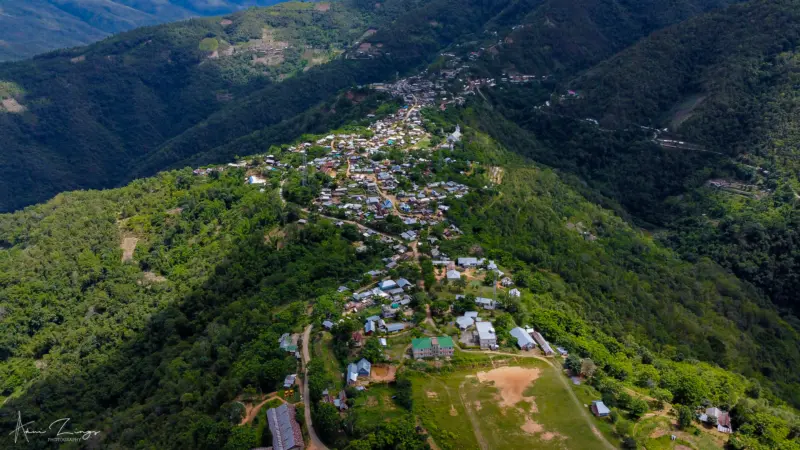

Jessami village's Mrs Hume's Pheasant Community Conserve isn't just about protecting the vulnerable state bird of Manipur, but a much greater effort to protect their commons from the threats of climate change and overexploitation.
A couple of weeks ago, I found myself on the road from Ukhrul to Jessami, accompanying Dr Weyepe N. Mekrisuh, a geologist and conservationist, to attend a biodiversity festival at Chizami in Nagaland.
Since Weyepe hails from Jessami, we had planned to make short stops at a few places in Jessami. I had heard about his village before, mostly in passing conversations and on social media, as a village that had taken it upon itself to protect the State Bird of Manipur, Mrs Hume's Pheasant.
Since he is closely involved in this effort, it felt like a chance to gain a deeper understanding and learn more about the conservation effort.
The 5-hour drive from Ukhrul to Jessami along NH-202 is slow and tedious due to the highway undergoing expansion and new construction.
Much of our journey was thus spent either stopping for JCB excavators to clear the debris or overtaking cars and trucks to avoid the billowing dust that rose from the back of these vehicles.
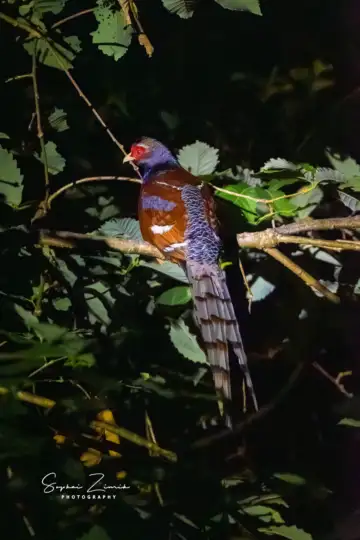 A Mrs Hume's Pheasant, the state bird of Manipur and Mizoram, in its roosting place. Photo by SC Horzak Zimik
Naturally, the dust-laden landscape and ongoing construction made it impossible not to bring up conversations about climate change and environmental degradation.
"It's been one of the worst years in terms of water scarcity," Weyepe mentioned at one point, as we drove past the Shirui river reservoir, the main water source of Ukhrul town. "Most of the spring recharge areas have reduced significantly."
Given his work on springshed management across the Ukhrul district, his concern wasn't a casual observation but one that came from experience. He'd spent years watching water sources and recharge areas within the Ukhrul district change due to climate change and the rampant exploitation of natural resources within the recharge areas.
Climate Change and Changing Landscapes
The extremity of the water scarcity in Ukhrul took Weyepe back to 2017, when a cloudburst in his village led to flash floods of a scale and extremity the village had never seen before.
Jessami, like several villages in the region, lived their lives closely tied to their land. The community depended on paddy cultivation along the river and the forest commons for other sources of food, including game from hunting.
However, in the aftermath of the cloudburst in 2017, many paddy fields near the river were rendered uncultivable due to the mass deposit of stones and debris. The river also changed its course, and some of the most fertile fields were lost to the changing river course.
Around the same time, crops like oranges and parkia (stink beans/bitter beans), which once grew extremely well in the village, also began to decline in yield.
The village was also starting to face growing pressure on forest cover and habitat loss of flora and fauna due to infrastructure development, especially road construction. Being one of the northernmost villages of Manipur and directly bordering Nagaland, the village serves as an intersecting point for the two states.
As such, much of the village's landscape had been dissected by road construction and other infrastructure in recent years, ushering in opportunities for development but with risks of climate change, habitat loss of biodiversity, and overall commons degradation. A growing sense that things were changing environmentally started to take root among the villagers.
Jessami's Mrs Hume's Pheasant Community Conserve
By 2023, conversations on commons conservation within the village began to take a more defined direction. For too long, the community had taken their commons for granted and risked losing their biodiversity if they didn't act soon enough.
Weyepe, who belongs to the village chief's family, started to take responsibility for expediting these conversations into action. He sat down with community leaders to discuss what could be done to protect the rich biodiversity that had sustained the community for eons and how some of the adverse effects of climate change could be mitigated.
The discussions culminated in the start of an initiative to protect and conserve the state bird, Mrs. Hume's Pheasant. The large forest pheasant, known for the striking plumage of its males, is a vulnerable species on the IUCN Red List and is found only in certain Northeastern states of India and parts of China, Myanmar, and Thailand.
Within the community commons, the bird was one of the worst affected by habitat loss from infrastructure development and excessive hunting in recent years. The ecological disturbances caused by various factors in the village were affecting not only the livelihoods of the community but also impacting the community commons and its ecosystem.
Identifying the need to protect the already vulnerable state bird and its habitat, an area covering roughly 28.5 square kilometres of forest commons was set aside as the community conserve area.
The conserve lies on the southern side of the village and is set in an area with subtropical evergreen and coniferous pine forests, a forest type favoured by the pheasant.
The initiative to conserve the vulnerable state bird was also designed to serve as the rallying point for the community's overall mission to conserve their forest commons, its resources, flora, and fauna. Hunting and trapping of any animals and birds were completely banned in the conserve area.
"Sightings have increased considerably since the conservation started, and we've started seeing Mrs Hume's Pheasant roaming freely in the conserve area," Weyepe said when we drove past the conservation area that day.
The conservation initiative has also seen other birds and animals reclaim the commons conserve area, and in the past few years, Jessami has become a go-to destination for birders interested in seeing the elusive Mrs. Hume's Pheasant and other rare birds endemic to the Indo-Burma biodiversity hotspot.
As we neared the village, we saw a group of birders from Mumbai quietly observing a flock of laughing thrushes by the side of the road.
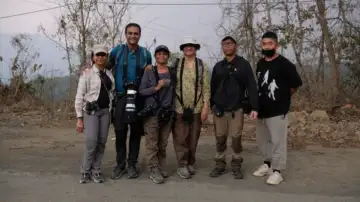 Birders from Mumbai at Jessami along with Weyepe (far right). Photo courtesy author.
 "We came to Jessami because there are many birds here that we don't see in other parts of India. For example, Mrs Hume's Pheasant isn't found in many other states, but we were lucky enough to see it here yesterday," said Shakuntala Pendse, one of the keen birders from the group.
Hunters to Spotters
The group had been led to the pheasant's roosting spot by Misehelo Wezah, a spotter from the village who knows the forest like the back of his hand. All his life, he'd hunted in the forest, knowing where birds roost and animals come to drink and feed during different seasons of the year.
In 2023, he and eight other hardcore hunters had completely given up hunting to honour the village's decision to conserve its commons. But their skills in tracking and familiarity with the forest were put to new use when tourists started arriving in the village for its rich avian diversity.
With time, these hunters-turned-spotters became the most important cog in the conservation initiative. To date, the community, helped by birdwatchers, has identified more than 145 bird species in the conserve area.
Weyepe believes it is the sense of ownership that each and every community member feels towards this initiative that has led to its success since its inception. "The effort is entirely community-led with no external funding. We charge the tourists a minimal conservation fee, which helps run the conservation board," he added.
We had wanted to meet and speak to Wezah that evening, but by the time we reached the village, the dry weather from the day had completely turned, and a thunderstorm loomed large. We decided to put off the meeting until the next day, hoping to reach Chizami, about 44 kilometres from Jessami, before the thunderstorm arrived.
Unfortunately, we couldn't outrun the storm, and heavy rain accompanied by hail, wind, and thunderstorms turned what should have been a short drive to Chizami into a much longer one.
"I've never seen rain like this in early spring. This already feels worse than the monsoon rains," Weyepe said, before adding, "Climate change is scary," as we navigated past landslide-prone areas in the sweltering rain.
"You haven't heard of any recent deaths by thunderstrikes, have you?" he asked me out of the blue, half joking, half serious. A streak of lightning flashed a few hundred metres in front of us. We shared a laugh, but I clenched the steering wheel and stepped harder on the accelerator.
The extreme indicators of climate change we'd talked about during our whole journey were staring us right in the face. Both of us sighed in relief when we reached Chizami, where it hadn't rained at all.
Learning to Live with Change
The following day, we returned to Jessami and met Wezah at the village junction as he was returning from the forests after guiding the birders around the conserve area.
"When we're able to show them the birds they come looking for, it feels different, and there's more satisfaction in this profession," Wezah replied when asked about how different spotting is from hunting. "They were quite happy to see Mrs Hume's Pheasant the other night," he added with a broad smile.
For Wezah and the other spotters, their new profession doesn't just offer better job satisfaction but also a better income. Most of them earn around 1,500 rupees a day showing the tourists around.
As Wezah spoke about the joys of conservation, he also brought to light some of the challenges. And here, there was a note of concern in his voice. "We're trying to protect these birds and animals, but some of the neighbouring villages have been hunting in our conserve area, and it is very disheartening," Wezah said despondently.
Weyepe mentioned to me that a day before, two youths from a neighbouring village had encroached on the conserve area for poaching.
"We can't force a community that has hunted all their lives to completely stop in one day. We're working on this to make sure our community's effort to conserve our commons and biodiversity is also respected by our neighbouring communities," Weyepe said, pointing out the fine line that emerges when working with Indigenous communities.
He even admits sombrely that his village's conservation effort isn't foolproof and that the long-term sustainability of the community-led conservancy depends on continued consensus from the community, something that can shift over time.
But perhaps what is most striking and hopeful about Jessami is not that it has found a solution, but that it has begun to take steps in the right direction.
The conserve is not presented as a finished model but something that is still being worked out. And there are signs of change. Bird sightings have increased exponentially, according to the locals, and crops such as oranges and parkia appear to be recovering.
Guiding, homestays, and related activities are slowly taking shape in the village, and these small-scale eco-tourism activities have begun to provide an additional source of income for the community.
In 2025, the community received recognition as the "Best Sustainable Tourism Practice" at the Northeast India Tourism Awards for their work in commons conservation.
After our meeting with Wezah, we began our journey back to Ukhrul, but the weather had other ideas, and we decided to return to Jessami and stay for the night. We'd had our share of fright the evening before and didn't have enough dad jokes to get us through the five-hour journey to Ukhrul in the middle of another thunderstorm.
Climate change is not a force we can push back against indefinitely. The way forward lies in adapting, restoring balance, and reimagining our relationship with nature, just as the community in Jessami is doing. And it is in that acceptance that lies a more enduring form of resilience.
The author is a recipient of the Promise of Commons Fellowship, on the significance of commons and its community stewardship.
Sikkim's fertility crisis is real, and cash incentives won't solve it: Here's why