
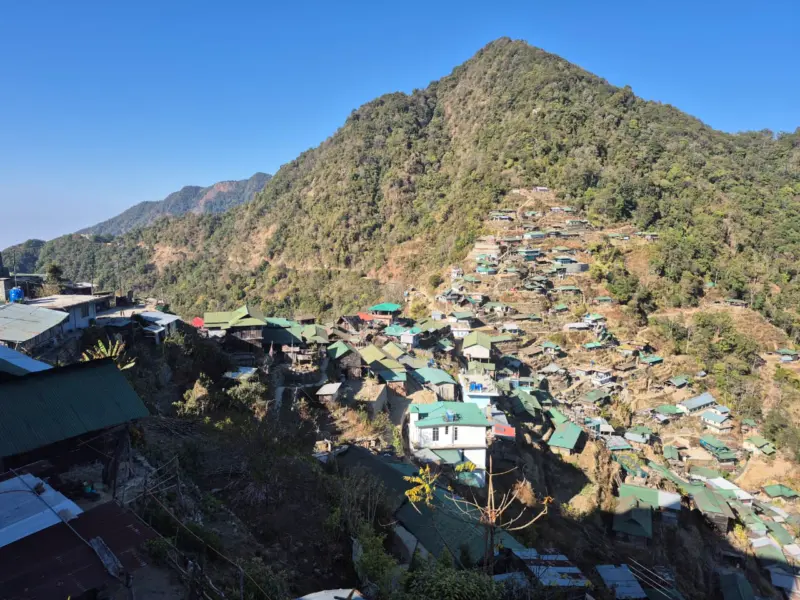

All photos by Sunita Chakma
For decades, women have not been recognised as the primary stewards of conservation but merely as users of the available resources in the landscape.
But a significant shift in this conversation is evident, like that in Nagaland, where change has now moved from lurking on the horizon to moving closer home.
From the slopes of Mount Pauna to the picturesque village of Kigwema, women are stepping out of the shadows to claim their rightful seats as ecological leaders, becoming key actors in community-led conservation.
In Nagaland, women's representation in decision-making spaces has traditionally been influenced by customary laws and practices.
Over the years, customary and political institutions have largely been led by men, while women have continued to play vital roles in sustaining community life. However, their participation in formal decision-making processes has often been limited.
However, things have been changing over the last few years.
For instance, women in Kigwema village now play an important role in monitoring and regulating forest use within CCAs. Although commercial logging is prohibited, limited extraction is sometimes permitted for specific community rituals, house construction, or small-scale self-consumption.
But even before any tree is felled for these requirements, households are often required to seek approval from the village council along with women members of the CCA committee or the Women's Society. Women members assess the purpose of extraction, verify whether the request aligns with community rules and ensure that only designated species or mature trees are harvested.
Speaking about forest use, Apeuna Iheilung, the president of Zeliangrong Mipui Organisation, says women have always been exercising their knowledge and care instincts for the purpose of conservation.
"Our Mother only advised us to cut dead branches, even if it's difficult to cut them," she adds, explaining that sustainable tending operations such as selective harvesting, and cutting only old branches and trees ensures the forest can regenerate naturally.
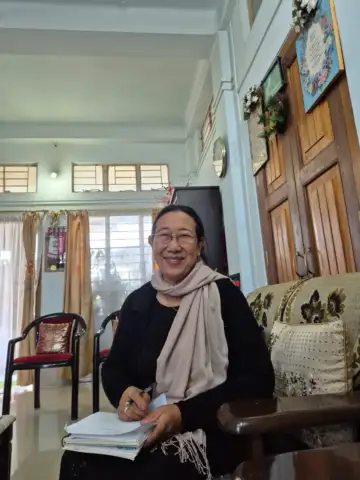 Apeuna Iheilung, the president of Zeliangrong Mipui Organisation. Known in the community as a strong and determined woman, she has consistently worked towards strengthening women's voices and participation in community decision-making spaces.
This understanding is passed down from mothers to daughters, creating a shared responsibility that is often more effective than formal rules. Women's engagement with forests is rooted in everyday subsistence practices, such as collection of fuelwood, medicinal plants, wild edibles and water.
These interactions culminate in intimate ecological knowledge grounded in lived experiences. For instance, in several hill communities, women can identify seasonal variations in non-timber forest products (NTFPs) and track changes in forest health through shifts in plant diversity. Such observations often serve as early warning indicators of ecological degradation.
It is precisely this grounded ecological knowledge that positions women as key actors in shaping landscape-level governance, particularly in ecologically sensitive regions where community stewardship is central to conservation.
The district of Peren district exemplifies this dynamic landscape context. Home to numerous CCAs, Peren reflects a model where local communities manage forests and biodiversity through customary institutions.
Sibeule Hegui, a councillor of Peren town and a very important woman leader of Peren shows how women are designing sustainable livelihoods.
 Sibeule Hegui, a strong woman leader from Peren district. Having served as Treasurer of the Village Council, a member of the CCA Committee, and currently as a Councillor of Peren Town, she has proved to be an inspiration for many.
Hegui, who has earlier served as the Village Council treasurer and a member of the CCA Committee, recalls how the women's collectives worked to restrict changes in land cover pattern by adopting organic coffee cultivation to enhance their income while protecting the forest. "We have made the conscious choice to restrict cultivation to areas between forest patches, avoiding large-scale clearing and banning the use of chemical fertilisers," she says.
Further south in Peren district, in Benreu village too, women have become the primary advocates for agro-ecological health. Benreu sits near the majestic Mount Pauna, a globally recognised important bird area.
Noticing how artificial fertilisers were impacting snail populations and soil quality, the women here have successfully pushed for restrictions on their use despite facing initial setbacks. They have also taken up seed stewardship, preserving traditional seeds to strengthen food sovereignty and climate resilience. This helps ensure that as shifting cultivation patterns change, the genetic diversity of Nagaland's crops remains secure.
A similar ecological sensitivity is visible in Kigwema, where women played a decisive role in banning the harvesting of snails from agricultural fields after observing their declining presence. They advocated for protecting snails to maintain soil health and ecological balance.
For women members of CCAs, the acknowledgement, acceptance and incorporation of their suggestions into village level plans marks a big achievement, etching a shift from token representation to substantial participation.
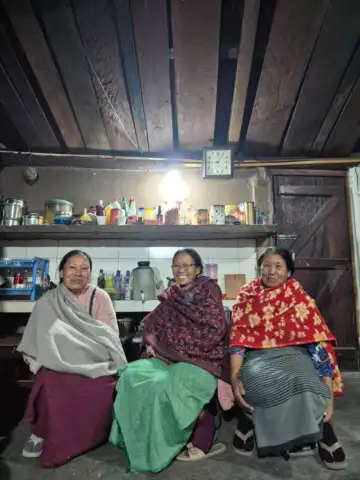 The ecological stewards of Benreu Village
 This transition has not always been straightforward, even within CCAs, which are often seen as alternative conservation models. While they recognise the stewardship role of indigenous and local communities and promote inclusive, rights-based conservation governance, challenges around equitable participation can still arise, particularly in ensuring meaningful space for women.
However, now, CCA management structures in many villages are successfully including women in their CCA committees, recommending representation of Women's Societies in project implementation and inclusion of women as signatories in agreements with government agencies.
Community forums like the Nagaland Community Conserved Areas Forum (NCCAF) have also passed resolutions that recommend inclusion of women in decision-making processes at all levels of biodiversity conservation, further strengthening the case of women participation in CCA committees.
Emerging platforms such as Mt Pauna Biodiversity Conservation Forum have also made efforts in the direction of inclusivity in their committee formation.
For the women, all this appears to be just a beginning. They are clear that participation alone is not enough. No wonder then that a common refrain heard among them is, "We want to see a CCA woman chairperson."
With contributions from Akhrieno Khamu, Project Manager, and Sunita Chakma, Assistant Project Manager, Foundation for Ecological Security (FES). The author is a development practitioner currently associated with the FES.