
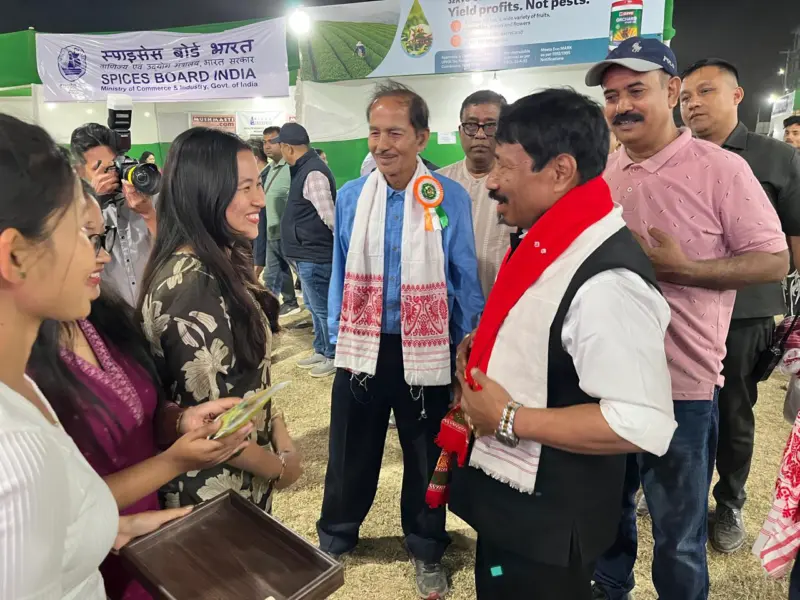

In February, as the winter sun softened over Taralangso, something more than celebration was unfolding at the 52nd Karbi Youth Festival.
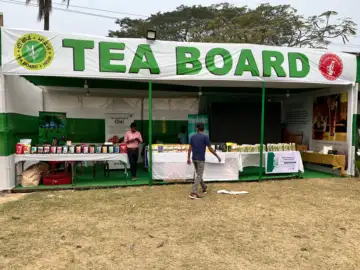
Amid the music, colour and collective pride organised by the Karbi Cultural Society, another story was quietly taking shape at the stall of the Tea Board of India.
It was the story of rural women moving from raw-leaf suppliers to value-creating producers - and of a market beginning to recognise that shift.
Visitors approached the stall out of curiosity and left with something more deliberate: recognition of quality.
A visitor from Jorhat said he had travelled for the performances, but what remained with him was the tea. He spoke about women stepping forward, about villages building industries, and about how this felt like a significant moment for the region. It did not sound like polite encouragement; it sounded like acknowledgement.
A health-conscious customer admitted he tasted the tea sceptically. "We drink tea every day," he said, "but this one is different." After a second sip, the scepticism faded, replaced by endorsement.
Even a doctor from Guwahati, after tasting the Premium Karbi Artisanal Green Tea, remarked that when quality speaks for itself, it does not require loud marketing. What he saw was not merely a beverage but the possibility of an industry capable of generating employment and sustaining itself on merit.
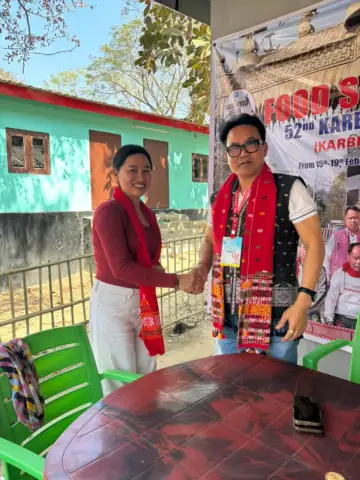 Lunsing Teron, Executive Member, Karbi Anglong Autonomous Council felicitating the team at the Karbi Youth Festival.
These reactions were not sentimental affirmations. They reflected consumer validation. Curiosity may draw attention, but expectation sustains markets. What stood out was that the tea was not being appreciated as a "good village product"; it was being evaluated as a premium product in its own right.
From Symbolism to Market Viability
Being invited to present at the Tea Board of India stall during the festival was not a ceremonial gesture. It signalled institutional recognition.
Ramen Lal Baishya, Deputy Director of the Tea Board of India, observed that many green teas in the market do not meet expected standards and that much of what is sold as Assam tea is blended elsewhere, often diluting identity.
In contrast, single-origin Assam tea that is authentic, traceable and pure carries strong demand.
That distinction is significant. For years, rural initiatives have often been appreciated for their intent - empowerment, culture and community resilience. Markets, however, respond to consistency, traceability, quality assurance and differentiation. When a senior representative of the Tea Board speaks in terms of demand for single-origin tea, he is articulating market logic rather than sentiment.
The transformation underway in Karbi Anglong is therefore structural. Moving from selling raw leaves to producing finished, branded tea shifts the economic position of producers.
Raw-leaf suppliers typically accept prices determined by intermediaries, whereas finished-product producers retain greater margins, control branding and negotiate from a position of strength.
This transition alters not only income potential but also bargaining power and long-term sustainability. It reshapes perception - from beneficiaries of development schemes to entrepreneurs with agency.
Weeks earlier, the Tea-RWE State-Level Convention at Moniram Langneh Auditorium in Deithor had already reflected this emerging maturity.
Nearly 500 rural women entrepreneurs gathered under the Udyamini programme, facilitated by Transform Trade with Grassroots Tea Corporation as the technical partner.
The discussions were practical and technical: composting methods, dryer design, standard operating procedures, packaging strategies, bio-pesticides and home-based processing units. The language of the gathering was not symbolic; it was operational.
Representatives from the Tea Board spoke of a dedicated marketplace in Guwahati for handmade and artisanal teas, while NABARD indicated institutional backing for scaling women-led enterprises.
Trade licences for multiple clusters were under consideration. These developments were not abstract promises but responses to visible groundwork. Institutional engagement following demonstrated capacity indicates that this initiative has moved beyond aspiration and into structured growth.
Culture, Confidence and a Converging Moment
The Karbi Youth Festival remains one of the largest ethnic festivals in Northeast India, celebrating identity, music, dance and language.
This year, tea became part of that cultural expression in a new way. It was not present merely as a commodity but as an extension of community confidence.
The same collective ethos that sustains festivals - cooperation, family-backed effort and pride in heritage - now supports this women-led tea enterprise.
The Rural Women Entrepreneurship initiative under Udyamini is not simply teaching processing techniques; it is building clusters, strengthening networks and anchoring enterprise within cultural identity. This convergence of culture and commerce lends durability to the initiative.
For years, discussions around local enterprise have centred on potential. What distinguishes this moment is the convergence of consumer validation, institutional recognition and organised production capacity.
Quality is withstanding scrutiny from both customers and officials. Market positioning is increasingly defined by premium, single-origin identity rather than by volume. Clusters are forming with technical knowledge and compliance awareness. These are the components of a functioning value chain, not merely a promising idea.
The events at the RWE Convention and the Karbi Youth Festival suggest that 2026 may mark a transition from experimentation to consolidation. When visitors express appreciation grounded in quality, when institutions respond with structural support, and when producers articulate their enterprise with confidence and technical clarity, it signals that a shift is underway.
People are no longer tasting this tea out of curiosity alone. They are approaching it with expectation. And expectation is what transforms a product into a market.
Beyond religion: Rethinking tribal rights and constitutional safeguards