




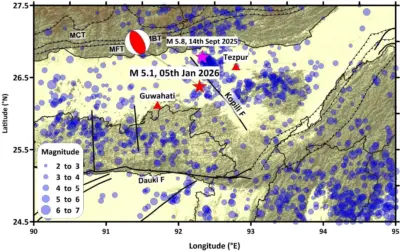

Guwahati: A 5.1-magnitude earthquake that jolted central Assam in the early hours of January 5 has been linked to tectonic movement along the Kopili Fault, a highly active geological structure that has been responsible for some of the region's most damaging earthquakes, according to a preliminary assessment by the National Centre for Seismology(NCS).
The tremor struck at 4:17:40 am, with its epicentre located in Morigaon district at a depth of 50 km, around 65 km northeast of Guwahati. Shaking was felt across large parts of Assam and neighbouring states, the NCS said.
Seismologists noted that the earthquake was associated with a thrust fault mechanism and occurred close to the zone that witnessed a magnitude 5.1 earthquake in Udalguri in September 2025, indicating sustained tectonic stress in the region.
Why the Kopili Fault matters
The Kopili Fault, a major northwest-southeast trending strike-slip fault, runs through central Assam and extends into parts of Meghalaya and Nagaland. Multiple geological and seismological studies by the Geological Survey of India (GSI) and researchers from institutions such as IIT Guwahati have identified the fault as one of the most seismically active structures in Northeast India.
The fault has been linked to several significant earthquakes, including the 2009 Bhutan earthquake (M 6.4), the April 2021 Sonitpur earthquake (M 6.4), and numerous moderate tremors recorded over the past decade. Studies suggest that the Kopili Fault accommodates ongoing crustal deformation caused by the collision between the Indian and Eurasian plates, making it prone to repeated seismic activity.
Intensity, impact and aftershocks
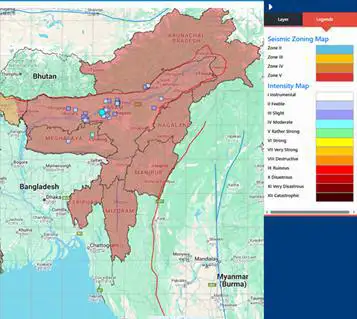
According to the NCS, the January 5 quake generated Modified Mercalli Intensity (MMI) levels ranging from II to IV, with noticeable shaking within a radius of about 200 km from the epicentre. A total of 90 felt reports were submitted through the NCS website and the BhooKamp mobile application, indicating light to moderate ground motion across the region.
Notably, no aftershocks were recorded until the preparation of the report. Scientists said the seismic energy may have attenuated quickly because the source zone has already been weakened by earlier earthquakes, particularly the 2021 Sonitpur event and its aftershock sequence.
Assam remains highly vulnerable
The NCS reiterated that Assam lies in one of India's most earthquake-prone regions, influenced by major tectonic features such as the Himalayan Frontal Thrust, Main Boundary Thrust, Main Central Thrust, Kopili Fault and Dhubri Fault. As per the Bureau of Indian Standards seismic zoning map (2025), the state falls under high seismic hazard zones, where moderate to strong earthquakes are expected.
Authorities have advised continued vigilance, though no major structural damage was reported following the January 5 tremor.