




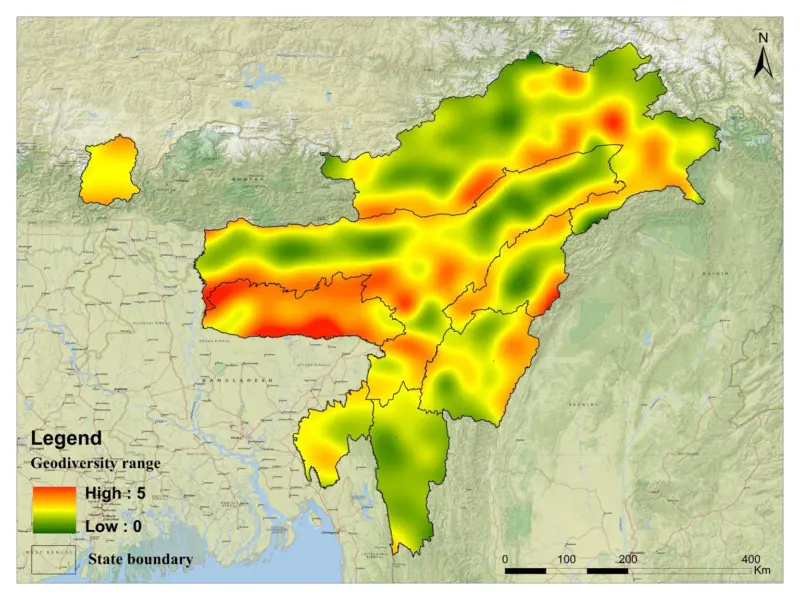

Guwahati: A landmark scientific study has mapped the "geodiversity" of Northeast India for the first time, revealing an extraordinary geological mosaic stretching from the Himalayas of Arunachal Pradesh and Sikkim to the plateaus of Meghalaya and the fossil-rich landscapes of the Indo-Myanmar region.
Published in the journal Geoheritage, the study identifies southern Meghalaya as the Northeast's richest geodiversity zone, while highlighting major geological hotspots across Assam, Arunachal Pradesh, Nagaland, Manipur and Tripura.
The study defines geodiversity as the diversity of Earth's non-living features - including rocks, soils, landforms, minerals and fossils - and argues that it is as important as biodiversity for conservation, tourism and land-use planning.
Conducted by researchers from Gauhati University and the Centre for Brahmaputra Studies - Durlov Lahon, Jatan Debnath, Nityaranjan Nath and Professor Dhrubajyoti Sahariah - the research mapped the geodiversity of all eight northeastern states using geological formations, geomorphology, lithology, soils, minerals and fossil occurrence data.
The researchers found striking spatial variation across the region.
The Himalayan foothills of Arunachal Pradesh and Bhutan showed high geological diversity due to the presence of Tertiary and Neogene sedimentary rocks, Palaeozoic formations, intrusive metamorphic systems and Quaternary sediments.
Meghalaya and Sikkim were identified as geologically significant because of their Palaeozoic rock systems, Jurassic and Triassic formations, Ordovician sedimentary and metamorphic rocks and Cretaceous igneous formations.
The study notes that the Meghalaya Plateau is largely composed of Precambrian igneous and metamorphic rocks, while its southern edge contains sedimentary formations created during ancient marine transgressions.
Researchers also documented high geomorphological diversity in the foothills of Arunachal Pradesh, the Assam-Meghalaya border and southern Meghalaya due to their dissected hills, valleys, piedmont slopes and plateau systems.
Meanwhile, Meghalaya, Nagaland, Manipur and western Arunachal Pradesh recorded high mineral occurrence indices because of the presence of limestone, sillimanite, kaolinite, pyrite, coal, molybdenum and other mineral resources.
Based on the geodiversity index, the researchers divided the Northeast into five categories - very high, high, moderate, low and very low geodiversity zones.
Southern Meghalaya emerged as the only major "very high" geodiversity zone in the entire Northeast, though this category covers just 0.53% of the region's total area.
High geodiversity areas account for 7.82% of the region, while 38.2% falls under moderate geodiversity. Nearly half the Northeast - 48.13% - falls under low geodiversity zones, mainly across the Brahmaputra valley, parts of Arunachal Pradesh and large parts of Mizoram.
The study identifies southern Meghalaya, the Assam-Meghalaya border, the Karbi Anglong plateau and parts of Arunachal Pradesh's foothills as the region's principal geodiversity hotspots because of their complex mix of rock formations, varied soils, dissected plateaus and mineral deposits.
Researchers say the findings could influence future land-use planning, environmental protection and tourism policy across the Northeast.
"Areas with significant geodiversity can be developed as tourist destinations, which may attract visitors and contribute to regional economic development," the paper notes, while calling for dedicated geotourism policies and stronger geo-conservation measures.
The study also highlights that many of the Northeast's best-known heritage and tourism sites already lie within moderate-to-high geodiversity zones, including UNESCO World Heritage sites such as Kaziranga, Manas and Khangchendzonga National Park, along with Geological Survey of India-designated geoheritage and geotourism sites.
Interestingly, the researchers found only a weak correlation between geodiversity and biodiversity despite Northeast India being one of the world's biodiversity hotspots. The study suggests that climate, habitat conditions and soil quality may play a larger role in shaping biodiversity patterns.
The researchers also warn that many of the region's abiotic resources are increasingly threatened by urbanisation, deforestation, mining and intensive agriculture.
They argue that the newly developed geodiversity index could become an important tool for natural resource management, environmental protection and sustainable tourism planning in one of India's most ecologically and geologically complex regions.
Tusks in the sky: Why elephants are climbing higher into Arunachal