
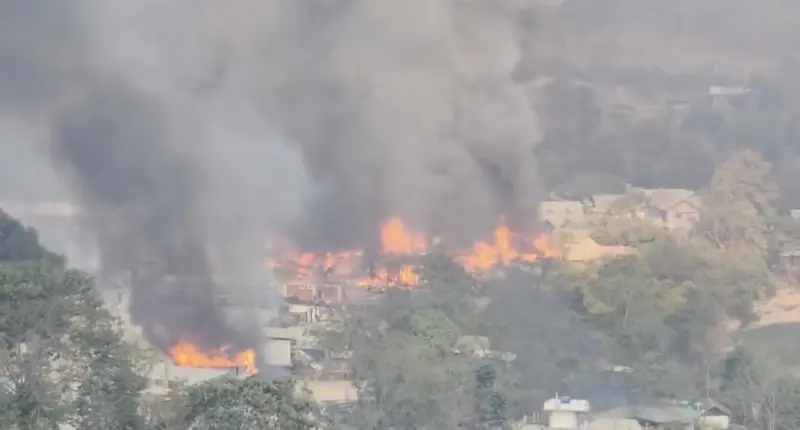

On Saturday, February 7, a drunken scuffle broke out between men from the Kuki and Tangkhul Naga communities in Litan, leaving a Tangkhul man with severe bruises.
His family approached the Chief of Litan Sareikhong village, Hemkhothang Baite, seeking intervention. Both sides agreed to meet the following day to settle the matter. The meeting was scheduled for Sunday.
By evening, the gathering had drawn more people than those directly involved. What had begun as a private altercation did not remain contained. The attempt at settlement gave way to confrontation, and the village slipped into violence.
The tension between the Kuki and Tangkhul Naga communities around Litan cannot be reduced to a single evening's altercation. The scuffle became a trigger, but the unease predates it. Strain over land ownership in and around the Litan bazaar area has persisted for decades, punctuated by smaller confrontations that never fully settled the question of territorial control.
The broader ethnic rupture that has reshaped Manipur since 2023 has further hardened community boundaries. In such a political climate, local disputes do not remain local for long. Suspicion deepens quickly, older grievances return to the surface, and an incident between individuals is read through older grievances. The events in Litan drew from that layered tension.
Litan Sareikhong sits strategically along National Highway 202, the road that links Ukhrul to Imphal. Supplies bound for Ukhrul move through this stretch, and traffic from Kamjong converges here towards the valley as well. When movement along this corridor slows or stops, the effect is felt beyond the village. The state government's decision on Monday to divert the Churachandpur-Aizawl helicopter service to accommodate stranded Ukhrul passengers reflected the disruption along this route.
The location has long carried more than logistical importance. The Litan bazaar area has been the subject of a protracted land dispute between the Sareikhong Kuki chiefs and the Tangkhul village authorities of Sikibung and Sharkaphung.
Competing claims over customary ownership have remained unsettled despite earlier attempts at negotiation. An administrative order issued by the Government of the People's Republic of Nagalim (GPRN) on October 8, 2024 (No.14-11/2024/ORD/WTR), described the area as part of the ancestral land of Sikibung/Sharkaphung, referring to the collapse of a land settlement process initiated in 1973-74 between the then Kuki chief of Sareikhong and the Tangkhul headman of the neighbouring village.
The present violence is being read against that history. Residents recall the burning of Chassad village in Kamjong district in March 2020, an episode that hardened mistrust between neighbouring Kuki and Tangkhul settlements.
Litan does not exist outside that memory. When confrontation returns to a disputed stretch of land, older episodes are pulled back into view.
In June 2025, near the Litan bridge, a Ukhrul-bound passenger vehicle and its driver were set upon; local accounts say three men from the Kuki community seized control of the vehicle and assaulted the driver. The episode prompted local leaders to convene: on June 28, 2025, village chiefs from the Litan area and Tangkhul civil-society representatives signed an undertaking intended to calm tensions.
That undertaking did not settle what underlies the clashes. Incidents like Mongkot Sepu leave traces: anger at public humiliation, unsettled claims of movement and access across the bridge, and the memory of exits and returns that never quite closed the account between neighbours. When another scuffle occurs, people read it against those traces. The events in Litan followed a pattern already familiar in the area.
Earlier confrontations had been formally addressed, yet the underlying grievances remained. When tension resurfaced, it did so against that unresolved background.
The conflict that has gripped Manipur since 2023 has altered everyday life across districts. Villages have reorganised around defence committees. Young men who once moved freely between markets now travel in convoys or avoid certain roads altogether. Weapons that had long receded from public visibility have reappeared in circulation. In such an environment, mistrust travels faster than clarification. Manipur has carried cycles of ethnic confrontation for decades.
Territorial claims overlap across hills and valleys, and political aspirations are mapped onto the same stretches of land. What one group describes as ancestral territory often sits within the historical memory of another. These competing claims have never been fully reconciled, and periods of calm have depended more on containment than resolution.
Recent months have also seen renewed visibility of armed formations linked to different ethnic constituencies. Some of these groups had receded from prominence in earlier years; their reappearance complicates an already fragile situation. Once armed actors re-enter a contested landscape, local disputes risk drawing in organisations whose objectives extend beyond the immediate trigger. The danger lies in how quickly a village confrontation can connect to wider networks of mobilisation.
On February 11, 2026, the Government of the People's Republic of Nagalim (GPRN) issued a press statement on the Litan burning. The organisation alleged that Kuki militant groups, acting in coordination with Indian security forces, had used what it termed "scorched earth" tactics. It further characterised the episode as part of a larger pattern in which the Indian state, in its view, relies on Kuki armed formations in contested areas.
Such framing reflects long-standing tensions between Naga underground groups, state security forces, and neighbouring armed actors. Allegations of proxy arrangements and territorial engineering have circulated in earlier phases of conflict as well. When a village-level confrontation is described in these terms, it travels quickly through political networks and reshapes how events are interpreted on the ground.
There has been no independent verification of the specific operational claims contained in the statement. Security agencies have not publicly responded in detail. Even so, the circulation of such allegations influences local perception. In an already armed and polarised setting, interpretation moves fast, and once hardened, is difficult to reverse.
More than fifty houses from both communities were reported burnt over three days, forcing families to leave with little notice. Temporary shelters have filled with those who, only days earlier, lived across the same stretch of land now under dispute.
The material damage is visible; the fracture it leaves behind will take longer to measure. Images and claims circulated rapidly on social media in the days that followed. Some posts carried photographs said to be from Litan but later traced to neighbouring areas across the Myanmar border.
Such circulation deepened suspicion and fed mobilisation on both sides before verification could intervene. The government responded by suspending internet services across Ukhrul and Kangpokpi districts, citing the need to contain escalation.
Yet restrictions on communication do not settle the conditions that produced the violence. Sporadic firing and reports of fresh confrontation in the vicinity have continued to unsettle residents. Litan now stands as another reminder of how quickly a local dispute can attach itself to larger political currents.
The episode also tests the capacity of the newly formed NDA-led government in Manipur. With senior leadership drawn from both Kuki and Naga constituencies, expectations of restraint and mediation are higher. Whether that expectation translates into sustained engagement on land disputes and community security will shape what follows in Litan.
Ukhrul violence: Three years on, is Manipur on the brink again?