




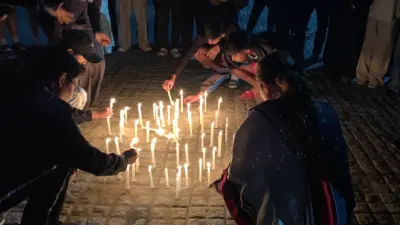

For more than three years, Manipur has remained trapped in a cycle of violence, displacement, and grief. Yet beyond political debates, ethnic narratives, and daily headlines lies another reality rarely spoken about-the quiet suffering of ordinary families whose lives and relationships cut across communities.
This reflection emerges not merely from observation, but from lived experiences shaped by relationships that span many of the identities that make up Manipur. Coming from a Tangkhul Naga background and being part of a Meitei family through marriage, life has always reflected the interconnectedness that has long defined Manipur. Relatives, friends, and loved ones belong to different communities, reminding us that the state's histories and relationships have never existed in isolation.
This is why the conflict has never felt distant. It has entered homes, relationships, and everyday conversations, forcing many families to live with a painful question: where do we belong when those we love are found on different sides of a conflict?
Growing up and studying in a Jawahar Navodaya Vidyalaya residential school offered a glimpse of a very different Manipur. Students from diverse communities lived, studied, played, and dreamed together. Ethnic identities existed, but they seldom defined friendships. Some of the closest friendships formed during those years continue to endure, transcending the divisions that dominate public discourse today.
When violence erupted on May 3, 2023, like many others across the state, there was shock, confusion, and disbelief. Few could have imagined that the conflict would continue for years. What remains most vivid from those early days is not political debates or accusations, but anxious messages exchanged among friends across communities, checking in on one another and their families to see whether they were safe.
One such friendship is with a member of the Kuki community. Amid fear and uncertainty, conversations revolved around a single concern: safety. There were constant messages, phone calls, and prayers, each carrying the hope that loved ones had escaped harm. Those moments served as a reminder that in times of crisis, our shared humanity often speaks louder than our differences.
Like many families across Manipur and beyond, efforts were made to contribute in whatever ways possible. Money, food, and other essential supplies were donated for those displaced by the violence. Yet among these acts of compassion, one person stands out-my mother.
Without recognition or publicity, my mother volunteered fearlessly to support internally displaced persons. She listened to their stories, shared their pain, and stood beside families who had lost homes, livelihoods, and, in some cases, loved ones. She is one among countless unsung heroes across Manipur whose quiet acts of compassion continue to sustain hope amid despair.
The conflict in Manipur is often discussed through political and ethnic lenses. While these dimensions are important, they do not fully capture the realities experienced by ordinary people. Families have been displaced, homes destroyed, livelihoods disrupted, and futures placed on hold. Children have lost years of normal childhood, students have seen their education interrupted, and many continue to live with deep uncertainty about what tomorrow might bring.
In places such as Langka in Kangpokpi district and villages like Thoiyee in Ukhrul district, many families continue to endure the consequences of prolonged instability. Relatives and friends speak of restricted movement, economic hardship, and the emotional burden of living amid constant insecurity. The anxiety of not knowing when normalcy will return has become part of daily life. Yet many of these stories rarely reach national headlines. Even within the Northeast, countless voices remain unheard.
One of the greatest tragedies of this conflict is not only the violence itself, but the silence surrounding it.
As ordinary citizens living through this conflict, many have come to realize that the deepest wounds are not always visible. Beyond the destruction of homes and livelihoods lie psychological scars that continue to shape everyday life. Fear and uncertainty have become part of daily existence for many families. Grief often remains unresolved, especially for those separated from their homes, communities, and loved ones.
Entire communities now carry memories of pain and loss. Children and young people have grown up amid disruption, displacement, and insecurity. Friendships have been strained, trust has been eroded, and social divisions have deepened. If these invisible wounds go unaddressed, they risk being passed down to future generations, making reconciliation even more difficult.
Healing Manipur, therefore, cannot be limited to rebuilding roads, houses, and institutions. It must also involve rebuilding trust, restoring relationships, and creating spaces where communities can heal together.
As Northeasterners, we often speak proudly of shared histories of marginalization, resilience, and solidarity. We frequently invoke the idea of being one region, bound by common experiences and struggles. Yet the prolonged crisis in Manipur compels us to ask difficult questions about our own capacity for empathy and collective responsibility.
When suffering becomes normalized, and communities endure pain in isolation, we risk losing something fundamental-our shared humanity.
For families whose lives cut across ethnic boundaries, this conflict is deeply personal. Human relationships cannot simply be reduced to ethnic categories. Relatives, friends, and loved ones may belong to different communities, but their fears, grief, and aspirations are remarkably similar. Regardless of ethnicity, parents worry about their children's futures. Young people dream of education, stability, and peace. Elders long to see a return to normalcy and reconciliation.
Conflict may divide territories, but suffering recognizes no ethnic boundaries.
Despite everything, it remains difficult to believe that coexistence is impossible. Countless families, friendships, and relationships across Manipur continue to demonstrate that our lives remain deeply interconnected. These relationships challenge narratives that insist communities cannot live together.
The road towards peace will not be easy. It requires political will, justice, accountability, and sincere dialogue among all stakeholders. But peace cannot be built by institutions alone. It also requires ordinary citizens to resist hatred, reject dehumanization, and make space for listening-especially to those whose experiences differ from our own.
The people of Manipur are more than statistics, displaced populations, or subjects of political debate. They are neighbors, relatives, friends, and family members.
Their voices deserve to be heard.
Dear Reader,
Every day, our team at EastMojo travels through rain, rough roads, and remote hills to bring you stories that matter - stories from your town, your people, your Northeast.
We do this because we believe in truthful, independent journalism. No big corporate backing, no government pressure - just honest reporting by local journalists who live and breathe the same air you do.
But to keep doing this work, we need you. Your small contribution helps us pay our reporters fairly, reach places others ignore, and keep asking the tough questions.
If you believe the Northeast deserves its own fearless voice, stand with us.
Support independent journalism. Be a Member.
Thank you,
Karma Paljor
Editor-in-Chief, eastmojo.com
Five years in detention, Myanmar women now allege abuse at Assam transit camp

Are MMA fighters Northeast's new sporting export?

Why Northeast matters for EU's green connectivity vision

The definition of insanity: Four decades of India's war on drugs
From frontier to gateway: Northeast poised to link India-Southeast Asia by 2047
Mizoram marks 40 years of peace: What happened to the Accord's HC provision?
Why is Mizoram's student body raising concerns over foreign nationals during SIR?

Fibre, Cloud & AI: Northeast eyes Rs 38,000-cr digital future
Across Manipur, many continue to pray for peace, coexistence, and the safe resettlement of all those displaced by this conflict. There remains a collective hope for a future where children can once again grow up without fear, where friendships can flourish across communities, and where families separated by violence can rebuild their lives with dignity.
And perhaps, before asking who belongs to which community, we must first ask ourselves a simpler question: in a time of immense suffering, are we still capable of seeing one another as fellow human beings?
Only when the answer is yes can hope for a peaceful and shared future truly begin.
Langkham Kalpana is a psychology educator and researcher from Manipur. Her reflections on conflict are shaped by personal experiences and relationships across communities. The views expressed are personal.
| ADB approves $42.2 million loan to boost Northeast bamboo sector