




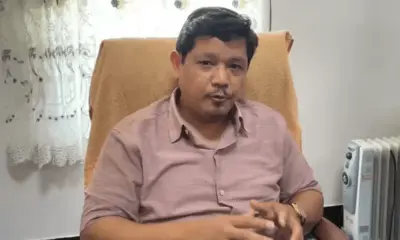

Shillong: Meghalaya Chief Minister Conrad K. Sangma has defended the state government's handling of the August 19 violence, rejecting criticism that his absence from Shillong during the incident amounted to a failure of governance.
Responding to criticism that he was in Delhi or Kerala instead of Shillong, Sangma said his travel schedule had already been fixed and that he was on a flight when the incident occurred.
He said the situation was being closely monitored by the government's senior leadership, including Deputy Chief Minister and Home Minister Sniawbhalang Dhar, the Chief Secretary, the Director General of Police and other senior police officials.
"In today's technology world, we were in touch almost every hour discussing almost every aspect," Sangma said, stressing that decisions were being taken without any gap in the government's response.
The Chief Minister also rejected the Opposition's allegation that the government was "sleeping" despite an ultimatum and earlier protests by the Khasi Students' Union (KSU).
According to Sangma, extensive communication was taking place behind the scenes, although meetings ahead of the rally could not be held. He declined to disclose details, saying they were part of the government's internal process.
Sangma said the government had formally written to the KSU and invited its representatives for discussions.
"We have written to them today, officially this time, and asked them to come for discussions and for talks," he said.
The government, he added, expects a response and intends to discuss all five agendas raised by the KSU.
Asked about demands from other NGOs and the United Democratic Party (UDP) to revoke the invocation of the Meghalaya Preventive Detention Act (MPDA) and Meghalaya Maintenance of Public Order (MMPO) provisions against KSU leaders, as well as calls for their release, Sangma said the government would allow the law to take its course.
"The law is in place for a reason," he said, arguing that the government cannot selectively change rules or interfere with legal proceedings because an organisation or individual is involved.
On whether there was a larger conspiracy behind the violence, Sangma said investigators were examining all possibilities.
He referred to a statement by the KSU general secretary claiming that KSU members were not involved in the violence, but said the government had acted based on the circumstances, reports and intelligence available at the time.
"We are not going to leave any stone unturned," Sangma said, adding that investigations would continue on all fronts.
He also rejected the description of the incident as an "intelligence failure".
According to Sangma, the authorities had intelligence and personnel deployed along the routes, but the scale and geographical spread of the incidents created significant challenges.
"There was a very clear understanding that this rally would be peaceful," he said. "Were we caught by surprise in some sense, by the scale and the action? Yes, we were."
Sangma said the scale of the violence was unprecedented and that five people had so far been identified. However, he said he did not yet have information about their organisational affiliations.
On the Opposition's demand for an FIR against non-state actors over the road blockade, particularly the disruption of vehicles carrying essential commodities, Sangma said the government would examine the demand.
He maintained that the immediate priority had been to bring the situation under control and resolve the issues through communication and discussions.
Govt focuses on restoring confidence
Addressing concerns over the impact of the violence on tourism, Sangma said the government was focused on restoring confidence among visitors and residents.
He acknowledged that the incidents had caused inconvenience and fear but said swift measures had been taken to prevent further escalation.
"We are now trying to de-escalate and bring back the sense of confidence in the people," he said, expressing confidence that normalcy would return soon.
Sangma called for coordinated confidence-building efforts involving the Meghalaya and Assam governments, organisations, tourism stakeholders and other groups.
Asked whether the government would introduce a standard operating procedure (SOP) for processions and rallies, Sangma said permissions already contain terms and conditions governing what participants can and cannot do.
However, in view of the recent incident, he indicated that the government could strengthen those conditions and impose stricter regulations for future processions.
Sangma said the government understood that citizens were fearful following the violence but assured them that strong action would be taken against those responsible for creating fear and harming innocent people.
He stressed that while citizens have the right to hold peaceful protests, that right does not extend to taking the law into their own hands or attacking innocent people.
The Chief Minister also appealed to civil society organisations, associations and other stakeholders to learn from the incident and work towards preventing similar situations in the future.
"We have been one of the most open governments" when it comes to dialogue, Sangma said, reiterating that the government remains willing to engage in talks.
However, he cautioned that there are limits that cannot be crossed.
"One cannot cross a line," he said, warning that the government would take action against anyone who does so.
Meghalaya, Assam agree measures to ensure safe transit after violence