




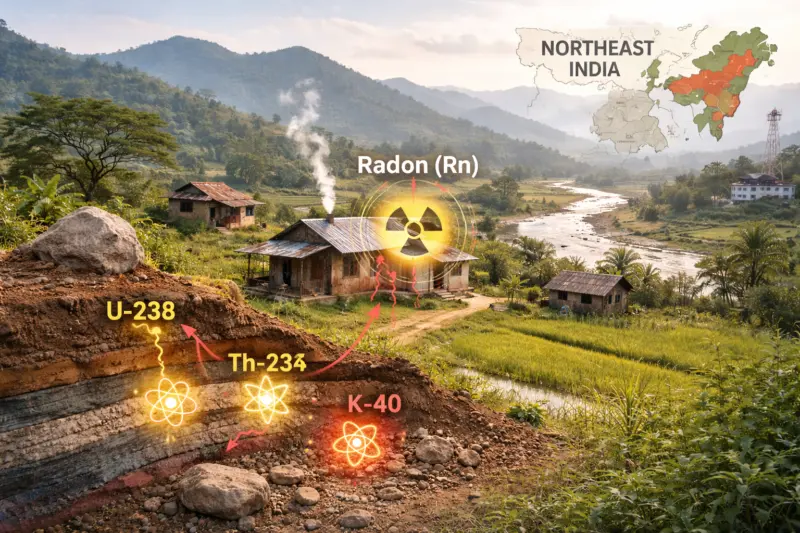

Guwahati: When we hear the word radiation, we often think of nuclear accidents or hospital scans. Yet radiation is also a natural component of the environment - present in soil, rocks and even the air inside homes.
A new peer-reviewed study suggests that parts of Northeast India record higher-than-global-average levels of natural background radiation.
The review, titled "A Comprehensive Analysis of Radionuclide Distribution in Northeast India" and published in the Proceedings of the National Academy of Sciences, India - Section A, was authored by Devashree Borgohain and Hari Prasad Jaishi of the University of Science and Technology Meghalaya (USTM), along with Mayuri Devee of Jorhat Engineering College.
The researchers compiled and analysed data from multiple studies conducted across the region to assess concentrations of naturally occurring radionuclides.
They found that the average uranium (U-238) concentration in the Northeast is 76.99 Bq/kg - more than double the global average of 33 Bq/kg. Thorium (Th-232) averages 81.57 Bq/kg compared to the global average of 45 Bq/kg, while potassium (K-40) averages 698.65 Bq/kg against a global mean of 420 Bq/kg.
The regional absorbed gamma dose rate was calculated at 111.03 nGy/h, nearly twice the global average of 59 nGy/h.
A state-wise analysis shows that Meghalaya records some of the highest concentrations of uranium, thorium and radium in geological materials, while Manipur shows particularly high potassium levels. Assam and Arunachal Pradesh report elevated indoor radon levels in several locations.
Indoor radon and thoron measurements across different house types - including RCC, Assam-type, bamboo and mud houses - indicate that in parts of Assam, particularly along the Kopili Fault Zone and in Kokrajhar district, radon concentrations exceeded global averages, with some readings crossing 200 Bq/m³.
The World Health Organisation recommends remedial action when indoor radon levels exceed 100 Bq/m³.
Radon is considered the second leading cause of lung cancer globally after smoking. It forms naturally from the decay of uranium in soil and rocks and can accumulate indoors, especially in poorly ventilated buildings.
Despite the elevated readings, the authors note that most measured values remain within internationally accepted safety limits. The regional annual effective dose equivalent (AEDE) was calculated at 0.681 mSv per year, which falls within global benchmarks.
However, Excess Lifetime Cancer Risk (ELCR) estimates in Meghalaya, Manipur and Assam were found to be relatively higher than in some other northeastern states, underlining the need for continued monitoring.
The study also reports variation across water sources. Groundwater, particularly from borewells, tends to show higher radon concentrations than surface water. In Baridua, Meghalaya, groundwater radon levels in sampled locations exceeded the United States Environmental Protection Agency (USEPA) limit.
The authors attribute the elevated radiation levels largely to the region's unique geology. Parts of Meghalaya and Assam host uranium-bearing sandstone deposits and mineral-rich rock formations that naturally release uranium, thorium and radon into the environment.
While the study does not establish a direct causal link between natural radiation exposure and cancer incidence in the Northeast, it calls for expanded indoor radon surveys, continuous environmental radiation monitoring and closer integration of radiological data with public health statistics to better understand long-term risks.
Vungzagin Valte: A life ended by a violence that never ended