




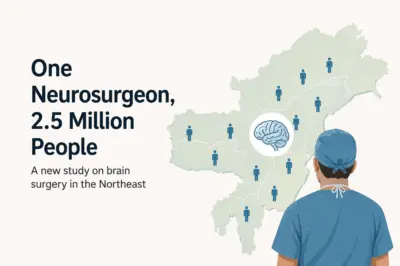

Across the Northeast, there are places where one neurosurgeon is expected to cover a population of 2.5 million people, and eight out of ten of them are based in or around a handful of capital cities, according to a new study published in the Indian Journal of Neurosurgery .
The paper, "Challenges Faced by Neurosurgeons in North East India: A Young Neurosurgeon's Perspective," is authored by Tamajyoti Ghosh of NEIGRIHMS in Shillong and Binoy K. Singh of AIIMS Raipur, and was published on August 20, 2026. For the research, the authors sent a Google Form to young neurosurgeons practicing across the region and analysed the responses.
The numbers behind the picture
The Northeast makes up 8 percent of India's landmass but only 3.75 percent of its population. Of the roughly 90 young neurosurgeons practising in the region, 50 responded to the survey. The findings paint a lopsided picture of where care is actually available.
Only one of the 50 respondents was a woman. Eighty-four percent of neurosurgeons in the region are concentrated in and around capital cities, leaving vast rural and peripheral areas with essentially no specialist access.
Just 20 percent work in government hospitals, where the study found job satisfaction was notably higher than in private practice.
And 62.5 percent of respondents were relatively junior, with only a few years of experience, suggesting the region's neurosurgical workforce is young and, potentially, still finding its footing.
When patients arrive too late
One of the study's more pointed findings is about timing. Patients in the Northeast tend to arrive at hospitals with more advanced, severe neurosurgical conditions than they might elsewhere, largely because of poor connectivity to remote areas and low public awareness of when a head injury or other condition needs urgent specialist care.
The paper cites separate research showing that 10 percent of head injury patients being transferred from smaller, peripheral centres to bigger hospitals deteriorate in consciousness during that very journey, a risk directly tied to how far patients often have to travel to reach a neurosurgeon at all.
The research also found that nearly 44 percent of head injury cases can actually be managed at a peripheral hospital without a neurosurgeon physically present, if that hospital has telemedicine support connecting it to a specialist elsewhere.
The study's authors point to expanding telemedicine as one of the more realistic near-term solutions, given how unlikely it is that fully staffed neurosurgery centres will appear in every district anytime soon.
A workforce that trains elsewhere
The survey also picked up on a pattern in how neurosurgeons build their careers. Many young specialists gain experience working outside the Northeast first, before deciding whether to return and settle in the region.
The study says there is chronic difficulty retaining trained staff locally, tied directly to the shortage of dedicated neurosurgery centres offering stable jobs and infrastructure.
Government insurance schemes exist to help patients afford neurosurgical care, but the study notes that only around 18 percent of the population is actually enrolled in them, and even among those enrolled, the schemes remain underused.
Combined with the cost and difficulty of travelling to a cities for treatment, this leaves a large share of patients either delaying care or going without it.
Need for health camps
The paper points to a few concrete, near-term interventions including regular health camps to catch neurosurgical conditions earlier, before they become emergencies, a wider use of telemedicine, building on evidence that a meaningful share of cases can be managed remotely.
They also suggested the need to have neurosurgery-equipped centres in peripheral areas, so patients are not forced to travel hundreds of kilometres for care that doesn't strictly require a Tier 1 hospital.
They also called for continued training of specialised therapists and rehabilitation professionals, an area the study flags as under-resourced even where neurosurgery itself is available.