
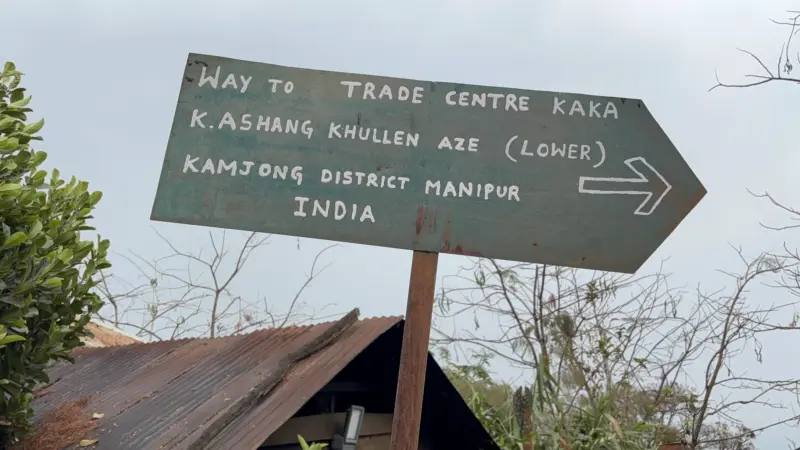

Kamjong: The proposed Integrated Check Post (ICP) at K Ashang Khullen Aze (KAKA) along the India-Myanmar border in Manipur's Kamjong district could serve as a key gateway for seamless cross-border trade with Southeast Asian nations, said Leishiyo Keishing, MLA of Phungyar Assembly constituency.
He emphasised that this initiative aligns with India's Act East Policy, which aims to strengthen regional connectivity and economic integration with Southeast Asian nations.
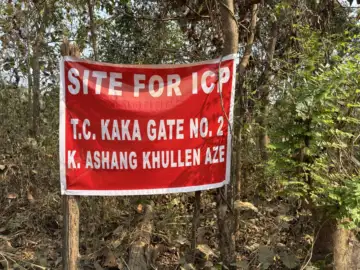
MLA Keishing made the statement about the proposed ICP-2 during his recent visit to KAKA, Wanglee and Namlee, which is situated approximately 55 km south of Kamjong district headquarters and 120 km from Imphal, the state capital. He was accompanied by potential investors during the visit.
According to MLA Keishing, about 100 km of the India-Myanmar boundary passes through Kamjong district. This entire border area in eastern Manipur holds significant untapped economic potential for international trade and commerce, aligning with India's Act East Policy and placing major focus on trade with Southeast Asian countries.
The border area possesses enormous economic potential. According to MLA Keishing, this potential is crucial not only for the state's economic growth but also plays an important role in helping India bridge gaps and deepen diplomatic ties with Southeast Asian nations.
MLA Keishing highlighted that all civilisations have historically developed along riverbanks. He noted that the border area is blessed with the Maklang River, one of the largest flowing rivers in eastern Manipur. When the water level rises, ferry services from Myanmar's Chindwin River used to reach the Maklang River at KAKA, just across the India-Myanmar boundary.
Despite the huge potential as a trade corridor, MLA Keishing noted that Manipur has only one ICP at Moreh, whereas there are around 24 ICPs with Bangladesh.
"Currently, Manipur has only one Integrated Check Post (ICP), located at Moreh. However, Moreh has not been functional for the past three years due to ongoing ethnic clashes. If an ICP had been established at KAKA, trade facilities and operations in this area would have been thriving, as it is considered a peace zone. Our focus has been on maintaining peace in Manipur, since trade and other business activities has remained at a standstill to this day, "said MLA Keishing.
MLA Keishing further informed that, despite the absence of an ICP in the region, informal cross-border trade activities involving a wide range of commodities, from low to high value items, are already underway in the border area.
To capitalise on and formalise these transactional activities, it is necessary to establish an ICP at the earliest opportunity, he said.
MLA Keishing also revealed that the region's economic potential has already attracted several companies and investors, some of whom have visited the area to explore various opportunities. Some have expressed interest in investing in hotel construction, while others are planning shopping complexes, warehouses and other commercial ventures.
The Phungyar MLA maintained that due to a lack of opportunities at home, many youths have left for metropolitan cities in search of work and better prospects. He emphasised that such economic potential in the region could pave the way for developing a sustainable model town in the border area.
"If we develop a model town and trading centre here, our youth will no longer need to migrate. They will be able to work locally, live with their families, and support their parents. This will ensure that their earnings circulate within the local economy, rather than being spent elsewhere.
"All of our grown-up children from the village are currently living in cities for jobs and studies. If similar employment and educational opportunities were available here, we would not need to send them to other cities. Personally, I also would like to see the establishments of ICP and trade centre here when I am still active," said Thingkhuila Hungyo, a resident of KAKA village.
Upcoming infrastructural projects:
According to the local MLA, KAKA villagers have already donated approximately 200 acres of land for the establishment of the Integrated Check Post in the region. Additionally, the Manipur government has also initiated the direct purchase of about 1,800 acres to support the larger development plan. He expressed optimism that the the newly formed state government, under the leadership of Chief Minister Yumnam Khemchand Singh, would advance the project with seriousness.
He noted that the Chief Minister has already visited the area during his tenure as the Minister for RD&PR and showed keen interest in the project after exploring the region's topography.
MLA Keishing highlighted that a bridge worth Rs 14.5 crore is currently under construction along the Maklang River. Upon completion, the bridge will provide connectivity to Choro and other border villages.
In the past, the border area was not connected to a mobile network, however, a new telecom tower has now been installed and will soon become operational, he said.
Electricity supply has already reached most areas, while a proposed dam project is being planned to ensure a reliable water supply for drinking as well as other commercial uses.
Road connectivity linking Huming Thana to Moirengthem is also being developed to strengthen access to the border region.
"The entire stretch from Huming Thana under Kamjong district to Moirengthem in Chandel is only about 35 kilometres. Within this corridor, industries, markets, factories and commercial complexes can easily be established," said MLA Keishing.
Plight of the locals:
Border pillars 91, 92, and 93 are situated in the K Ashang Khullen Aze (KAKA) area of Kamjong district, Manipur, along the border with Myanmar. This region has experienced disputes, as locals alleged that new pillars were placed approximately 7 km inside Indian territory. Despite ongoing tensions, villagers from KAKA and other neighbouring border villages have provided shelter to a significant number of Myanmar refugees fleeing conflict since 2022.
According to the village authorities, many refugees have since returned to their homes, though some continue to stay due to the ongoing crisis in certain parts of Myanmar.
P Hungyo, a village authority from KAKA village, explained that the original border pillar in the area was numbered 8, but the recently established pillar is numbered 92. He noted that the original wooden pillar was located further down, approximately 5 km from the new pillar's current location.
Hungyo further informed that members of the border village communities have reaffirmed their commitment to safeguarding their land and boundaries. He emphasised the importance of cooperation from all residents, including Civil Society Organizations (CSOs), in this effort. The villagers have urged the Government to correct the placement of the original border pillars before initiating any development activities.