
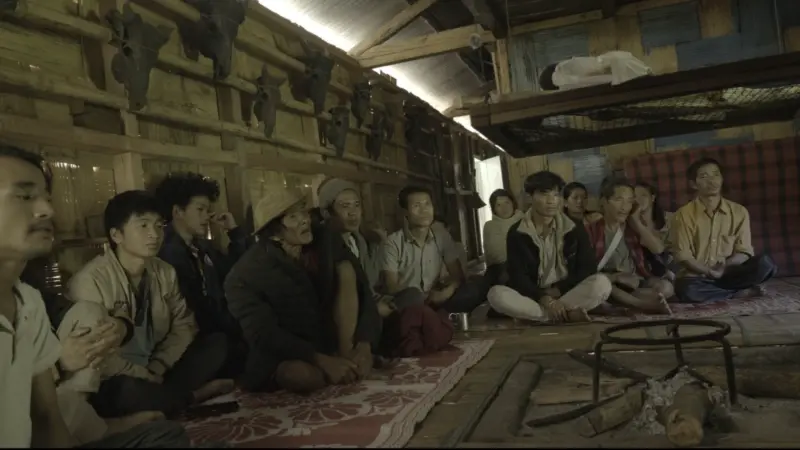

For 71-year-old Badyong Tawsik, land is not property but life itself. A resident of Nukung village in Anjaw district of Arunachal Pradesh, he belongs to the Miju Mishmi, one of the sub-tribes of the Mishmi community.
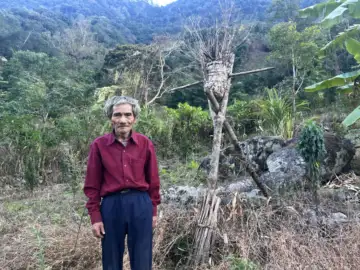 Badyong Tawsik, a Mishmi elder, stands beside a ritual structure used during Miti (Mati) Puja in Nukung village last year
For generations, his people have believed that the soil, river, forest, and mountains are living beings inhabited by spirits that protect livelihoods, ecology, and culture.
"Our gods and goddesses are in the soil, in the water, in the river, and in the forest," Tawsik says.
Each winter, when agricultural work slows and the cold settles in the mountains, the Mishmis perform Mati (or Miti) Puja, locally called Taka/Namshang.
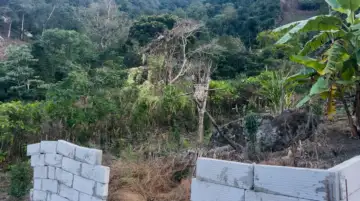 A photo of Namshang / Taka ( Miti puja ) performed previous year.
"We call it Taka/Namshang in Kaman Mishmi dialect and in general Tamladu festival. Tamladu term is derived from Taorah (Digaru) Mishmi dialect," Tawsik explains.
The ritual is dedicated to the spirits of the land and is one of the most important ceremonies in the community's calendar.
Villagers pray for good health, protection from illness and misfortune, and abundant harvests from farming and animal husbandry. According to belief, if Mati Puja is not performed properly, the land will not yield crops.
The Ritual
Tawsik has presided over the ritual in Nukung for years. He describes it carefully, not as symbolism but as a precise practice governed by strict rules.
"With your hands, you take soil. The soil is spoken to," he explains. The earth is placed inside a locally made bamboo basket lined with leaves. "According to rules and customs, everything is prepared properly."
Wood from a specific tree is selected and prepared. Leaves are added-eight by eight, in small pieces. At the main soil altar, offerings are placed. A fire is lit. Below it, a wooden platform is constructed, empty except for what custom allows.
"A bamboo basket is made where a chicken is kept inside it," Tawsik says. "What is done there, the priest does it carefully and skillfully. It should not be careless or dirty."
The sacrifice is offered. Blood is poured at a spot marked long ago, exactly where it must fall. Depending on the place, several chickens or roosters may be offered. "That place has its own fate," he says.
For the Mishmis, Mati Puja is not only prayer. It is also a form of ecological observation-a way of reading whether the land is in balance.
Changes in landscape
Over his lifetime, Tawsik has watched that balance shift. As a child, he remembers waking to thick frost and dew outside his home during winter. "That has disappeared over time," he says. Snow once visible on nearby mountain peaks is now rare, seen only faintly from far away. Cold still comes, but it no longer lasts as it once did.
"I have seen many things myself," Tawsik says. "While watching all this, I also think about climate change. I have experienced it personally."
Earlier, rivers flowed steadily. Green algae (Spirogyra) clung to stones even during dry seasons. Streams did not dry abruptly. Water rose slowly during rains and receded gently.
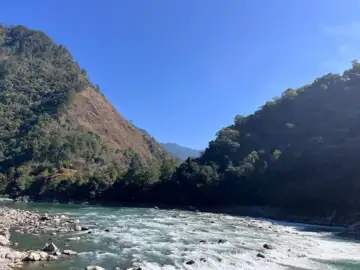 Lohit River, Anjaw District, Arunachal Pradesh
"At that time, there was no disturbance in water," he adds, and questions, "Earlier, streams would not dry like this."
Speaking about the changing landscape, a younger resident of Nukung village says floods now arrive suddenly and disappear just as quickly. Small rivers, he adds, change their course year after year. "We do not even know where the water comes from now," he says. "Earlier, water sources were clearly visible. Now they are not."
Fish populations have also shifted. Species that were once common are no longer found, while unfamiliar ones have appeared. "Earlier, we did not need much effort to catch fish," he says. "Within one hour, we could catch three or four fish."
What elders like Tawsik describe is reflected in scientific research. A 2017 peer-reviewed study published in the journal Ecological Indicators assessed climate-change-induced social vulnerability across Arunachal Pradesh and identified Anjaw district as the most vulnerable in the state.
The study warned that in districts like Anjaw, exposure to climate stress and sensitivity of livelihoods already outweigh communities' capacity to adapt-an imbalance researchers described as alarming.
Scientists studying the Eastern Himalayas say the region is warming faster than the global average. Rising temperatures are altering snowfall patterns, accelerating glacier retreat, and changing river behaviour.
Satellite inventories show hundreds of glacial lakes in and above Anjaw district, some of which are considered high-risk because they could trigger glacial lake outburst floods (GLOFs)-sudden floods capable of reshaping river systems downstream.
For Nukung village, the sense of vulnerability has exacerbated with the proposed Kalai-II Hydroelectric Project, a 1,200-megawatt dam planned on the Lohit River. Villagers believe large infrastructure projects, especially dams, can rupture the delicate relationship between humans and the spirits of the river and mountains.
Nukung, with just 107 people across 21 households (2011 Census), is the only one among more than 30 affected villages to openly oppose the project.
The Lohit River, for the Mishmi, is not merely a water source. It is a living presence, woven into ritual, livelihood, and worshipped during the Namshang. Blocking its flow, elders say, risks disturbing forces that cannot be measured in megawatts.
The Kalai-II project is no longer just a proposal. On 30 December 2023, the Government of Arunachal Pradesh signed a Memorandum of Agreement (MoU) with THDC India Limited, a central public sector hydropower company, formally reviving the project.
Under the MoU, THDC is authorised to prepare the detailed project report, acquire land through the state, and build, operate, and maintain the dam for 40 years, after which it will be handed back to the state.
Arunachal Pradesh is entitled to 12 percent free power from the project as royalty. Environmental safeguards and rehabilitation plans are mandated on paper, as required under Indian law.
On 7 February 2025, the Deputy Commissioner of Anjaw district issued an official circular notifying a Social Impact Assessment (SIA) for the Kalai-II project under India's land acquisition law.
The order authorised household-level surveys in 33 project-affected villages, including Nukung, to be conducted between 11 February and 27 February 2025 by the G.B. Pant National Institute of Himalayan Environment.
For residents of Nukung, the circular confirmed what they feared: the project had entered an active land acquisition phase, even as they insist that Free, Prior, and Informed Consent (FPIC) was never obtained.
According to Roshman Tawsik, a resident of Nukung village, the project's Environmental Impact Assessment (EIA) and Social Impact Assessment state that Nukung will be 100 percent submerged, while nearby Mla village will also be affected. The community has formally objected, arguing that complete submergence would mean the loss of land, livelihood, culture, and identity.
"Nukung is not just houses," villagers say. It is their ancestral home and cultural heartland.
They also warn that the dam would inundate sacred sites central to Mishmi belief, including Hutung Graam, believed to be the abode of their supreme deity; Mlaang and Mlaanguh's farm, a key cultural marker; Kaapyiu Raknaang, a site where community rituals were once performed; and downstream sacred places such as Parshuram Kund (Tailung) and Nimkeh.
Anjaw lies in one of India's most sensitive border districts, close to the Line of Actual Control with China.
In such frontier regions, infrastructure projects are often framed as strategic necessities, prioritised for connectivity and national integration. For small Indigenous communities like Nukung, this has meant that decisions about land and development are frequently made far from the villages themselves.
For the community, Namshang lies at the heart of their belief, and this ritual binds their spiritual world to the natural landscape. "The gods and goddesses we believe in will be disturbed and our identity itself will disappear," an elder says.
Marina Dai is a mentee at the Climate Change Media Hub, Asian College of Journalism.
Arunachal: Hidden fungi in bamboo show promise against drug-resistant bacteria