






Guwahati: Scientists have developed a novel technique that can reveal the age, sex and even reproductive status of tigers and leopards by analysing the chemical signatures in their urine and scat, offering conservationists a powerful new way to monitor India's elusive big cats without disturbing them.
The study, led by researchers from the National Centre for Biological Sciences (NCBS-TIFR) and published in the Journal of Chemical Ecology, could significantly improve wildlife monitoring in tiger landscapes across the Northeast, including Assam, Arunachal Pradesh, Mizoram and other states where camera traps often struggle to capture elusive animals.
Supported by the National Geographic Society and carried out in collaboration with Ahmedabad University, the research analysed samples collected from zoos in Bengaluru, Ahmedabad and Vadodara, along with urine samples from individually identified wild tigers in Rajasthan's Ranthambore Tiger Reserve.
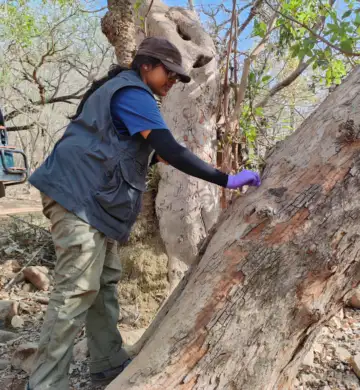 Aditi collecting samples from the wild.
The researchers found that volatile organic compounds (VOCs) present in urine and scat act as chemical fingerprints, allowing scientists to distinguish between tigers and leopards while also identifying an animal's sex, age and reproductive condition.
"This approach is much simpler than genetic testing and relies on samples that are easy to collect in the field," said lead author B.V. Aditi Prasad. "Current monitoring methods tell us how many big cats are present, but they provide little information about population structure or breeding status."
In a first for tiger research, the team successfully analysed odours collected directly from wild tigers rather than relying solely on captive animals.
Among the findings, researchers identified a chemical compound called 2-nonanol, which was found in much higher concentrations in the urine of pregnant and lactating tigresses than in other females, opening the possibility of monitoring breeding populations without capturing or disturbing animals.
 Team members of the tiger study.
The study also hints at future applications in wildlife health.
Researchers detected unusually high levels of another compound in the scat of a captive tiger undergoing treatment for epilepsy, suggesting that scent chemistry could eventually help detect health problems in wild animals.
Senior author Shannon B. Olsson said chemical analysis of urine and faeces has long been used in medicine and forensic science, but its application in wildlife conservation could allow researchers to assess the health and reproductive status of endangered species using non-invasive methods.
NCBS scientist Uma Ramakrishnan said combining chemical ecology with existing tools such as camera traps and DNA analysis could help scientists better understand and conserve India's big cats.
The findings could be particularly valuable for the Northeast, which is home to globally significant tiger and leopard populations in reserves such as Kaziranga, Manas, Orang, Namdapha and Pakke, where dense forests and rugged terrain often make conventional wildlife monitoring challenging.