




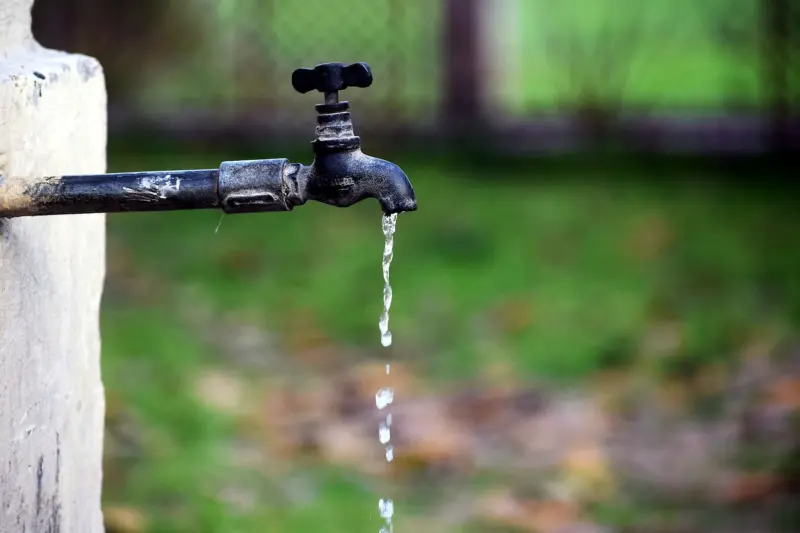

Now that winter is already upon us, water scarcity is going to become a major concern, especially in the rural areas. Sources will start drying up, forcing households to travel farther to collect water for domestic consumption.
Jal Jeevan Mission (JJM) attempts to solve this problem by attempting to provide safe and adequate drinking water through individual household tap connections by 2024.
In 2022, the Government of Meghalaya was awarded the 'Best Performing State' for the implementation of the JJM. But a year after the deadline, the results have been mixed: in some areas water security has improved, while in others there are complaints that the pipelines have been laid but there is no water flowing through them.
This is surprising considering the state receives a substantial amount of rainfall every year, which should augment the water sources that feed those pipes throughout the year.
Annual groundwater extraction in the state is just over 3%, which is lesser than the 20% to 40% withdrawal rates that signal medium to high water stress conditions. Annual potential water availability is also considerably high.
If one considers the average annual rainfall of 280 cm, population of 34 lakhs (projected from the 2011 Census data), and total area of the state, i.e., 22,720 square kilometres, total annual potential water availability is 19,277 m³ capita-1. This is far above the 1700 m³ per capita threshold below which, according to the Falkenmark Index, water stress conditions arise.
So, in theory, the state should have surplus water resources that just require a sound extraction and management strategy. But the reality on the ground is not commensurate with theoretical expectations.
If one were to conduct a study on household water security in any part of the state, they would invariably still find households suffering from severe water insecurity, especially during the dry season, i.e., from December to February.
And with pre-monsoon rainfall having failed in the last few years, the water scarcity period could in future be extended by at least another month.
The situation, therefore, is worrying, and there needs to be a water policy which considers the various challenges that the state is facing and proposes ways to tackle them.
The 2019 Meghalaya State Water Policy appears to be an attempt to do just that. The Policy is quite comprehensive and tackles a whole host of issues, ranging from water supply and sanitation, conservation of water resources, tackling the challenges created by climate change, to creating a participatory system for water management. There are, though, a few odd sections that contradict each other.
Maintaining water for minimum ecological needs (so that ecosystem functions like evapotranspiration, habitats for aquatic creatures, etc., are not disturbed) has been identified as the second most important priority sector for water allocation under the policy.
However, at the same time, under 'project planning and implementation', there is a suggestion for considering inter-linking of rivers so that surplus water can be transferred to areas that are water scarce.
Inter-linking of rivers or inter-basin transfer of water was part of the National Perspective Plan (NPP) prepared by the Ministry of Irrigation in 1980. The idea was revived in 1999 when the BJP-led National Democratic Alliance came to power, and in 2024 Prime Minister Narendra Modi laid the foundation stone for the construction of the Ken-Betwa project that aims to divert water from the Ken River in Madhya Pradesh to the Betwa River in neighbouring Uttar Pradesh.
A problem with such projects is that they displace people (7000 families will be affected by the Ken-Betwa project) and submerge a large amount of area. But the biggest casualty will be the local ecology.
The habitat of aquatic animals will be disturbed, and the local hydrological cycle will be affected in a way that is not clearly understood. Therefore, to claim that maintaining water for minimum ecological needs is a very important priority and then to suggest river interlinking projects is highly contradictory.
Under the 'participatory water resources management' section, it has been suggested that the community should consider reclamation of the abandoned degraded mines and quarries while also taking up cleaning of rivers from time to time.
But under the section on 'conserving, harnessing and promoting efficient use of water resources', although there is discussion of protecting and preserving water resources, including through control of jhum cultivation, there is no mention of mining (limestone and coal) and quarrying (sand and stone), which are responsible for degrading much of the state's water resources.
The Lukha River in East Jaintia Hills is infamous for turning blue because of the acid drainage from the coal mines. It is important to recall that it was the Dimasa Students' Union who filed a case in the NGT against the unregulated rat-hole mining in Meghalaya, which was turning the Kopili River acidic.
There is also no mention of infrastructural projects that are destroying water bodies like in the case of the Myntdu River in Jowai.
Recently, the Meghalaya State Pollution Control Board (MSPCB) has asked the National Highways & Infrastructure Development Corporation Limited (NHIDCL) to pay a penalty of Rs 15 lakh for allegedly polluting the Umngot River. Instead, the focus is on jhum cultivation, which reveals the lack of awareness of community rules that specifically prohibit farming near water sources in order to prevent their contamination.
So, not mentioning the main culprits for destroying and contaminating the water resources in the state and instead blaming jhum suggests a bias which will not serve well the objectives of the policy.
The rest of the things are pretty standard with some new innovations being introduced. An intriguing concept is the implementation of the "beneficiary pays principle" under the Payment for Environmental Services (PES), where upstream communities will be compensated by downstream communities for conserving the water resources, stopping degradation, and revitalizing the catchment upstream.
This is a good concept and sounds promising but will depend on the payments made to the communities and the kind of conditions under which the areas to be conserved are to be managed. I have been informed that a big concern expressed by many communities in relation to carbon credit projects (a form of PES) in Meghalaya and elsewhere is the duration of the contract under which the area will be taken up for conservation and locked for a certain period of time, extending around 40 years or so.
In Manipur, lands for such projects are being solicited from the community (indigenous tribal communities in the hills) on the promise that once land comes under the project, it cannot be appropriated by the valley-based State government anymore. There is no doubt catchment protection is essential for water conservation, and communities have to be adequately compensated for it. But the specific modalities of implementation will determine whether the community will receive a fair outcome.
The PES system also reveals a perspective that treats water resources (or for that matter any ecological resources) as being eligible for commodification and therefore amenable to pricing.
There is a whole section on 'water tariffs' which argues that pricing of water ensures its efficient use and conservation. There is mention of giving the freedom to Water Users Associations (WUAs) in irrigation projects to fix rates for water charges subject to approval by the Water Regulatory Authority.
Water tariffs will also be fixed for both rural and urban areas in consultation with the Regulatory Authority to manage the quantum of water allocated to the consumers. Urban households are already paying for water - either to the municipality, locality, or the private water tankers - but rural households are not doing so at the moment.
This could change very soon. Personally, I am distressed by this suggestion. In 2010, the human right to water and sanitation (HRWS) was recognized as a human right by the United Nations General Assembly. So, asking the most vulnerable populations (particularly in rural areas) to pay for it is highly troubling.
The 2019 Meghalaya State Water Policy is quite comprehensive and deals with a lot of subjects while laying down the framework of how water governance will look like in the future.
Some parts are laudatory, but there are areas which are riddled with contradictions and concerns. How the good and the bad parts are reconciled will determine whether the Policy will succeed or remains only on paper. The future of water security of the state depends on it.
The Deoliwallahs: A quiet tragedy India must finally confront