




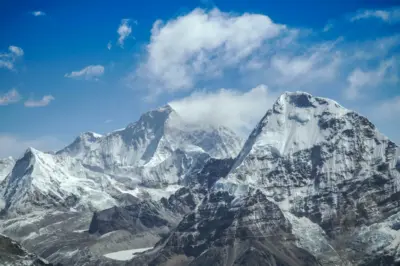

A new study combining 120 years of observed temperature records with climate projections has found that the western Himalaya is warming faster than the central and eastern stretches of the mountain range and is likely to experience the greatest loss of snow in the decades ahead.
The study, titled "Vulnerability of the Himalayan region under the climate change", combines observed temperature data from 1901 to 2020 with projections from eight global climate models to examine how temperature and snow patterns are changing across three sectors of the Indian Himalayan region and how those changes could evolve by the end of the century.
Led by the Department of Remote Sensing and Geoinformatics at Birla Institute of Technology (BIT), Mesra, Ranchi, in collaboration with the Indian Institute of Tropical Meteorology (IITM), Pune, and Ashoka University, the research examines the western Himalaya, comprising Ladakh, Jammu & Kashmir and Himachal Pradesh; the central Himalaya, largely Uttarakhand; and the eastern Himalaya, including Sikkim, Arunachal Pradesh and the wider Northeast.
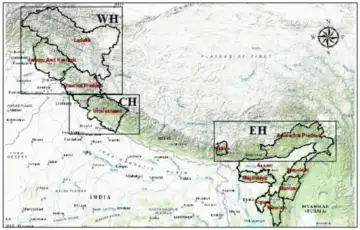
The researchers found that the western Himalaya consistently shows the strongest warming signal across seasons and emission scenarios. Winter is warming faster than spring in the western and central Himalaya, while night-time temperatures are increasing faster than daytime temperatures in much of the region.
The projected consequences for snow are particularly stark. Under a high-emission pathway, spring snow loss in the western Himalaya by the end of the century could be around three times greater than under a low-emission pathway. The study also projects that winter snow loss in the western Himalaya could be more than five times greater under the highest-emission scenario than under the lowest-emission pathway.
"The Himalaya is often discussed as a single system, but our observations and models both say otherwise. The western Himalaya consistently emerges as the most sensitive stretch - it warms the most and loses the most snow under every pathway we tested. That has direct consequences for the states that sit in it," said Protyusha Mukhopadhyay, lead author, Birla Institute of Technology (BIT), Mesra.
Warming already visible across the Himalaya
The study used two complementary forms of evidence. The first was a 120-year record of observed temperatures between 1901 and 2020. The second consisted of eight global climate models that were first evaluated against observed historical conditions and then used to project future changes under five possible emission pathways, ranging from scenarios involving substantial emission reductions to those in which fossil fuel use remains high.
The analysis focused on winter, when snow accumulates, and pre-monsoon spring, when snowmelt becomes an important part of the region's hydrological cycle.
Compared with the first three decades of the 20th century, all three Himalayan sectors had already warmed by close to 1°C in winter by the two decades leading up to 2014. Winter warming was 1.06°C in the western Himalaya, 0.96°C in the central Himalaya and 1.09°C in the eastern Himalaya.
Spring temperatures had risen by 1.08°C in the western Himalaya and by 0.83°C in both the central and eastern Himalaya.
The researchers noted that the warming has not occurred at a uniform pace. Warmer-than-normal years have become increasingly common across all three sectors during the past two to three decades, indicating that much of the observed change has occurred relatively recently.
The three sectors collectively contain more than 15,000 glaciers and form the headwaters of the Indus, Ganges and Brahmaputra river systems, which support the livelihoods and water needs of roughly 1.5 billion people.
The regional differences therefore have implications well beyond the mountains themselves, particularly for water availability, agriculture, ecosystems and communities downstream.
Western Himalaya could warm by more than 7°C
The climate models show a persistent west-to-east gradient in projected warming throughout the century.
Under a high-emission pathway, winter temperatures during 2081-2100 are projected to be 7.18°C warmer in the western Himalaya than the early-20th-century baseline. The corresponding projected warming is 6.71°C in the central Himalaya and 5.82°C in the eastern Himalaya.
Spring warming follows the same pattern, with projected increases of 6.91°C in the western Himalaya, 6.41°C in the central Himalaya and 5.16°C in the eastern Himalaya.
"In the west and centre, winters are warming faster than springs. Less snow on the ground would mean a darker surface, which absorbs more heat, which melts more snow. It matters because winter is the season in which snow is supposed to build up; warmer winters mean less snow banked for the melt months that follow," said Parthasarathi Mukhopadhyay, corresponding author, Ashoka University.
The finding is significant because winter snow accumulation acts as a natural reservoir, storing water that is released during the warmer months. A reduction in winter snowpack can therefore alter both the timing and volume of downstream water availability.
Warmer nights could accelerate snowmelt
One of the clearest signals in the observational record is the faster increase in minimum, or night-time, temperatures compared with maximum, or daytime, temperatures across the western and central Himalaya.
In the western Himalaya, winter minimum temperatures increased by 1.23°C, compared with a 0.87°C increase in maximum temperatures. During spring, minimum temperatures rose by 1.25°C, while maximum temperatures increased by 0.91°C.
The difference was even wider in the central Himalaya during winter, where minimum temperatures rose by 1.20°C compared with a 0.72°C increase in maximum temperatures.
The eastern Himalaya showed a different pattern. There, winter maximum temperatures increased by 1.19°C, compared with a 0.99°C rise in minimum temperatures.
The researchers said rising night-time temperatures are particularly important because colder nights allow snow and ice to refreeze. When those cold periods become shorter or disappear, the snowpack has less opportunity to recover between melting periods.
"Rising night-time temperatures are the quieter half of this story, and arguably the more consequential one. When the cold nights that let snowpack recover start disappearing, you change the melt cycle itself rather than how much snow falls, but when the water arrives downstream," said Dr Swagata Payra, co-author, BIT Mesra.
Spring emerges as the most vulnerable season for snow
The study found that snow loss is greater during spring than winter across all three Himalayan sectors, with the western Himalaya experiencing by far the largest decline.
The researchers measured snow in terms of snow water equivalent, or the amount of water contained in the snowpack, expressed as kilograms per square metre.
In the western Himalaya, spring snow is projected to decline steadily even under the lowest-emission pathway. The projected reduction is 24.2 kg per square metre by 2040, 27.4 kg by 2060 and 32 kg by the end of the century.
Under the highest-emission pathway, the projected end-of-century spring snow loss reaches 95.9 kg per square metre. According to the researchers, this could indicate an almost complete loss of seasonal snow in some pockets of the western Himalaya.
The central Himalaya is projected to experience lower but still substantial losses, ranging between 17.0 and 34.9 kg per square metre by the end of the century depending on the emissions pathway.
The eastern Himalaya is projected to lose the least spring snow, with losses ranging between 5.5 and 11.1 kg per square metre.
Winter snow follows the same broad regional pattern. By the end of the century, western Himalayan winter snow loss is projected to range from 9.5 kg per square metre under the lowest-emission pathway to 53.2 kg per square metre under the highest-emission pathway.
Emissions make a major difference
The researchers found a substantial difference between the possible future pathways.
Under a low-emission scenario, western Himalayan winter temperatures at the end of the century are projected to be 2.55°C above the early-20th-century baseline. Under the high-emission scenario, the increase reaches 7.18°C - a difference of about 4.6°C between the two pathways.
The difference is similarly pronounced for snow. Under the high-emission pathway, spring snow loss in the western Himalaya is roughly three times that projected under the low-emission pathway. For winter snow, the difference is more than fivefold.
"The models agree on where we are headed over the next two to three decades. What remains open is the second half of the century, and that is determined by emissions rather than by anything intrinsic to the mountains. A low-emission pathway does not stop the warming, but it changes its magnitude by several degrees," said Mukhopadhyay.
The eight climate models showed broad agreement for the next two to three decades but diverged considerably towards the end of the century. The researchers attributed that divergence largely to differences in future greenhouse gas emissions.
Eastern Himalaya faces a different risk
Although the eastern Himalaya emerges from the study as the least-warming and least-snow-losing of the three sectors, the researchers cautioned against interpreting this as an absence of climate risk.
The eastern Himalaya has already emerged as a hotspot for glacial lake outburst floods, or GLOFs - sudden and potentially destructive floods that occur when a lake formed or dammed by glacial debris breaches its natural barrier.
"That risk is expected to spread westward in the future, driven by retreating glaciers and the new lakes they leave behind, not by temperature alone," said Protyusha.
The finding underscores the need to consider multiple climate-related hazards rather than relying solely on temperature or snow-loss projections.
Calls for stronger monitoring and regional adaptation
The researchers have called for climate adaptation strategies tailored to the different Himalayan sectors rather than policies that treat the entire mountain range as a single climatic system.
Their recommendations include region-specific climate services and adaptation policies, stronger monitoring that combines ground-based observations, satellite products and sustained high-resolution climate modelling, improved early-warning systems, sustainable water management, community-level resilience programmes and greater transboundary cooperation.
The study also highlights the limitations created by the scarcity of observations in the high mountains. The researchers said more measurements on the ground are needed to determine how much snow and ice melts each year and how much of that meltwater ultimately reaches rivers downstream.
Sonam Lotus, Scientist E and Head, Meteorological Centre, Leh, India Meteorological Department, cautioned against drawing conclusions from individual seasons while stressing the need for sustained observation.
"Last winter saw unusually low snowfall, particularly across the western Himalaya, but a single season by itself cannot be taken as evidence of a longer-term trend. We need to continue observing these changes over several years to understand whether we are seeing a shift in the broader climate pattern. For instance, this year we have seen above-average rainfall over parts of the western Himalaya despite it being an El Niño year, which is an interesting development that needs to be understood in the context of longer-term observations. We are also beginning to see subtle changes on the ground associated with increasing summer temperatures. These changes are important, but we need sustained monitoring and more detailed studies to understand how the climate of the western Himalaya is evolving. The overarching situation needs to be observed regularly before we can draw firm conclusions about emerging trends."
Dr M. Rajeevan, Former Secretary, Ministry of Earth Sciences, Government of India, said the study was important in demonstrating the need to examine the Himalaya as a set of distinct climatic regions.
"Studies such as this are important because the Himalaya cannot be treated as a uniform climatic region. The warming signal and its implications for snow and water resources can vary considerably across the western, central and eastern Himalaya. The finding that the western Himalaya is showing a particularly strong warming signal highlights the need to understand these regional differences more closely. At the same time, the Himalaya remains a data-sparse and complex region, and there is a need for more detailed studies combining ground-based observations, satellite data and higher-resolution climate modelling. Strengthening this evidence base will be important for understanding how changes in temperature and snow may translate into changes in water availability and climate-related risks across the region."
Taken together, the study presents a clear regional picture: the western Himalaya is warming fastest, losing the most snow and showing the greatest divergence between low- and high-emission futures. The eastern Himalaya is projected to experience comparatively less warming and snow loss, but remains vulnerable to hazards such as glacial lake outburst floods.
The findings also point to an important distinction between what is already locked into the climate system and what can still be influenced by human decisions. The models broadly agree on the direction of change in the coming decades, but the magnitude of warming and snow loss towards 2100 varies sharply according to future emissions.
For a mountain system that regulates water for vast populations across South Asia, the researchers argue that sustained observation, region-specific planning and emissions reduction will be critical to determining how severe those changes ultimately become.
'Andaman-endemic' plant found in Assam, first mainland India record