




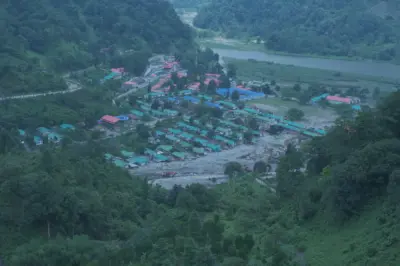

All photos by Marina Dai
After hours of heavy rain, a flash flood swept through Possa village and the North Eastern Electric Power Corporation (NEEPCO) colony in Yazali Circle of Arunachal Pradesh's Keyi Panyor district on the morning of 24 June, destroying homes, damaging infrastructure, and forcing residents to flee with little warning.
"We never imagined the water would come this way," recalled a resident who has lived in the NEEPCO colony for nearly 35 years.
"It had been raining since early morning. When I woke up around 7 a.m., the river looked normal. We saw people moving their vehicles because they thought the water level might rise. Even then, no one expected the flood to come from this direction."
According to her, the main river remained within its course. Instead, a smaller stream that usually flowed quietly through the settlement suddenly turned into a raging torrent.
 Debris and damaged homes in Possa and NEEPCO colony in Keyi Panyor after a flash flood swept through the area following hours of heavy rainfall on June 24, 2025.
"We had never seen anything like this. People ran with only the clothes they were wearing. Some didn't even have time to put on slippers."
For many residents, it was unlike anything they had experienced in decades.
However, Keyi Panyor was not an isolated tragedy. It became one of the clearest reminders of how destructive this year's monsoon has been across Arunachal Pradesh.
According to the Department of Disaster Management's Daily Situation Report dated July 20, the state recorded 173 landslides, 104 flood incidents, 80 heavy rainfall events and eight flash floods during the season.
The disasters affected 594 villages across 337 administrative circles, impacting nearly 1.49 lakh people. Fifteen people lost their lives, including four in flash floods, while roads, bridges, drinking water systems, power lines and other critical infrastructure suffered extensive damage.
Districts from East Kameng , Changlang, Lower Dibang Valley, Upper Subansiri and East Siang also reported repeated floods, landslides and damaged infrastructure.
Scientists point to both rainfall and the landscape it fell on.
According to the India Meteorological Department (IMD), rainfall over Arunachal Pradesh between 1 June and 10 July was characterised by short-duration, high-intensity spells rather than being evenly distributed throughout the season.
During this period, the state recorded 22 heavy rainfall events, nine very heavy rainfall events and two extremely heavy rainfall events.
 Families displaced by the flash flood take shelter at a relief camp after their homes were inundated in Keyi Panyor.
 Dr A. Sandeep, head of the IMD's Meteorological Centre in Itanagar, said the monsoon exhibited pronounced intra-seasonal variability, with intense downpours interspersed with comparatively dry periods.
While a single season is insufficient to establish a long-term climatic trend, he said, such concentrated rainfall substantially increases the likelihood of flash floods and landslides in mountainous regions.
The intense rainfall created the conditions for flooding, but Arunachal's steep terrain and small river catchments made the flood more severe.
Gyati Gyuth, a scientist in the Division of River Basin at the Centre for Earth Sciences and Himalayan Studies, says what happens after the rain falls is equally important.
In the Yazali-NEEPCO catchment, which covers only about 17 square kilometres, intense rainfall can quickly generate rapid surface runoff, causing rivers to swell within a short period and leaving communities with very little time to react.
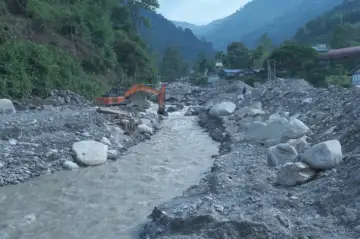 The stream that swelled into a destructive torrent after intense rainfall. Locals called it the pei river
"A state like Arunachal has steep terrain that is inherently unstable and highly susceptible to landslides and flash floods," Gyuth explained. "If rainfall intensity exceeds the soil's infiltration capacity, rapid surface runoff increases peak discharge and the likelihood of flash floods. At the same time, increased soil moisture raises pore-water pressure, reducing soil strength and triggering landslides."
According to Gyuth, his analysis also suggests that while the state's overall rainfall may be decreasing, high-intensity rainfall events are becoming more frequent, accompanied by increasing maximum and minimum temperatures.
Although he says these observations require continued long-term monitoring, they point to the need for closer scientific assessment of how mountain river basins are responding to changing climatic conditions.
Research Officer (Wildlife) Tajum Yomcha from the Office of the Principal Chief Conservator of Forests (Wildlife & Biodiversity), Itanagar, says forests act as natural flood-control systems by absorbing rainfall, reducing surface runoff, limiting soil erosion, and slowing the movement of sediment into rivers.
Healthy forests also recharge groundwater and sustain springs and streams during dry periods.
"Any change in forest cover will definitely have an impact on local weather and water security," he said. "Healthy forests are not just important for biodiversity; they are essential for maintaining resilient mountain watersheds."
According to Keyi Panyor Additional Deputy Commissioner Likha Tejj, Arunachal Pradesh needs a more institutionalised approach to disaster risk reduction. He called for greater public awareness, catchment restoration, scientific hazard mapping, better road planning in vulnerable areas, and stronger investment in research and early-warning systems.
"This is not only a Keyi Panyor-centric disaster," he said. "The state needs long-term research and an institutionalised approach to prevent such situations in the future."
For the families who witnessed the events of that morning, the river will never look quite the same again. Whether this flood remains an exception or becomes a warning for the future will depend on how Arunachal prepares for the seasons ahead.
The author is a mentee of the Climate Change Media Hub at the Asian College of Journalism, Chennai. The programme is supported by Interlink Academy, Germany.