




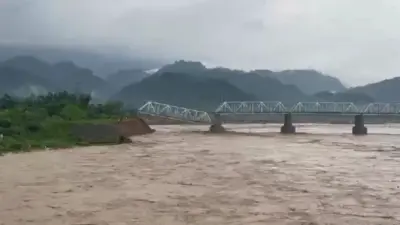

The Brahmaputra River system is the ecological spine of Northeast India, shaping the geography, culture and economy of the Assam Valley.
Yet, in contemporary climate discourse, this powerful transboundary river is too often reduced to a static national security variable or a predictable annual disaster statistic.
National narratives habitually focus on macro-geopolitical concerns-such as upper-riparian dam construction, hydrological data-sharing protocols with China and cross-border water management agreements.
While these geopolitical concerns are valid, they frequently obscure the human reality on the ground: the severe daily vulnerability of riverine and char (shifting river island) communities in Assam.
For millions of indigenous, agrarian and marginalised inhabitants living along the banks, climate change is not an abstract future threat or a diplomatic negotiating point. It is an ongoing, compounding crisis of erosion, displacement and non-traditional security that directly alters their daily lives.
The Dual Threat of Unpredictable Monsoons and Riverbank Erosion
The hydrological dynamics of the Brahmaputra Basin appear to have entered an era of unpredictability. Historical monsoons, on which farming communities depended for centuries to determine when to sow and harvest crops, are being replaced by erratic cloudbursts, intense rainfall and prolonged dry spells.
When extreme rainfall occurs in the fragile Himalayan foothills, enormous volumes of water descend into the narrow alluvial plain of Assam, leading to sudden flooding. Nevertheless, while flooding attracts the majority of emergency assistance and media attention, a more destructive and permanent disaster is occurring at the same time-baan-khohonia, or riverbank erosion.
Unlike floodwaters, which eventually recede, riverbank erosion results in the loss not only of the homes of agrarian communities but also of schools, farmland and ancestral property. Research conducted by the Asian Development Bank shows that the dynamic nature of the Brahmaputra contributes to land loss in agricultural regions.
Over the past decades, hundreds of thousands of hectares of fertile land have been ravaged by the river. Affected communities can become homeless climate refugees virtually overnight.
While government policies recognise floods as sudden natural calamities and allocate emergency funding, riverbank erosion continues to be viewed as a slow and non-reimbursable process, leaving people without adequate compensation for the loss of their land.
Precarity on the Chars: Living on Shifting Sands
The char areas of Assam are particularly vulnerable to climate change and river-related disasters. These temporary river islands, formed through the deposition of river-borne sediment, are home to some of the region's most marginalised communities. People living in these areas face constant insecurity.
During the flood season, the land they live and farm on can quickly disappear, forcing families to rebuild their homes and livelihoods repeatedly.
The incessant mobility of these communities creates enormous developmental challenges. Infrastructure on the chars is extremely limited: medical services are inadequate, many schools are damaged or rendered inaccessible by floods, and access to safe drinking water is disrupted.
The absence of land titles (pattas) on many chars means that residents may be unable to access formal financing, crop insurance or government rehabilitation programmes. As a result, char residents often have to rely on informal, high-interest loans, deepening structural poverty and vulnerability to exploitation.
Non-Traditional Security and the Challenge of Internal Displacement
When riverbank erosion leads to the loss of homes and livelihoods, the resulting displacement generates consequences that extend far beyond the riverbanks. Thousands of rural families may be forced to move to cities such as Guwahati, Silchar and Dibrugarh, while others migrate to peripheral areas such as forest reserves or embankment slopes in search of work in the informal economy.
Such involuntary movement turns environmental degradation into a significant driver of internal displacement and creates new security challenges for the state.
In a complex, multi-ethnic state like Assam-where land rights, indigenous identity and demographic balances are politically sensitive-unplanned climate-induced migration can create socio-political tensions.
Displaced people living on public land or at the margins of forests face social stigma, the risk of eviction and a lack of political recognition, often being treated as encroachers rather than people affected by climate change.
Existing national security frameworks tend to focus on hard borders and transboundary hydrology, while neglecting these internal socio-ecological dynamics. Failure to integrate climate resilience into regional governance, land-use policies and human security frameworks will lead to the continued loss of habitable areas in the Brahmaputra basin.
Rethinking Interventions: From Hard Concrete to Ecosystemic Adaptation
For decades, hard-engineering solutions have been the conventional response to fluctuations in the Brahmaputra, particularly the construction of earthen embankments and concrete structures.
However, studies by institutions working on climate issues, including the Intergovernmental Panel on Climate Change (IPCC), suggest that such interventions cannot adequately account for the immense variability of major rivers with complex hydrology, such as the Brahmaputra.
In Assam, for example, ageing embankments can fail during extreme floods, allowing sand to be deposited across farmland and leaving large volumes of water trapped behind breached structures even after river levels have fallen significantly.
To build genuine, long-term resilience, policy strategies need to embrace ecosystem-based adaptation, nature-based river management and community-based disaster management models. Indigenous knowledge systems-such as the traditional elevated stilt houses (chang ghar) built by the Mishing community-provide tested methods of adapting to seasonal fluctuations rather than attempting to control them.
In addition, disaster management systems should clearly recognise riverbank erosion as an official natural disaster, allowing affected families to receive the same rights as other victims of natural disasters in terms of state assistance, land resettlement and financial support.
Bridging Transboundary Policy and Local Realities
The Brahmaputra River cannot be managed effectively through fragmented administrative structures. The challenges facing Assam's riverine communities can only be addressed through comprehensive approaches that link diplomatic strategies with adaptation policies.
At the international level, India must ensure that basin-wide hydrological data is shared and that cooperation on disaster forecasting is established among the countries and states sharing the river basin. At the operational level, it is equally important to prioritise the human rights and socio-economic security of local populations at the national and state levels.
Placing the lived experiences of marginalised riparian communities at the centre of the climate-change discourse transforms the narrative surrounding the Brahmaputra. The river must no longer be viewed merely as an engine for hydroelectric generation, a route for multimodal cargo transit or a site of geopolitical friction. It is a living, volatile ecosystem supporting millions of vulnerable people. Protecting Assam's future requires acknowledging that true regional climate security begins not only at diplomatic summit tables but also on the eroding, fragile riverbanks of the Brahmaputra Valley.
The Brahmaputra will continue to flow, but whether it remains a lifeline or becomes an existential crisis for millions depends on our policy priorities. As climate change accelerates hydrological uncertainty across the Eastern Himalayas, abstract geopolitical posturing and piecemeal concrete embankments are no longer sufficient.
True regional security in Northeast India cannot be measured solely by cross-border treaties or infrastructure expenditure; it must be measured by the stability, dignity and survival of the people living on its most fragile banks. Recognising riverine and char communities not as collateral damage, but as the central focus of climate adaptation, is both an ecological necessity and a moral imperative for Assam's future.
Views expressed are that of the author and do not reflect EastMojo's stance on this or any other issue. The author is a policy analyst with an M.A. in International Relations from Jadavpur University, Kolkata. Her work explores South Asian geopolitics, maritime security, India's strategic autonomy and the strategic significance of India's Northeast.
Meghalaya, Assam agree measures to ensure safe transit after violence