
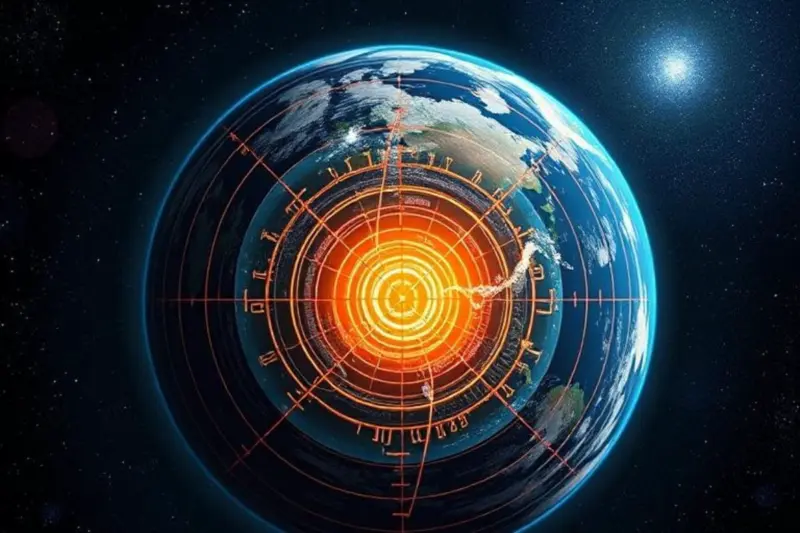

Earth's magnetic poles are shifting. Currently, the exact position of the North Pole is moving from Canada towards Siberia. But what impact does this have?
Earth's Magnetic Field
Earth is a unique planet in our solar system because it has a very powerful magnetic field. This special effect is due to the activities happening in Earth's molten core. Because of this field, Earth acts like a magnet and its poles are close to the Earth's rotation axis. Changes in the movements within the core cause the position of the magnetic poles to shift, as is happening right now.
Benefits of the Magnetic Field
The biggest benefit is that the magnetic field protects Earth from solar winds and cosmic radiation. As a result, these rays never reach the Earth's surface, and life remains safe from their harmful effects. At the same time, some of the charged particles from the Sun enter the atmosphere through the poles, creating beautiful, colorful displays in the sky, known as the Aurora.
This Change is Happening Rapidly
Until 1990, the position of the North Magnetic Pole was nearly stable over Canada. But by 2020, it has been rapidly moving towards Siberia at a speed of 50 kilometers per year. This has led scientists to study the potential impacts of this change.
A Major Question
The big question is whether this change affects the structure of the entire magnetic field that spans Earth. This shifts the path of the charged particles trapped in the Earth's radiation belt. The radiation belts are areas in the magnetic field where high-energy protons and electrons are found. When Earth's magnetic field strength or shape changes, these particles move around, bounce, and continue shifting from place to place. But how this happens has been a question for scientists for many years.
To answer this question, researchers from the Indian Institute of Geomagnetism (IIG) - Ayushi Srivastava, Dr. Bharti Kakkar, and Dr. Amar Kakkar - used an international geomagnetic reference field model and performed a simulation of the three-dimensional motion of test particles. They wanted to measure the change in the entry points of energetic protons from 1900 to 2020.
What Was the Situation Before?
The results of the study were published in Advances in Space Research. The researchers found that in 1900, the magnetic field over Canada was very strong. This meant that charged particles were at higher altitudes, and the field was stable at that time. However, by 2020, since the magnetic field shifted towards Siberia, the field over Canada had weakened.
What is Happening Now?
Since 2020, the magnetic field over Siberia has strengthened, and the activity of high-energy particles has changed. As a result, the entry point of charged particles in Siberia has increased from 400 km to 1200 km. This has altered both the collisions and behavior of these particles with Earth.
The temperature will begin to rise, and this will impact satellites, GPS, and even space missions. The paths of satellites orbiting the poles will change because the density of particles in the atmosphere has increased. Space agencies will need to work hard to keep satellite paths on track. As a result of this change, Earth's atmosphere will store more energy in charged particles, and they will start heating up. This will definitely have significant effects on satellites and global systems.
There will be changes in the appearance of the colorful displays in the polar skies, known as the Aurora. Additionally, their intensity will change. Scientists will need to pay closer attention to space weather. Furthermore, space agencies might soon begin working together on this issue.