




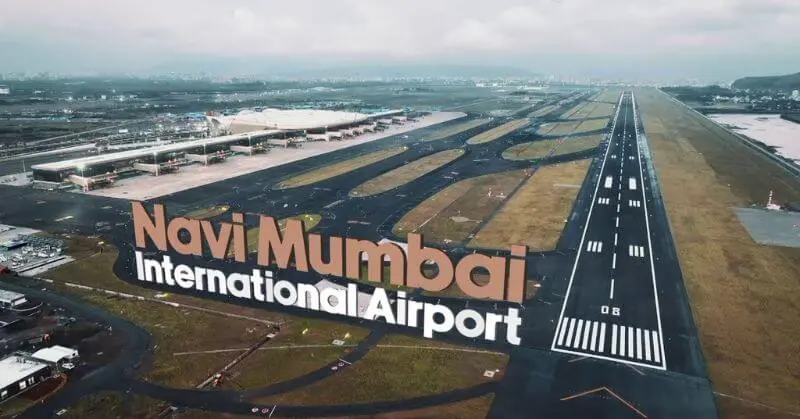

The Navi Mumbai International Airport (NMIA) was inaugurated on October 8 by Prime Minister Narendra Modi, making Mumbai comparable to London, New York, and Tokyo - cities with multiple airports.
This is a new airport constructed under a public-private partnership between Adani Airport Holdings and CIDCO and will begin commercial operations in December 2025.
Navi Mumbai International Airport is the first 100 percent digital airport in India. They will not have paper tickets or queues longer than necessary at the counter. It has AI-powered terminals, baggage drop, online immigration, and pre-reserved parking. All check-in to boarding is automated.
You are able to send your bags via the internet, clear immigration electronically, and reserve your parking space even before you step out of the door. It is fast and conveniently constructed.
The Navi Mumbai International Airport covers 1,160 hectares. It currently has one runway and one terminal capable of serving 20 million passengers per annum. But the plan is much bigger.
At full capacity, NMIA will comprise a minimum of four terminals and two runways, which will carry 155 million passengers each year. That renders it one of the biggest hubs in Asian aviation. The facilities are of international quality and oriented towards the comfort of passengers.
The construction of this airport cost ₹19,650 crore. It is an enormous investment, but one worth making. The airport will generate more than 2 lakh jobs in aviation, logistics, IT, hospitality, and real estate.
They are not merely figures in a book. Actual families will be provided with workplaces, and the economy of the whole region will be enhanced due to this project.
Large airlines are already registered. The three airlines that will use the Navi Mumbai Airport are IndiGo, Air India Express, and Akasa Air, which will link the airport to major domestic and international destinations.
Increased airlines translate to increased options for passengers. Competition normally produces improved service and prices, hence benefiting the travelers.
The commercial flights commence in December 2025. The first percentage of traffic will be international (40%), and later it will go up to 75%. The airport will be working 12 hours a day initially before transitioning to 24-hour operations.
The gradual process assists in correcting problems at an initial stage. When things go up, it is better to start small.
Arun Bansal, the CEO of Adani Airports, terms NMIA as an anxiety-free airport. The best part? Real-time luggage tracking. You will receive notifications, such as your bag being on carousel number 20.
You will no longer get anxious at the baggage section about the location of your suitcase. You will have its location at every step.
NMIA shall be the first large-scale airport in India to be connected to expressways, metro lines, suburban rail, and waterways. It becomes easy to access the airport.
Take a metro, drive, ride in a local train, or travel using water transport - all of them are possible. Such connectivity is not common in India, and it sets a new standard.
Mumbai needed this. The current airport in the city has been operating above capacity for years. The Navi Mumbai International Airport will alleviate that strain and make Mumbai a serious world aviation center.
Mumbai, with its capacity of 155 million passengers when full, will be able to compete with other big cities in Asia. Economic gains expected in the coming decades include employment, business, and tourism.