
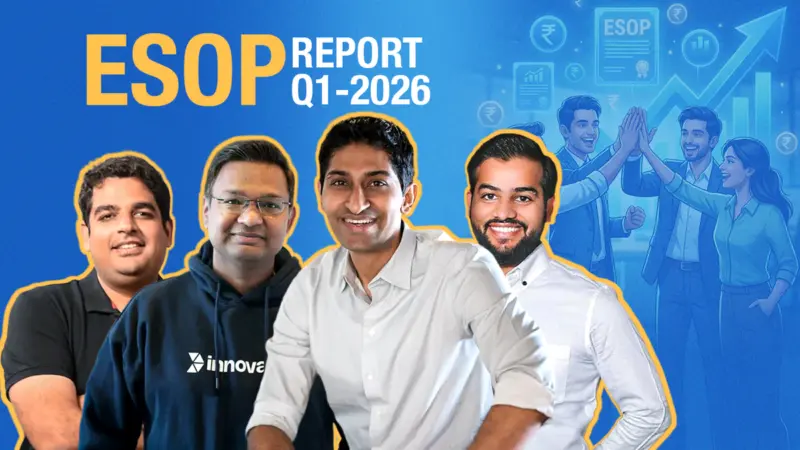

ESOP buybacks, liquidity, and payout programs were a common trend during 2021 to 2022, a period widely seen as a golden phase for Indian startups due to strong venture capital inflows.
However, the momentum began to slow in 2023 in terms of the number of buybacks and declined further in 2024 and 2025 in terms of total value.
2026 has opened on a strong note. ESOP buybacks in the first quarter alone have already surpassed the full-year figures recorded in both 2024 and 2025.
According to data compiled by Entrackr, seven startups have collectively bought back ESOPs worth nearly $220 million in Q1 2026. In comparison, buyback, liquidity, and payout activity remained subdued in 2025 at just over $75 million. The total value stood at around $190 million in 2024, well below the $802 million recorded in 2023, $440 million in 2021, and $200 million in 2022.
In 2023, Flipkart contributed $700 million to the total through ESOP liquidity provided as compensation for the decline in value following the PhonePe spin-off, while other startups together accounted for $102 million in buybacks.
The cumulative ESOP buybacks by Indian startups since 2020 have reached approximately $2 billion ($1,977 million).
In the ongoing calendar year, Mumbai-based software testing platform BrowserStack has led ESOP liquidity events with a $125 million share buyback programme aimed at employees and early investors. The initiative enables nearly 500 employees to sell their shares, with roughly half of the total amount reserved for them, while the remaining portion is allocated to early backers such as Accel.
Healthtech firm Innovaccer has also completed a $75 million ESOP buyback, offering liquidity to both current and former employees holding vested stock options. Media reports indicate that several holders of restricted stock units also benefited, although the exact number remains undisclosed.
Crypto exchange CoinDCX, despite being in the spotlight for multiple developments, repurchased ESOPs worth $12 million. Meanwhile, edtech company Unacademy rolled out a Rs 50 crore ($5.5 million) ESOP buyback programme to provide liquidity to its workforce. Founder Gaurav Munjal stated that eight employees are expected to earn over Rs 1 crore each, 17 employees will receive more than Rs 50 lakh, and 38 employees are likely to make upwards of Rs 10 lakh. This comes at a time when the edtech sector continues to face fundraising challenges, with the SoftBank-backed firm eventually being acquired by upGrad.
Other startups that have participated in ESOP buybacks in 2026 include higher-education and employability platform Emversity, visa processing startup Atlys, fintech company Cashfree, and cybersecurity firm Kratikal.
There have been no major new rules specifically for ESOP buybacks, though some regulatory changes could influence how companies structure such programmes. For instance, the Securities and Exchange Board of India phased out the open-market route for share buybacks from 2025 for listed firms, while also proposing its reintroduction under a revised framework. This shift could affect liquidity options as startups move closer to public listings. Meanwhile, provisions under the Companies Act, 2013 remain unchanged, and buybacks continue to be a key mechanism for employee liquidity. The Union Budget 2026 also did not introduce any changes to ESOP taxation, keeping the current framework intact.
While many argue that buybacks serve a limited purpose as there remain far too few to make an impact, with a few headline grabbers distorting perception, buybacks do have a strong use case. Many startups see the delayed gratification as one way to ensure employee loyalty, overriding the other extreme consequence of employees leaving after a big payday. Equally importantly perhaps is the fact that buybacks have virtually been counted as part of CTC in others, making the founders prioritise these above much else at times now. Much like the many successful IPO's, one would usually expect buybacks to become a more prominent feature going ahead as well, despite the uncertain market conditions. The fact remains that for an employee, the risk-loyalty reward is best served by a buyback right now, as upfront tools like sign-on bonuses are no longer the preferred route for many firms.