
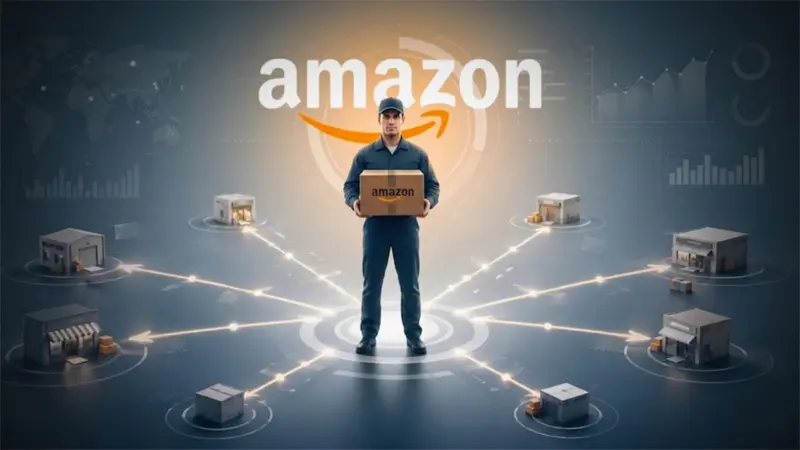

Amazon has opened its end-to-end logistics network - Amazon Transport Services, to third party businesses, as it opens up its supply chain network to companies outside its ecosystem.
The company said that any business can now use its network to store, move, and deliver goods, even if they don't sell on Amazon. This includes everything from freight and warehousing to fulfillment and last-mile delivery.
In simple terms, Amazon is now offering its full logistics stack as a service. This puts it in direct competition with global logistics firms like FedEx and UPS, which have traditionally handled shipping and supply chain for businesses. In a similar vein, Flipkart, through Ekart Logistics, already offers delivery and supply chain services to businesses outside its platform.
Amazon has built this network over the years to support its own e-commerce operations. Now, it is opening that infrastructure to others and trying to earn from it. The strategy is similar to how Amazon Web Services came out of Amazon's internal tech systems and became a separate large business.
Companies can choose to use only parts of the service or the full stack, depending on what they need. This could help brands that want faster delivery and better control over their supply chain.
Globally, large companies like Procter & Gamble and 3M have already started using Amazon's services. The announcement also shook the market, with shares of logistics companies reacting after the news.
In India, Amazon already offers services like shipping and fulfillment to sellers. If this expands further, it could increase competition for players like Delhivery, Blue Dart, and Shiprocket, and Flipkart's eKart.
For Amazon, which has always built its own logistics service as a point of differentiation, the call in India seems to have been driven by sheer scale and the need to sweat the network better. Like a power grid, the network probably has enough spare capacity to absorb more traffic without overloading, and deliver some revenues as well. Of course, if it is Amazon, there is no knowing how the data it collects might be used eventually, but there is little doubt that the option in the market will be valuable for many business owners. The sheer size and versatility of its network gives Amazon an advantage over many players, and it will be interesting to see how far and quickly this is rolled out.