
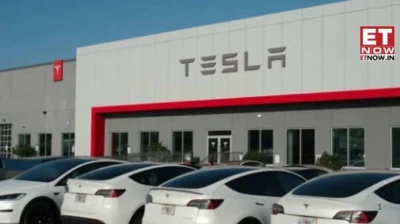

Tesla doesn't do things the way other car companies do. No sprawling dealership networks, no pushy showroom sales staff, no third-party service centres taking calls on their behalf.
That philosophy, which has defined how Tesla operates globally, is now being transplanted into India and the man tasked with making it work here has just given the clearest public picture yet of where things stand.
Sharad Agarwal, Tesla India's Country Head, outlined the company's operating model and current infrastructure in a recent interview that covered everything from service philosophy to delivery timelines. The picture that emerged is of a company moving deliberately, building infrastructure in parallel with customer demand rather than ahead of it and betting that the quality of its product and ownership experience will do the selling.
Service model India has never seen before
The first thing Agarwal made clear is that Tesla is not building a conventional service network. The company is following what it calls a direct to consumer service model meaning Tesla owns and operates every touchpoint in the ownership experience. There are no authorised third-party workshops. No independent dealers. The relationship between buyer and brand stays unbroken from the moment of purchase through every service interaction that follows.
More significantly, Agarwal said customers need not visit service centres at all for most issues. Tesla's over-the-air software update capability means a large category of problems that would send a conventional car to a workshop can be resolved remotely the car's systems are diagnosed, updated, or corrected through a wireless connection without the owner ever leaving home. For a country where service centre visits are often a half-day commitment involving traffic, queues, and follow-up calls, that's a meaningfully different ownership proposition.
For issues that do require physical attention, Tesla currently operates two service stations in India one in Gurgaon and one in Mumbai. These are the only two markets where Tesla has an established presence for now, with expansion to follow as the customer base grows beyond the initial launch cities.
Charging infrastructure taking shape
On the charging front, Tesla has five Supercharging stations operational across India. Since opening its doors in the country, the company has also installed home charging units across 28 states a figure that signals wider geographic reach than the two service station locations might suggest. Home charging is Tesla's primary solution for daily energy needs, with Superchargers positioned for highway travel and longer journeys.
Deliveries begin June 2026
The detail most buyers have been waiting for deliveries of Tesla's new car in India will begin in June 2026. The Model Y has already launched here across three variants, with the Model Y L added to the lineup at Rs. 61.99 lakh last week. June's delivery start gives customers who have placed orders a concrete timeline to plan around.
Agarwal's broader vision for Tesla India is a digitally enabled ecosystem one where the entire experience of buying, owning, charging, and servicing a Tesla happens through connected, technology-driven channels rather than physical infrastructure built for a previous generation of car ownership. India, with its strong digital adoption and growing appetite for premium EVs, is being positioned as the right market to prove that model can work at scale outside Tesla's traditional Western strongholds.
The infrastructure is still thin. Two service stations and five Superchargers is a modest footprint for a country of 1.4 billion people. But Tesla has always built the network to match the fleet - and June's deliveries mark the point where that fleet starts growing in India in earnest.
Read more news like this on www.etnownews.com