




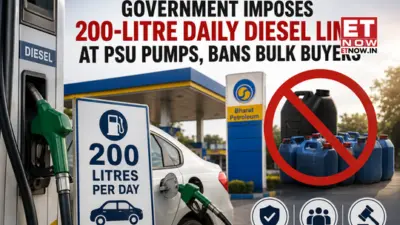

The central government has moved to clamp down on large-scale diversion of diesel from public sector retail outlets, issuing a temporary order that caps the quantity any single customer can purchase at a pump and bars industrial and commercial buyers from sourcing fuel through retail channels meant for ordinary consumers.
The Ministry of Petroleum and Natural Gas notified the Motor Spirit and High-Speed Diesel (Temporary Regulation of Supply through Retail Outlets) Order, 2026, citing a surge in bulk procurement at PSU pump stations driven by a widening gap between retail and bulk diesel prices. The order is valid for up to 90 days.
What Is Driving the Rush at PSU Pumps
At the heart of the problem is a price arbitrage that has made government-run retail outlets far cheaper than dedicated consumer pumps for industrial and bulk buyers. Retail diesel at PSU stations is currently priced at roughly Rs 40 per litre less than bulk diesel, a gap large enough to make diversion commercially attractive.
Private oil marketing companies have also exited a portion of the market, with their high-speed diesel sales falling by around 58 per cent in May 2026 compared to the same month last year, after they raised prices in line with international rates. That pullback has pushed even more bulk volume toward PSU outlets run by Indian Oil, Bharat Petroleum, and Hindustan Petroleum.
The result has been a sharp and uneven spike in demand at public sector pumps. Government data for May 2026 shows that 327 districts across the country recorded diesel sales growth of more than 10 per cent compared to the previous year, with 80 of those districts seeing growth exceeding 30 per cent. The ministry said instances of large quantities of diesel being collected in jerry cans and then resold had come to its notice, prompting the order.
What the Order Says
Under the new rules, retail outlets operated by PSU oil marketing companies will dispense diesel only into vehicle tanks or containers approved by the Petroleum and Explosives Safety Organisation. The daily limit per customer or vehicle has been set at 200 litres.
Industrial, institutional, and commercial buyers are now prohibited from purchasing fuel at retail outlets and must source their requirements through dedicated consumer pumps. Diesel bought at retail stations cannot be resold under any circumstances.
The three PSU oil marketing companies and their retail dealers have been made responsible for enforcing these restrictions on the ground. State governments and union territory administrations have been directed to act against black marketing and unauthorised diversion.
Violations will attract penalties under the Essential Commodities Act, 1955, and other applicable laws.
Not a Shortage, Government Insists
The ministry was careful to frame the order as a targeted intervention rather than an emergency measure, stating explicitly that there is no shortage of petrol or diesel in the country. India remains the world's fourth largest refiner and fifth largest exporter of refined petroleum products, the ministry noted.
The 200-litre daily cap, officials pointed out, is well beyond anything a private car or two-wheeler owner would need in a day and would not affect ordinary consumers in any practical sense.
The order comes against the backdrop of ongoing disruptions in West Asia, which have pushed up global oil prices and put pressure on state-run fuel retailers. PSU oil marketing companies are currently absorbing losses of approximately Rs 500 crore per day on the sale of petrol, diesel, and domestic LPG in order to keep retail prices stable for households, farmers, and small consumers. The government said this price support was never intended to extend to industrial and bulk consumers, whose procurement costs are expected to follow international market rates.
By keeping bulk buyers away from subsidised retail outlets, the order is intended to ensure that the government's price support actually reaches the consumers it was designed for, and that pump availability is not disrupted by commercial activity that was never meant to flow through the retail network.
Read more news like this on www.etnownews.com