
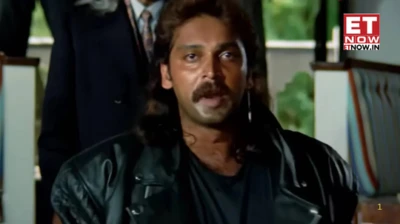

He was the face audiences loved to fear. Through the 1980s and into the 1990s, Mahesh Anand was one of Hindi cinema's most recognisable villains - a towering, menacing presence who appeared in over 300 films alongside the biggest names of his generation.
He shared the screen in Shahenshah, Coolie No. 1, Vishwatma, and Toofan, among scores of others. Directors sought him out. Producers wanted his name on their posters. For a stretch of years, few actors in the industry were more consistently employed.
He died alone on a sofa in a Versova flat in February 2019, at the age of 57. His body was not discovered for several days. By the time police broke down the door, decomposition had already set in.
This is the story that Bollywood rarely tells about itself.
A Career Built From Nothing
Mahesh Anand did not arrive in the film industry with connections or privilege. He spent eighteen years of his life in poverty before finding his footing - beginning his career as a model and dancer before transitioning into acting. His debut came in 1984 with the film Karishma, and from the very beginning, his physical presence shaped the roles that came his way. Tall, broad-shouldered, with a face capable of projecting genuine menace, he was typecast almost immediately into antagonist roles. Rather than resist that categorisation, he owned it completely.
Over the years that followed, he built a filmography that most working actors in any era would envy. Three hundred films is not a number that happens by accident - it speaks to consistent demand, professional reliability, and the kind of screen presence that directors trust to carry difficult scenes. Films like Ganga Jamuna Saraswati, Insaaf, and Shahenshah gave him moments that audiences remembered long after the credits rolled.
For a period in the late eighties and early nineties, Mahesh Anand was at the top of his profession.
Five Marriages, Growing Isolation
His personal life was as turbulent as his career was prolific. Mahesh Anand married five times, each relationship ending in separation and leaving behind a little more distance between himself and the people around him.
His first marriage was to Barkha Roy, sister of actress Reena Roy - a union that drew attention at the time but did not last. He then married Erica Maria D'Souza, a former Miss India International, with whom he had a son. That marriage too ended. A third marriage to Madhu Malhotra followed, then a fourth to Usha Bachani, and finally a fifth to a Russian woman named Lana - a relationship that by all accounts remained strained throughout.
What is most striking in retrospect is not the number of marriages but what they collectively failed to provide: a sense of permanence, of being anchored to someone. His stepbrother reportedly deceived him financially. His only son eventually withdrew from his life. The industry that had once kept him constantly busy moved on to newer faces, as it invariably does.
By his final years, the man who had once been one of Bollywood's most sought-after villains could not afford to buy drinking water.
A Cry for Help That Went Largely Unheard
In the period before his death, Mahesh Anand turned to Facebook to describe his circumstances. In a post that attracted some attention at the time, he laid out what his life had become - the financial ruin, the loneliness, the sense of having been forgotten by an industry and a world that had once depended on him. It was a raw and painful document, the kind that tends to generate sympathy in the moment and then fade quickly from collective memory.
The industry that profits so enormously from its stars rarely builds structures to catch them when they fall. Mahesh Anand's Facebook post was a distress signal. It did not change the trajectory of his final years.
The End
On February 9, 2019, police in Mumbai broke open the door of his Versova flat after neighbours raised concern. They found him on his sofa - dead, surrounded by liquor bottles and food. Doctors determined that the cause of death was natural. He had been there long enough that his body had begun to decompose. In a city of twenty million people, in a flat located in one of Mumbai's busiest neighbourhoods, a man who had appeared in more than three hundred films had died without anyone noticing for days.
His fifth wife, Lana, flew in from Russia upon hearing the news. She took responsibility for the final rites, accompanying his remains to the crematorium. It was a quiet, uncelebrated end for a man whose career had been anything but.
What His Story Leaves Behind
The film industry has a phrase it reaches for in moments like these - "he will be remembered." The honest version of Mahesh Anand's story is that he largely was not. A generation of audiences who watched him menace their favourite heroes from cinema screens across the country never knew what became of him. His death received a fraction of the coverage that his contemporary villains - men who stayed connected to the industry's social machinery - would have received.
What lingers is not just the sadness of his personal circumstances but the systemic indifference that surrounds such stories. Mahesh Anand was not a peripheral figure in Hindi cinema. He was a working professional for decades, contributing to the industry's commercial success across hundreds of productions. The idea that such a person could end his days unable to afford basic necessities, dying alone and undiscovered, points to something the industry has never adequately confronted about how it treats the people it uses and then moves past.
He made audiences shiver in darkened cinemas across a decade and a half. He deserved better than the ending he got.
Read more news like this on www.etnownews.com