
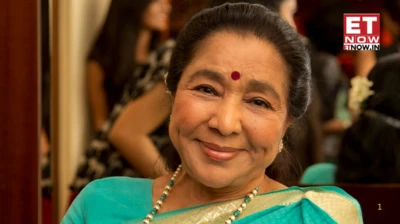

India lost its most recorded voice on Sunday. Asha Bhosle, the singer whose career spanned eight decades and whose voice became the emotional soundtrack of countless Indian lives, passed away at Breach Candy Hospital in Mumbai on April 12, 2026. She was 92. Dr Pratit Samdani of Breach Candy Hospital confirmed that the cause of death was multi-organ failure.
With her passing, Indian music loses not just a legend but an era - a voice so distinctive, so versatile, and so deeply embedded in the cultural memory of the subcontinent that it is genuinely difficult to imagine the landscape of Indian cinema and music without it.
Also Read: Music legend Asha Bhosle dies at 92 after hospitalisation at Breach Candy Hospital in Mumbai
The Beginning: A Nine-Year-Old Who Had No Choice
Asha Bhosle was born on September 8, 1933, in Sangli, Maharashtra, into the family of Pandit Dinanath Mangeshkar - a classical singer and theatre actor whose own musical gifts would define his children's destinies. She was the second daughter in a household where music was not a career choice but a way of life.
When Dinanath Mangeshkar died suddenly, Asha was just nine years old. The family was left without its primary breadwinner, and the responsibility of survival fell on the children. Asha and her elder sister Lata began singing and acting almost immediately - not out of ambition but out of necessity. The girl who would become one of India's most celebrated artists began her professional life not chasing fame but chasing rent.
Her first recorded work came in 1943 with the Marathi film Majha Bal. Five years later, in 1948, she made her Hindi playback debut with the film Chunariya. She was fifteen years old, already a professional with five years of experience behind her, and the industry had barely begun to notice what it had in its midst.
A Career Unlike Any Other in the History of Recorded Music
What Asha Bhosle built over the seven decades that followed her debut is a body of work that has no parallel in the history of Indian - or arguably global - music. She recorded over 12,000 songs in more than twenty Indian and foreign languages, spanning every conceivable genre: film songs, ghazals, bhajans, pop, classical compositions, cabaret numbers, folk music, and everything in between.
The breadth of that range was precisely what set her apart. While her elder sister Lata Mangeshkar came to be associated with a specific kind of refined, classical elegance, Asha defied categorisation. She could be playful and mischievous in one recording, achingly romantic in the next, and then turn around and deliver a ghazal of such understated depth that it left listeners breathless. She inhabited every style she attempted with total conviction - never sounding like a classical singer forcing herself through a pop number or a film singer reluctantly tackling classical territory.
Some of her most enduring songs include Piya Tu Ab To Aaja, Dum Maro Dum, Chura Liya Hai Tumne Jo Dil Ko, and In Aankhon Ki Masti - recordings that have outlasted the films they were made for and continue to find new audiences across generations.
In 2011, that extraordinary body of work received formal global recognition when Asha Bhosle's name was inscribed in the Guinness Book of World Records as the artist with the highest number of studio recordings in the history of music. It was a record that surprised nobody who had been paying attention - and one that may never be broken.
The Awards: A Career Measured in Honours
The institutional recognition that accompanied Asha Bhosle's career was as comprehensive as the career itself. She won two National Film Awards for Best Female Playback Singer - for her work in Umrao Jaan and Ijaazat - two films that together represent the pinnacle of what Hindi film music can achieve when composer, singer, and cinematic context align perfectly.
Her relationship with the Filmfare Awards was one of the longest and most decorated in the history of the ceremony. She won the Filmfare Award for Best Female Playback Singer eight times, eventually receiving a Lifetime Achievement Award that acknowledged what individual wins could not fully capture - the totality of a contribution that had shaped the award's own history.
In 1997, the Government of India recognised her with the Padma Shri. Eleven years later, in 2008, she was elevated to the Padma Vibhushan - one of the country's highest civilian honours. The year 2000 brought the Dadasaheb Phalke Award, Indian cinema's most prestigious lifetime recognition, cementing her place among the absolute giants of the art form. She was also nominated for Grammy Awards in both 1997 and 2006, extending her recognition into the international arena in a way that few Indian artists of her generation achieved.
The Shadow of Lata: Forging Her Own Path
To understand Asha Bhosle's professional journey fully, it is necessary to acknowledge the particular challenge she faced that no other singer of her era did - building a career in the shadow of Lata Mangeshkar. Her elder sister had established an almost complete dominance over Hindi film playback singing by the time Asha was old enough to compete for significant assignments. Lata's voice had become the default choice of nearly every major composer and director working in Bombay cinema.
Rather than attempt to replicate what Lata did better than anyone else, Asha carved out territory that her sister left largely unexplored. She embraced the cabaret numbers, the racy items, the experimental compositions that more conservative sensibilities avoided. She worked closely with composers who wanted something different - and in doing so, built a parallel universe within Hindi film music that eventually became as celebrated as the one her sister occupied.
Her collaboration with R.D. Burman became the defining musical partnership of its era - a creative alliance that produced some of the most joyfully inventive recordings in the history of Indian cinema. When they eventually married in 1980, personal and professional love had been intertwined for years already.
A Personal Life Defined by Tragedy and Resilience
Behind the voice that millions loved was a personal life marked by suffering that few of her admirers fully knew. Asha Bhosle's private story is one of the most remarkable - and most painful - in Indian entertainment history.
At sixteen, she married Ganpatrao Bhosle against her family's wishes. He was approximately twenty years her senior and had worked as her personal secretary. The marriage, which she entered believing she was choosing freedom, became instead a form of captivity. In her biography Asha Bhosle: A Life In Music by Ramya Sarma, published in 2025, she described her first husband as controlling and short-tempered - a man she characterised as a sadist who derived pleasure from causing pain. She endured the abuse silently for years, believing it was her duty.
The darkest moment came when she was four months pregnant. In a state of complete despair, she swallowed an entire bottle of sleeping tablets. She survived - saved, she later said, by the thought of her unborn child. The suicide attempt, barely known publicly for decades, stands as the most harrowing testament to how much she endured behind the recordings that were delighting audiences at the very same time.
She finally walked away from the marriage in 1960 while pregnant with her third child. She raised three children - sons Hemant and Anand, and daughter Varsha - alone.
The years that followed brought professional triumph and personal devastation in equal measure. Her daughter Varsha Bhosle, a singer and journalist, died by suicide in 2012 after a prolonged battle with depression. Three years later, in 2015, her eldest son Hemant - himself a music composer - died following a long fight with cancer. Asha had outlived two of her three children.
Her second marriage, to R.D. Burman in 1980, was a genuine love story - the coming together of two of Indian music's most naturally collaborative souls. But even that relationship faced difficulties, with the two reportedly separating in the early 1990s before Burman's death in 1994. They had no children together, but the music they made will outlast them both.
The Legacy That Remains
Asha Bhosle is survived by her son Anand Bhosle, who has managed her professional commitments in her later years, and by her granddaughter Zanai Bhosle, who has already performed alongside her grandmother and is building her own artistic career. The family's musical legacy continues into its third generation.
In her final decades, Asha remained active in ways that regularly astounded observers. She performed on stage into her eighties, launched restaurant businesses that carried her name across multiple countries, and continued to record occasionally - each appearance a reminder that the voice, even at its most weathered, retained something irreplaceable.
She was called Asha Tai by those who loved her - a term of affection and respect that captured something essential. Not just a great singer, but a great woman. Not just a legend, but a survivor.
India will not see another like her. The recordings she left behind - 12,000 of them, in twenty languages, across eight decades - are her answer to time. They will keep singing long after the world that made them has changed beyond recognition.
Asha Bhosle is gone. Her voice is not.
Read more news like this on www.etnownews.com