
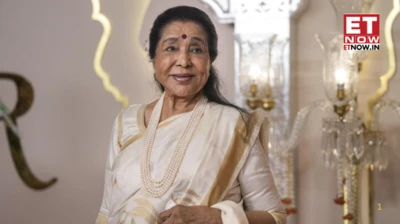

Numbers rarely capture what a human life means. But in the case of Asha Bhosle, the numbers are so staggering that they demand to be stated plainly before anything else: over 12,000 songs.
More than twenty languages. Eight decades of active recording. One Guinness World Record. Two National Film Awards. Eight Filmfare Awards plus a Lifetime Achievement honour. A Dadasaheb Phalke Award. A Padma Vibhushan. Two Grammy nominations. And a voice that, at its peak, could move between a mischievous cabaret number and a classical composition within the same recording session without breaking a sweat.
No other artist in the history of recorded music has left behind a body of work of this scale. The Guinness Book of World Records made it official in 2011. But anyone who had been listening already knew.
Where It All Began
Asha Bhosle's recording career began not with ambition but with necessity. Born on September 8, 1933, in Sangli, Maharashtra, into the musically gifted Mangeshkar family, she lost her father Dinanath Mangeshkar when she was just nine years old. With no breadwinner and a family to support, young Asha and her elder sister Lata began singing and performing almost immediately. Music was not a dream they chased - it was a lifeline they grabbed.
Her first recorded work came in 1943 with the Marathi film Majha Bal. She was ten years old. Five years later, in 1948, she made her Hindi playback debut with Chunariya - a quiet beginning for what would become the most prolific recording career in the history of music.
The early years were not easy. Hindi film playback singing in the late 1940s and 1950s was effectively dominated by her elder sister Lata, whose voice had become the default choice of nearly every major composer working in Bombay. Rather than fight for the same territory, Asha carved her own - embracing the genres that others avoided, working with composers who wanted something different, and building a reputation for versatility that eventually became her greatest commercial and artistic asset.
The Guinness World Record: 12,000 Songs Across 20 Languages
When the Guinness Book of World Records officially recognised Asha Bhosle in 2011 as the artist with the highest number of studio recordings in music history, it was confirmation of something the industry had long understood but never quite stated with that level of formality.
Twelve thousand songs is a number that requires a moment of genuine reflection. At a rate of one song recorded per day, it would take over thirty-two years to reach that total. Asha Bhosle did it across eight decades while simultaneously building a stage career, raising children largely alone, running restaurants, and navigating a personal life of extraordinary complexity.
The languages in which she recorded span the full breadth of the subcontinent and beyond - Hindi, Marathi, Bengali, Tamil, Telugu, Kannada, Gujarati, Punjabi, Malayalam, Urdu, and several foreign languages including English and Russian, among others. Each language brought its own musical traditions, its own rhythmic sensibilities, its own emotional register. Asha inhabited all of them with the same complete conviction she brought to her most familiar Hindi recordings.
What made this achievement possible was not simply longevity - though she had that in abundance - but an almost supernatural adaptability. Most singers, however gifted, find their natural register and work within it. Asha Bhosle seemed constitutionally incapable of being confined to a single register, style, or mood.
The Songs That Defined a Nation
Any attempt to identify the greatest songs in Asha Bhosle's catalogue is an exercise in necessary incompleteness - there are simply too many, spread across too many decades and genres, for any single list to do justice to the full range. But certain recordings have embedded themselves so deeply in Indian cultural memory that they demand individual mention.
Dum Maro Dum from Hare Rama Hare Krishna, composed by R.D. Burman in 1971, was a song that divided opinion when it was released - its druggy, free-spirited energy felt genuinely transgressive for its time - and has never stopped being played since. It announced to the industry that Asha Bhosle could do things with a lyric and a melody that no other singer working in Hindi film music was prepared to attempt.
Chura Liya Hai Tumne Jo Dil Ko from Yaadon Ki Baaraat, composed by R.D. Burman in 1973 and sung as a duet with Mohammed Rafi, occupies a different emotional register entirely - tender, romantic, impossibly melodic, and so perfectly constructed that it sounds inevitable rather than composed. Generations of listeners have heard it for the first time and felt they already knew it.
Then there is Yeh Mera Dil from Don - urgent, percussive, and as alive today as it was the evening it was first heard - and Aaja Aaja from Teesri Manzil, a song that captured the entire spirit of 1960s Bombay in four minutes of rock-inflected abandon.
Burman composed with Asha's voice in his ear - or so it seemed to anyone listening to the recordings they made together through the 1970s and into the 1980s. He pushed her into rhythmic and melodic territory that no other composer dared attempt, and she met every challenge with a flexibility and a commitment that made the results sound effortless. The funk influences, the jazz inflections, the western rock elements blended into film song structures - these experiments worked because the voice delivering them could handle anything asked of it.
They married in 1980, formalising a bond that had been shaping Indian music for over a decade. Burman died in 1994. The recordings they made together remain some of the most distinctive, most joyful, and most technically adventurous in the history of Indian cinema.
The Awards: A Career That Collected Honours Across Every Decade
Asha Bhosle's awards record is as comprehensive as her discography - a recognition that came from every institution capable of conferring it.
The National Film Awards came twice - for Umrao Jaan in 1982 and Ijaazat in 1987. Both films asked her to deliver something subtle and deeply interior rather than externally dramatic, and both times she delivered performances that transcended the conventional definition of playback singing.
The Filmfare Awards told a longer story. She won the Best Female Playback Singer award eight times across her career - a total that represents both extraordinary consistency and a remarkably long period of competitive dominance in one of the most contested categories in Indian film awards. When the Filmfare eventually gave her a Lifetime Achievement Award, it was acknowledging that individual wins could no longer capture the full scale of what she had contributed.
The civilian honours placed her among India's most decorated artists. The Padma Shri came in 1997, the Padma Vibhushan - one of the nation's two highest civilian awards - in 2008. The Dadasaheb Phalke Award in 2000 completed the picture, placing her in the company of Indian cinema's absolute founding giants.
Internationally, two Grammy Award nominations - in 1997 and 2006 - recognised that what she had built was not merely a national treasure but a contribution to world music. Few Indian artists of her generation received Grammy consideration at all. Asha received it twice.
Versatility as a Superpower
What separated Asha Bhosle from every other singer of her era was not the quality of her voice alone - though that voice was exceptional - but the range of what she could do with it. She was equally at home in a mujra, a bhajan, a ghazal, a rock-influenced number, a folk song, a classical composition, or a purely experimental recording that defied easy categorisation.
This versatility was not simply technical. It was emotional and imaginative. Asha could inhabit a character through her voice in the way that the greatest actors inhabit a role - completely, without visible seams, making the listener believe that no other singer could have delivered this particular song in this particular way. That quality of complete inhabitation is what made her irreplaceable across eight decades of changing musical fashions, production styles, and audience tastes.
Other singers rose and fell with the fashions. Asha adapted to every era while remaining unmistakably herself. That is the rarest gift a performer can possess.
The Final Chapter
In her later years, Asha Bhosle remained active in ways that regularly astonished observers. She performed on stage into her eighties with an energy and a command of an audience that performers half her age might have envied. She launched restaurant businesses - Asha's restaurants - across multiple countries, taking her love of food and her name to international markets. She continued to record occasionally, and each new recording was received as a gift from a voice that had no business still sounding that good.
She passed away on April 12, 2026, at Breach Candy Hospital in Mumbai, due to multi-organ failure. She was 92 years old.
The recordings remain. All 12,000 of them. In twenty languages. Across eight decades. In every genre that Indian music has ever attempted and several it had not tried before she arrived.
Asha Bhosle did not just sing India's songs. In a very real sense, she sang India itself - its joy, its longing, its mischief, its grief, its devotion, and its irrepressible, unstoppable will to celebrate being alive.
No silence will be loud enough to mark what has been lost. But the music will carry on.
Read more news like this on www.etnownews.com