
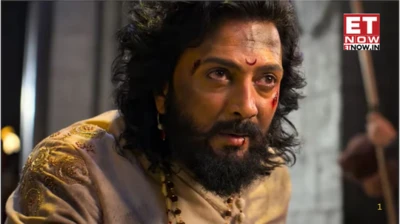

Forty-eight hours. That is all it took for Raja Shivaji to permanently alter the box office conversation around Marathi cinema.By the end of its second day in theatres, Riteish Deshmukh's historical epic had crossed Rs 23.90 crore net in India - surpassing the lifetime domestic collection of Nach Ga Ghuma, crossing into the top ten highest-grossing Marathi films of all time, and achieving something no Marathi film had ever managed before: delivering double-digit net collections on two consecutive days.
The first Marathi film in history to accomplish that particular feat. In only its second day of release.
The Numbers That Tell the Story
Day 1 brought Rs 12.40 crore net. Day 2 - Saturday - brought Rs 11.50 crore net. The day-on-day hold of approximately seven percent is not simply a healthy figure for a historical epic in its second day. It is a figure that the trade will examine carefully as evidence of something more durable than an opening-weekend surge.
Most films in this budget range and genre experience significantly steeper drops between their first and second days - particularly when the opening falls on a public holiday, as Raja Shivaji's Maharashtra Day release did. The expectation for such films is that the holiday crowd inflates Day 1 beyond what organic demand can sustain, producing a sharper correction on Day 2 when regular Saturday audiences show up in smaller numbers.
Raja Shivaji held. Seven percent is a hold. And the occupancy data from within that second day tells an even more encouraging story.
The Evening Surge: Word of Mouth in Real Time
The occupancy breakdown for the Marathi version on Day 2 is precisely the kind of data that separates a film with genuine audience momentum from one riding a marketing-driven opening weekend.
Morning shows opened at 30.57 percent occupancy - a reasonable figure for the first shows of a Saturday. By afternoon, that had risen to 57 percent. Evening shows climbed further to 63.57 percent. Night shows peaked at 71.71 percent.
That curve - from morning to night, each show fuller than the last - is the signature of word of mouth operating in real time. Audiences who saw the morning and afternoon shows spoke to friends and family. Those conversations filled the evening and night shows. A film that builds through its second day rather than declining through it is a film that people are recommending to each other. That is the most valuable commercial signal a production can receive, and Raja Shivaji received it loudly on Day 2.
Hindi vs Marathi: The Two-Speed Performance
The split between the film's two primary language versions continues to tell a story of contrasting trajectories. The Marathi version contributed approximately Rs 7.15 crore of the Day 2 total, recording 55.71 percent overall occupancy across its shows. The Hindi version contributed approximately Rs 3.40 crore, with overall occupancy of 20.46 percent across 3,041 shows.
The gap between 55.71 percent and 20.46 percent is significant - it reflects the reality that Raja Shivaji's emotional and cultural connection is strongest with the audience that comes to it in its original language. Maharashtra felt this film on Maharashtra Day with an intensity that the Hindi belt, still discovering the film through word of mouth and reviews, has not yet matched.
The commercial question for the coming week is whether the Hindi version's occupancy can climb toward the kind of numbers that would transform Raja Shivaji from a Marathi blockbuster into a genuine pan-India phenomenon. The evening surge in Marathi shows on Day 2 suggests the film has the storytelling quality to generate the recommendations needed to drive that crossover. The next ten days will determine whether those recommendations are being made across language lines.
The Budget Equation: Rs 75 Crore In, 32 Percent Recovered in 48 Hours
Raja Shivaji is reported to have been made on a budget of approximately Rs 75 crore - making it the most expensive Marathi film ever produced. In two days, it has recovered 32 percent of that estimated cost, with a domestic gross of Rs 28.20 crore against the net collection of Rs 23.90 crore.
For a film with this budget profile, the breakeven conversation typically begins around the Rs 75-80 crore mark when theatrical revenues from all languages, territories, and ancillary rights are factored in. With the film tracking to enter the top ten Marathi grossers of all time within its first three days, and with a Hindi version that has the potential to grow through the week, the production's financial outlook is considerably more comfortable than it might have appeared when the budget was first announced.
The Marathi film industry's previous benchmark for scale - Sairat's Rs 80.98 crore lifetime domestic collection, which sits at the top of the all-time list - now becomes the conversation point for Raja Shivaji's longer-term trajectory. The film needs roughly Rs 57 crore more to reach that summit. Given the current pace and the occupancy trends visible in its first two days, that target is within realistic range if the film holds through the coming weeks.
Rewriting the Record Books: Where Raja Shivaji Stands
The all-time Marathi box office chart is a list that has accumulated over decades of the industry's history. The films on it - Sairat, Baipan Bhari Deva, Ved, Natsamrat, Pawankhind - represent the pinnacle of what Marathi cinema has achieved commercially in the modern theatrical era.
Raja Shivaji has entered that conversation in forty-eight hours. By the end of Day 3, it will have surpassed Krantijyoti Vidyalay Marathi Madhyam at number ten on that list. No Marathi film has ever moved through the record books at this pace.
For Riteish Deshmukh - who financed, directed, wrote, produced, and starred in this film as a personal tribute to his late father and to the history of Maharashtra - the commercial validation arriving through these numbers carries a weight beyond the purely financial. He bet his creative reputation and significant capital on the idea that Marathi cinema could carry a story of this scale and ambition to a mainstream audience.
Two days in, that bet is paying off in a way that will be talked about in the Marathi film industry for years.
The Week Ahead: Holding the Line
The real test of Raja Shivaji's commercial ceiling begins Monday. Weekday collections will determine whether the film has the depth of audience interest to sustain meaningful daily numbers through the working week or whether its appeal is concentrated in the Maharashtra holiday and weekend windows.
A film that can hold Rs 3-4 crore on weekdays from its current position is a film tracking toward a Rs 60-70 crore domestic total. A film that holds Rs 5 crore or more on weekdays is a film that will challenge Sairat's all-time record. The occupancy trajectory visible in Day 2's evening surge suggests the latter is possible.
The Marathi film industry has not seen a moment quite like this in years - a film that broke every precedent in its first two days and is now asking its audience to keep coming back for more.
Based on the numbers so far, they appear to be listening.
Read more news like this on www.etnownews.com