
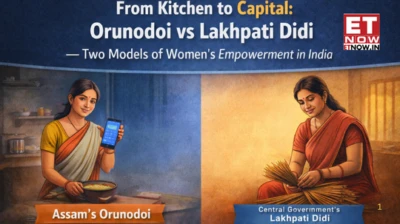

There is a woman in a village in Assam who receives Rs 1,250 in her bank account every month from the state government, unconditionally, simply because she is a woman from a low-income household.
There is another woman in a village in Uttar Pradesh who has learned to make and sell agarbatti, has taken a loan through a self-help group, and is on her way to earning Rs 1 lakh annually from her own enterprise. Both women are beneficiaries of government schemes designed to improve their economic lives. Both schemes are being held up as models worth studying. But they are built on entirely different assumptions about what women need and how the state should provide it.
Understanding the difference between Assam's Orunodoi scheme and the central government's Lakhpati Didi programme tells you something important about the competing philosophies that currently shape India's approach to women's economic welfare - and about which approach is actually moving the needle.
Orunodoi: Assam's Quiet Revolution in Direct Transfer
Orunodoi, the word that means sunrise in Assamese, was launched by the Assam government under Chief Minister Himanta Biswa Sarma in October 2020, making it one of the earlier large-scale direct benefit transfer schemes specifically targeting women in India. The premise was straightforward and deliberately unencumbered by conditions: identify women from economically vulnerable households, open bank accounts in their names, and transfer money directly to them every month without asking them to do anything in return except exist and be eligible.
The initial transfer amount was Rs 830 per month. It has since been revised upward to Rs 1,250 per month, with the government signalling further increases. The scheme targets women who are the primary earner or head of a household, widows, divorced or separated women, and women from families below a certain income threshold. Crucially, the money goes directly into the woman's bank account - not a joint account, not a husband's account - which is a design choice that carries significant implications for who actually controls the resource.
By 2024, Orunodoi had enrolled over 25 lakh women across Assam, making it one of the largest direct benefit transfer programmes for women in any single Indian state. The state government allocates several thousand crore rupees annually to sustain it, a fiscal commitment that reflects political will as much as policy conviction.
The economic logic behind Orunodoi is rooted in the direct cash transfer philosophy that has gained significant academic credibility over the past two decades - the argument that giving poor people money, rather than goods or subsidised services or conditional benefits, is both more efficient and more respectful of their agency. The woman who receives Rs 1,250 in her account decides what that money does. She might spend it on food, on her children's education, on a medical expense, on a small productive asset, or on nothing more complicated than reducing the anxiety of financial precarity. The scheme trusts her to make that decision better than any government programme can make it for her.
Critics of the direct transfer model argue that it creates dependency rather than capability, that it is fiscally unsustainable at scale, and that it does not address the structural barriers - lack of skills, lack of market access, lack of confidence - that keep women from participating in the formal economy. These are legitimate concerns. What the data from Orunodoi's first four years suggests, however, is that the money has measurably improved financial security for its recipients, increased women's bargaining power within households, and in many cases provided the small financial buffer that allowed women to take risks - including economic ones - that they could not afford before.
Lakhpati Didi: The Enterprise Bet
The Lakhpati Didi programme, launched by the central government under Prime Minister Narendra Modi, operates from an entirely different premise. Where Orunodoi gives women money, Lakhpati Didi gives women skills, market linkages, and access to credit - and then expects them to earn the money themselves.
The scheme works through the existing Self-Help Group network, which is among the most significant and underappreciated social infrastructure assets in rural India. Over the past two decades, the SHG movement has enrolled tens of millions of rural women into groups that pool savings, provide small loans, and build financial habits and social confidence simultaneously. Lakhpati Didi takes that existing infrastructure and adds a specific economic target: train and support SHG members to earn a sustainable income of at least Rs 1 lakh per year from their own enterprise or livelihood activity.
The training covers a deliberately wide range of activities - agarbatti making, LED bulb assembly, plumbing, drone operation and maintenance, agricultural processing, handicrafts, food production, and various forms of small-scale manufacturing and service provision. The choice of activities is designed to match women's existing skills and local market demand rather than imposing a uniform model. A woman in a hill district learns something different from a woman in a coastal village.
Prime Minister Modi announced an ambitious target of converting 3 crore women into Lakhpati Didis - women earning Rs 1 lakh or more annually - by 2025. The government subsequently reported achieving the 1 crore mark ahead of schedule and revised the target upward to 3 crore. The numbers have been debated, with some independent researchers questioning the methodology used to count a woman as a Lakhpati Didi and whether Rs 1 lakh annually - approximately Rs 8,333 per month - represents genuine economic independence in 2024's cost environment.
The scheme has nonetheless produced documented success stories across states. Women who have completed drone training are being hired by agricultural companies for crop monitoring and pesticide spraying at daily rates that comfortably exceed their previous household incomes.
Women making and selling processed food products through SHG networks linked to government procurement systems have built businesses with consistent monthly revenues. The programme's most significant structural innovation is the market linkage component - ensuring that women who acquire production skills also have somewhere to sell what they produce, which has historically been the point at which women's enterprise initiatives collapse.
Two Philosophies, One Goal
The fundamental difference between Orunodoi and Lakhpati Didi is not about which women they are trying to help - both target economically vulnerable rural and semi-urban women - but about what they believe the primary barrier to those women's economic wellbeing actually is.
Orunodoi's implicit answer is that the primary barrier is financial insecurity itself. A woman who does not know where next month's money is coming from cannot plan, cannot invest in herself, cannot take the risks that economic participation requires. Give her a predictable income, however modest, and you remove the floor-level anxiety that prevents everything else. The scheme does not ask her to become an entrepreneur. It asks only that she exist and receive.
Lakhpati Didi's implicit answer is that the primary barrier is a lack of capability and market access. A woman who has skills, credit, and customers can generate her own income at a level that no government transfer programme can sustainably match. The scheme bets on enterprise rather than welfare, on capability rather than support, on the conviction that the best thing the government can do for a poor woman is equip her to not need the government.
Both arguments have merit. Both have limitations.
The direct transfer model works best for women who face structural barriers - age, disability, caregiving responsibilities, location - that genuinely prevent economic participation regardless of skills and motivation. For a 60-year-old widow in a remote Assam village, Rs 1,250 a month may be more genuinely transformative than any amount of agarbatti training. For a 28-year-old woman in a town with functioning markets and a working SHG network, the enterprise model may create more durable and dignified economic independence.
The most honest answer is that India needs both, targeted at the right populations, which is, not coincidentally, approximately what the current policy landscape looks like when you map the two schemes together.
The Numbers That Matter
Orunodoi's enrolled base of over 25 lakh women in Assam alone, each receiving Rs 15,000 annually, represents a direct injection of approximately Rs 3,750 crore per year into the hands of women who were previously outside formal financial systems. The multiplier effects of that money - spent locally, in rural economies, on goods and services that recirculate within communities - are difficult to measure precisely but are real. Women who control their own financial resources make different household decisions, invest more in children's education, and are less economically dependent on spouses or male relatives in ways that have documented long-term development benefits.
Lakhpati Didi's ambition, if the 3 crore target is achieved and sustained, would represent the largest single expansion of women's enterprise income in Indian history. Women earning Rs 1 lakh annually who were previously earning little or nothing would collectively add hundreds of thousands of crore rupees to India's GDP - money that flows from productive activity rather than government budgets, which makes it both more fiscally sustainable and more economically multiplying.
What Both Schemes Get Right
The detail that both Orunodoi and Lakhpati Didi share - the detail that matters most from a development economics perspective - is that both put economic resources directly in women's hands rather than in household accounts nominally controlled by male heads of family.
of development research across the world have produced one finding more consistently than almost any other: money given to women is spent differently from money given to men, with systematically better outcomes for children's nutrition, health, and education. Schemes that understand this and design their delivery mechanisms accordingly are not just welfare programmes. They are investments in the next generation's human capital, which is the foundation of any economy's long-term productivity.
Both Orunodoi and Lakhpati Didi understand this. They disagree about the mechanism. But they share the conviction that the economic empowerment of Indian women is not a welfare question - it is a growth question. And on that, at least, the data is unambiguous.
The Road Ahead
Orunodoi faces the question that every direct transfer scheme eventually faces: fiscal sustainability at scale. As Assam's enrolled base grows and transfer amounts increase, the state's annual commitment expands accordingly. The political economy of reducing or eliminating a direct cash transfer once it is established is deeply unfavourable, which is both a strength and a risk of the model.
Lakhpati Didi faces the question that every enterprise promotion scheme eventually faces: whether the income gains are durable or whether they represent a one-time boost that fades when government training and market support withdraw. Building genuinely self-sustaining businesses from scratch, in rural markets, among women who have never participated in the formal economy, is harder than a target number suggests.
Both schemes are works in progress. Both are producing real benefits for real women in real villages across India. The argument between their underlying philosophies - welfare versus enterprise, security versus capability, transfer versus training - is not one that will be resolved by the success or failure of either programme alone.
It is, in the end, the argument that every developing economy has to have with itself about what women deserve from the state, what the state can sustainably provide, and what happens in the space between the two. India is having that argument at scale, in real time, with tens of millions of women's lives as the evidence base.
The sunrise that Orunodoi promises and the lakhpati that its central counterpart envisions are the same destination. The road each takes to get there is where the real policy story lies.
Read more news like this on www.etnownews.com