
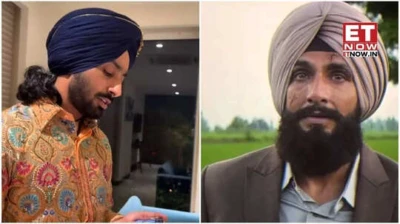

There's something unusual happening with the music of Dhurandhar 2: The Revenge. It isn't just being heard-it's being felt, reinterpreted, and quietly lived through thousands of screens.
If you've stepped into Instagram lately, chances are you've come across a reel that stops you mid-scroll, not because of visuals, but because of a line that lingers long after the video ends.
Unlike the soundtrack of the first film, this album doesn't chase scale alone. It leans into emotion-sometimes painfully so. And right at the centre of that emotional storm sits Jaiye Sajana, a track that doesn't announce itself loudly, yet ends up becoming the one you return to when everything else fades. What makes it stand out isn't just composition or performance. It's a single line-fragile, haunting, and devastatingly simple-that has turned the song into something far bigger than a film track.
The Line That Broke The Internet (And Something Within Us)
There's a moment in Jaiye Sajana where the world of the song collapses into a single thought:
Saanu sariyan visar gaiyan rahvan,
Ve kehde paase jaiye sajjna
Translated loosely, it reads like a quiet confession: when love disappears, direction disappears with it.
This isn't dramatic heartbreak. It's disorientation. The kind where nothing feels familiar anymore-not places, not people, not even yourself.
That's precisely why it has exploded across social media. With over 1.4 lakh reels already using the track, the line has found its way into:
- Breakup edits that feel almost too real
- Long-distance love stories that never quite resolve
- Grief montages that go beyond romance
- Existential reflections that have nothing to do with relationships at all
What's striking is how adaptable the line is. It doesn't belong to one kind of pain-it slips into many.
Where The Song Lands In The Film
Within the narrative of Dhurandhar 2, the song arrives at a moment that doesn't ask for attention-it demands silence. It plays against the loss of Rehman Daikat, leaving Ulfath Rehman in a space where grief isn't loud, but all-consuming. That one line becomes the emotional spine of the sequence. It isn't just about losing a person; it's about losing a sense of where life was supposed to go.
And then, almost in parallel, the film gives us Ranveer Singh's Hamza Ali Khan returning home-not as a triumphant hero, but as someone who understands that the life he left behind no longer exists for him. He doesn't knock. He doesn't enter. He simply recognises that some doors, once closed, are not meant to be reopened.
The song doesn't narrate this. It absorbs it.
What The Lyrics Really Say (Beyond Translation)
On paper, the lyrics-interpreted by platforms like Lyricsraag-speak of longing, sleepless nights, and a city that no longer feels like home. But the deeper thread running through them is restraint.
This is not a song about crying. It's about not being able to cry even when everything inside you has collapsed.
A few recurring ideas quietly shape the emotional arc:
- Love that refuses to fade, even when everything else does
- A world that continues moving, indifferent to personal loss
- The strange numbness that follows deep emotional rupture
- The inability to find 'home' again-physically or emotionally
It's this layered writing that makes Jaiye Sajana feel less like a song and more like a lingering thought you can't quite shake off.
The Sound: Where Sufi Meets Silence
Composed by Shashwat Sachdev and voiced by Satinder Sartaaj alongside Jasmine Sandlas, the track resists the usual Bollywood instinct to overwhelm. Instead, it holds back. And that restraint becomes its strength. There's a distinct Sufi undercurrent-poetic, philosophical, almost spiritual-but it's grounded in Punjabi folk sensibilities that keep it intimate rather than abstract.
The arrangement doesn't try to compete with the lyrics. It steps aside. That decision alone explains why the song travels so effortlessly beyond the film and into personal spaces-headphones, late-night playlists, quiet commutes.
Who Is Satinder Sartaaj, Really?
For many listeners discovering him through Dhurandhar 2, Satinder Sartaaj might feel like a fresh voice. In reality, he has been quietly shaping a very different musical language for years. Born as Satinder Pal Singh Saini in Punjab's Hoshiarpur district, his journey into music wasn't driven by the usual industry playbook. It unfolded slowly, almost academically.
- He pursued formal training in music, going on to complete an MPhil and PhD in Sufi singing from Panjab University
- Before mainstream recognition, he spent time teaching music, deeply rooted in its theory and philosophy
- His early global exposure came unexpectedly, when organisers in Toronto discovered his performances online and invited him to perform
From there, his rise wasn't explosive-it was steady. Songs like Sai and Udaarian built a reputation that blended poetry with melody in a way that felt rare. Performing at venues such as the Royal Albert Hall and winning honours like the Brit Asia TV Music Award only reinforced what his listeners already knew: this was an artist who wasn't chasing trends.
He was building a voice.
A Song That Opened A New Door
Following the success of Jaiye Sajana, Sartaaj acknowledged the overwhelming response with a simple note of gratitude to listeners and the film's team. But what's unfolded since then is more telling. This isn't just a viral moment. It's a crossover. For perhaps the first time, a large section of mainstream audiences-who may never have actively sought out Punjabi Sufi music-are now engaging with it, even if unknowingly.
And it all circles back to that one line. Because sometimes, it doesn't take an entire song to stay with you. Just a sentence that feels like it was written for a moment you didn't know how to explain. And suddenly, you're listening again.
Read more news like this on www.etnownews.com