
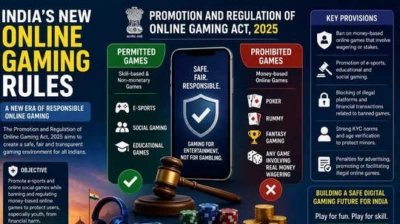

From May 1, 2026, India's online gaming landscape changed permanently. The Promotion and Regulation of Online Gaming Act, 2025, along with its accompanying rules notified on April 22, came into force yesterday and the immediate impact on the real-money gaming industry has been severe.
The new regime introduces a structured approach to governing online gaming activities, with a focus on distinguishing permissible formats from prohibited online money games while strengthening user safeguards and regulatory oversight.
The single most consequential provision of the new law is a complete nationwide ban on real-money online games. The online gaming legality law bans all online money games those where money is staked to win money. This includes fantasy sports apps, poker apps, and rummy apps for money. Hosting such games is now prohibited a crime that attracts up to three years' imprisonment and fines up to Rs 1 crore. Foreign gaming companies offering real-money games to Indian users are equally covered their platforms are liable to be blocked by the government under the new compliance framework.
The industry didn't see this coming quietly. Several major real-money gaming companies have already begun shutting down Indian operations or pivoting their product offerings. Court challenges have been filed, with the industry arguing the ban unconstitutionally restricts games of skill. As of May 1, no court had issued a stay on the law's enforcement.
What the law actually allows
The ban targets one specific category of gaming. Everything outside it e-sports, competitive gaming, and social games without real-money staking is not just permitted but actively encouraged under the new framework. The new rules provide a clear, time-bound test to classify games as either prohibited online money games or permissible social games and e-sports.
A central Online Gaming Authority will be established to handle game classification, ensure compliance, and address user complaints. For gaming companies, the regulations bring stricter oversight and operational requirements.
Operators must submit a digital application to the Online Gaming Authority with details such as the game category, revenue model, target age group, user safety measures, grievance mechanisms, and compliance information. The authority may review gameplay mechanics, payment structures, and platform architecture before granting approval.
User protections built into the framework
The rules mandate safeguards such as age-gating, time-use controls, and a structured grievance redressal mechanism. These measures are designed to address risks like gaming addiction while ensuring platforms remain accountable. Increased scrutiny at the payments layer is also expected to restrict access to offshore or exploitative platforms.
A two-level grievance redressal structure has been introduced users must first approach the service provider's internal grievance mechanism and if unresolved, complaints can be escalated to the Online Gaming Authority within 30 days, with a further appeal available to the Secretary of MeitY acting as the appellate authority.
Jobs question nobody is answering
Behind the legal arguments and compliance deadlines is a human cost that is only beginning to surface. Jobs in the real-money gaming industry developers, marketers, customer service are now illegal. Employees who stay on with these companies risk personal liability. Gaming gig workers are at particular risk as there are no employment contracts in the sharing economy.
The Act has no phased rollout and no transition arrangements it is effective from May 1 with no grace period. Companies that are winding down operations have weeks, not months, to sort out employee obligations. India's online gaming sector employed tens of thousands of people at its peak. Where those jobs go from here is a question the law, for all its detail, does not answer.
Read more news like this on www.etnownews.com