
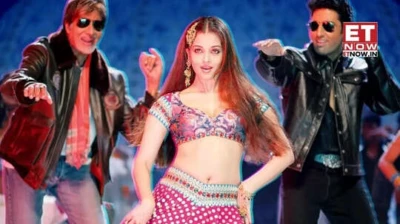

There are songs that fade with time, and then there are songs that quietly settle into memory and refuse to leave. Kajra Re from the 2005 film Bunty Aur Babli belongs firmly to the latter.
Nearly two decades on, its rhythm still plays at weddings, its hook line still slips into conversations, and its poetry continues to be unpacked. At the heart of this enduring charm lies Gulzar, a writer who rarely wastes a word and almost never writes without layers. What sounds playful on the surface often carries history, geography, and emotion beneath it. One such line that has intrigued listeners for years is "Balli Maran se Daribe talak, teri meri kahani Dilli mein." It feels intimate, almost like an inside reference. But what exactly is Gulzar saying here, and why does this line matter so much?
To understand it, you have to step into Old Delhi, not as a tourist, but as someone willing to get lost in its lanes.
Why did Gulzar choose Ballimaran and Dariba Kalan?
Gulzar's relationship with Delhi has always been poetic rather than literal. He does not just describe the city, he distils it. In this line, he picks two very specific locations: Ballimaran and Dariba Kalan, both tucked inside the labyrinth of Chandni Chowk.
Ballimaran is not just another crowded lane. It is where Mirza Ghalib once lived, and where echoes of classical Urdu poetry still seem to linger in the air. Dariba Kalan, on the other hand, has been a jewellery hub since Mughal times, known especially for its silver market. These are not random dots on a map. They carry memory, culture, and a sense of lived history.
By placing his lovers' story between these two points, Gulzar is doing something subtle. He is anchoring romance within a space that already breathes poetry. It is almost as if the love story borrows legitimacy from the city's past.
Is this line about geography or something deeper?
On the surface, the line maps a short physical stretch in Old Delhi. But poetry rarely stops at geography. Think of how we say "from Kashmir to Kanyakumari" to describe the whole of India. Gulzar uses "Ballimaran to Dariba" in a similar way, but on a more intimate scale. What he is really suggesting is this: Their love story exists everywhere within Delhi. It is not confined to one moment or one street. It spills across the city, from one end of Old Delhi to another.
There is also a second layer. Old Delhi is chaotic, dense, noisy, and deeply personal. Love stories here are rarely grand gestures. They are hidden in glances, in narrow alleys, in shared silences. By choosing this setting, Gulzar turns the romance into something lived rather than performed.
What does "Kajra Re" itself symbolise?
The opening line, "Kajra re kajra re, tere kare kare naina," draws from the imagery of kohl-lined eyes. The word "kajra" is rooted in folk traditions, particularly from the Braj region, where dark, expressive eyes are often compared to those of Lord Krishna. Gulzar uses this imagery to elevate something simple into something evocative. The heroine's eyes are not just beautiful. They are magnetic, almost dangerous. They disrupt peace, create chaos, and pull the lover in without warning. There is a quiet cultural continuity here. Folk poetry meets mainstream cinema, and the result feels both rooted and modern.
What does "aankhon ki siyahi se likhe vaade" mean?
One of the most striking lines in the song speaks of promises written with kohl reaching through the eyes. It sounds abstract, but it is deeply relatable. In poetry, eyes often carry what words cannot. You may hide your feelings, deny them even, but your eyes tend to give you away. Gulzar builds on this idea. If the heart is a book, then kohl becomes the ink. And the eyes become the page where everything is written, whether you want it to be or not.
It is a reminder that emotions rarely stay hidden. They travel, often silently, from one person to another.
Why does Gulzar mention a yawn in a love song?
Perhaps the most unexpected metaphor in the song is the mention of a yawn. "Ho meri angdaai na toote tu aaja." It sounds almost playful, but it carries a deeper meaning. The yawn here represents a dreamlike state. The heroine is suspended between reality and longing, as if she is dreaming of love but fears waking up before it is fulfilled.
By asking her lover to arrive before the yawn breaks, she is really saying: come before this moment ends, before this feeling fades, before this dream dissolves into ordinary life. It is classic Gulzar. He takes something mundane and turns it into something unexpectedly tender.
Did you know these lesser-known facts about Kajra Re?
- The song was composed by Shankar-Ehsaan-Loy, whose fusion style gave the track its distinctive energy.
- It was performed by Alisha Chinai along with Shankar Mahadevan and Javed Ali.
- The on-screen trio of Aishwarya Rai Bachchan, Abhishek Bachchan, and Amitabh Bachchan added to its cultural impact, making it one of the most recognisable dance numbers of its time.
Why does the song still feel fresh after all these years?
Because it is not just a song. It is a collage of longing, flirtation, poetry, and place. Gulzar does not merely describe love. He situates it within memory, within language, within a city that feels alive. The brilliance of "Balli Maran se Daribe talak" lies in its specificity. It does not try to be universal in an obvious way. Instead, it becomes universal precisely because it is so rooted in one place. And that is perhaps why, even today, when the song plays, it does not feel dated. It feels like a quiet walk through Old Delhi, where every corner holds a story, and somewhere between two lanes, someone is still falling in love.
Read more news like this on www.etnownews.com