
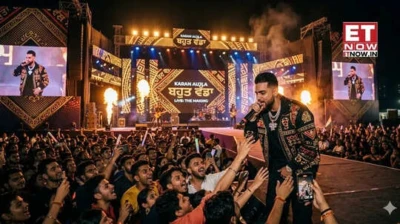

Why concerts are getting cancelled in India: The cancellation of a major concert today no longer feels like an isolated mishap. It has become part of a wider global pattern.
From Karan Aujla facing concert disruptions to controversies around events involving Ye and international tours by artists such as Shakira seeing schedule changes across markets, the live entertainment industry is increasingly proving vulnerable to forces far beyond the stage. Film release calendars are also becoming more unpredictable, with studios delaying projects and shifting dates in response to mounting global and domestic pressures.
India's entertainment ecosystem may be booming on the surface, but beneath the sold-out arenas, rising ticket prices and blockbuster announcements lies an industry grappling with volatility. The broader entertainment economy, including live events, concerts and theatrical releases, is now estimated to be worth around Rs 10,000 crore. Yet insiders say that growth has exposed the business to greater risk than ever before.
India's Rs 10,000 Crore Entertainment Economy Faces Growing Volatility
According to Mohit Bijlani, Founder of Team Innovation, the recent spate of concert cancellations is not an isolated trend but a reflection of a deeper systemic issue. "I don't view concert cancellations as an isolated incident. They're a reflection of how complex and globally exposed this business has become," he says. Bijlani notes that India's emergence as a serious destination on the international touring circuit has brought both prestige and vulnerability. "When global artists perform here, it validates both the scale and appetite of the market. But it also means we're now directly tied to global volatility which is currency fluctuations, rising freight costs, visa challenges and even geopolitical uncertainty. What happens thousands of miles away can determine whether a show in Mumbai or Delhi goes ahead."
That global exposure has transformed the economics of organising concerts. What audiences often perceive as glamorous, high-margin events are in fact financially precarious operations. "What many people don't realise is that putting together a concert today is essentially managing a high-risk financial structure," says Bijlani. "We're often paying international artists in dollars while earning in rupees, so even small exchange rate movements can significantly impact margins." He adds that the break-even threshold for major concerts has risen sharply due to escalating costs across staging, sound, logistics, security and compliance. "The break-even point today is far higher than it was even a few years ago."
Why Ticket Prices Have Soared But Demand Remains Unpredictable
These rising costs have fundamentally changed ticket pricing. Fans who once considered Rs 2,000 premium for a concert ticket are now routinely seeing entry-level prices begin at Rs 7,000 for major arena shows. But according to Bijlani, higher prices have made demand less predictable rather than more secure. "Ticket prices have increased significantly to keep up with costs, but that has also made demand more unpredictable. A Rs 2,000 ticket once felt premium; today, large-format shows often start at Rs 7,000 and go much higher. Audiences are more selective, they wait longer to buy and sales cycles have become volatile while most of our costs remain fixed upfront."
Even sponsorship, long seen as a safety cushion for promoters, no longer offers the same security. Brands have become more demanding and selective in how they deploy their marketing budgets. "Sponsorship, which used to act as a financial cushion, is also evolving. Brands today are far more outcome-driven where they want measurable returns, deeper integrations and digital amplification. Deals take longer to close and sometimes don't come through in time to meaningfully de-risk a show," Bijlani explains.
Layer global instability on top of these economics, and the entire model becomes increasingly fragile. Freight bottlenecks, insurance hikes, airline shortages and geopolitical tensions can all derail touring schedules. "Supply chains are still not fully stable post-pandemic. Insurance premiums have risen. Artist routing is affected by geopolitical tensions. Even something as indirect as airline availability or freight delays can disrupt timelines enough to make a show unviable. And when one piece slips, the entire structure can unravel quickly," he says.
This same fragility is now affecting the film business. Big-budget films increasingly rely on international post-production pipelines, VFX vendors, overseas shoots and synchronised global release strategies. Delays in one part of the chain can push back entire release calendars. In many cases, the forces affecting concert cancellations and film postponements are fundamentally similar: global dependence, rising costs and shrinking room for error.
Bijlani is clear that concert cancellations are rarely caused by one single mistake. "Concerts don't get cancelled because of one bad decision. When a show falls apart, it's usually the final crack in a system already under pressure. And right now, that system is more fragile than it appears from the outside." He notes that several factors often converge simultaneously-regulatory delays, logistical setbacks, weak ticket sales, artist concerns and local objections. "There are multiple factors that can force a cancellation, many of which are beyond a promoter's control."
Regulatory unpredictability remains one of the industry's biggest structural pain points. "Permissions that seem on track can get delayed or even denied at the last minute due to local compliance issues or administrative changes. In some cases, events face petitions or objections from third-party groups citing socio-political or cultural concerns, which can stall or shut down a show entirely," Bijlani says.
He also points out that artists themselves are becoming more commercially data-driven when assessing tour viability. "International and even domestic artists today are highly data-driven in their touring decisions. If ticket sales don't align with their expected draw or brand positioning, there can be pressure to reassess or withdraw. These are difficult conversations, but they're part of the commercial reality of the business."
When a concert is cancelled, the damage extends far beyond disappointed fans. "Promoters absorb immediate financial hits which include artist deposits, marketing spends, operational costs but the ripple effects go much further," Bijlani explains. He adds that local economies suffer too, with hotels, transport providers and food businesses losing out on significant event-driven demand. "Vendors, from stage crews to sound engineers, lose critical income. Artists risk losing momentum and fan goodwill. And audiences lose trust, which is far harder to rebuild than revenue."
The reputational fallout has become even more severe in the social media era, where cancellations spark instant outrage online. According to Jashoda Madhavji, Founder of Dream N Hustle Media, concert cancellations have evolved into major trust and brand-management crises. "From a PR and marketing standpoint, concert cancellations have evolved beyond operational disruptions as they've become defining moments for how brands and organisers build and protect trust," she says. "When a major event is called off, the fallout is immediate and emotional. Fans are disappointed, brand partners worry about lost visibility, and the narrative can quickly turn negative in a hyper-connected social media environment."
Sponsorship Is No Longer The Safety Net It Once Was
Madhavji says the reputational cost can often outweigh the financial damage. "The impact goes beyond a single event as credibility is at stake for organisers, sponsors and everyone associated. Campaign momentum stalls, media investments are difficult to recover and the reputational cost, while intangible, is significant."
As a result, the industry is being forced to adopt more transparent communication strategies. "There is a visible shift from narrative control to proactive transparency," Madhavji notes. "Clearly explaining the reasons, whether safety concerns, logistical challenges or broader global disruptions, helps reposition the decision as responsible rather than reactive. In this environment, honesty isn't optional; it's expected. How a cancellation is handled can matter just as much as how an event is promoted."
She stresses that crisis management today is about much more than issuing a statement. "Fans don't just miss a show-they lose anticipation, money and often personal plans tied to the experience. Any response, therefore, needs to acknowledge this emotional investment first. Communication must be immediate, clear and human and never delayed or overly corporate."
Execution after the cancellation is equally critical. "Refunds or rescheduling plans need to be communicated clearly and executed efficiently, as this is where audience goodwill is often won or lost. Delays or ambiguity at this stage can do more damage than the cancellation itself," Madhavji says. She adds that direct communication from artists can help preserve trust. "A personal message from the artist can further humanise the situation and rebuild connection."
Can Industry Disruption Lead To A Stronger Entertainment Ecosystem?
Despite the challenges, both experts believe this period of disruption could ultimately strengthen the entertainment business. Madhavji says the industry is being pushed towards a more mature and sustainable model. "The industry is being pushed to mature, operate with greater transparency, and build more sustainable connections with its audience."
Bijlani echoes that sentiment, arguing that the Indian live entertainment business is evolving rather than collapsing. "The Indian live entertainment industry is maturing. We're becoming more disciplined about risk, building more robust sponsorship models and investing in homegrown talent so we're not overly dependent on international tours."
Still, he warns that unless structural problems are addressed, cancellations and delays will remain part of the business. "The demand for live experiences in India is real and it will only grow. But unless we address the underlying economics such as cost volatility, infrastructure gaps, policy inconsistencies, and risk allocation we will continue to see high-profile cancellations."
His final warning is perhaps the starkest summary of the industry's current reality: "And each one will cost far more than just a night of music."
Read more news like this on www.etnownews.com