




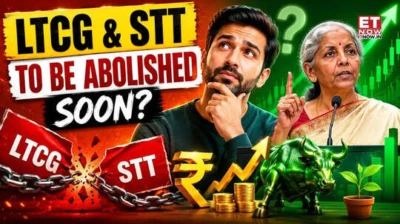

LTCG and STT: Ace investor Vijay Kedia has written to Finance Minister Nirmala Sitharaman with a set of suggestions aimed at strengthening India's capital markets, including a proposal to abolish long-term capital gains (LTCG) tax on listed equities.
ET Now asked Finance Minister Nirmala Sitharaman whether the government is considering a review of equity taxation. The FM said the government is open to hearing investor concerns regarding stock market taxation. Speaking to ET Now, she further confirmed that the government has already received representations on issues related to equity taxation.
The remarks come amid weak market returns, persistent FPI selling, and rising debate around LTCG and STT. Investors and market participants are closely watching for possible policy signals going forward. Here's what it means for investors.
What is STT?
The Securities Transaction Tax (STT) on derivatives was increased, effective April 1, 2026. In the 9th budget speech, as part of the amendments made to the Finance (No. 2) Act, 2004, under Budget 2026, Finance Minister Nirmala Sitharaman had proposed higher rates for futures and options trading.
During the Budget speech, the Finance Minister said, "I propose to raise the STT on futures to 0.05 per cent from the present 0.02 per cent. STT on options premium and exercise of options are both proposed to be raised to 0.15 per cent from the present rate of 0.1 per cent and 0.125 per cent, respectively."
STT is a transaction-based tax levied on the purchase or sale of specified securities traded on recognised stock exchanges.
It is not based on profit or income. Instead, it is levied at the very moment a transaction takes place. This tax is automatically collected by the exchange or intermediary and deposited with the government.
STT liability depends on the transaction, including equity purchase -- buyer pays, equity sale -- seller pays, options premium-- seller pays, options exercise -- buyer pays and futures-- seller pays.
The Securities Transaction Tax (STT) on derivatives increased effective April 1, 2026, which changes the rate from the old rate of 0.02% to a new rate of 0.05%, while the rate for options shifts from the previous 0.1% to a revised 0.15%.
Read more: Vijay Kedia writes to FM Nirmala Sitharaman, suggests capital market reforms, LTCG changes - FULL text of ace investor's X post
What is LTCG?
Long-term capital gains (LTCG) arise from the sale of stocks, properties, etc., held longer than 24 months. 12.5% tax is applicable on long-term capital gains.
The Union Budget 2026 retained the Long-Term Capital Gains (LTCG) tax structure without making any adjustments to the current rates or exemption thresholds, meaning that the prevailing framework remains fully in effect, with equity LTCG taxed at a rate of 12.5%.
LTCG and STT to be abolished soon? What it means for investors
In his letter, Kedia argued that long-term investors should be viewed as providers of patient risk capital rather than speculators. According to him, investors who stay invested in businesses for years help companies expand, generate employment, innovate and contribute to India's economic growth.
Kedia said India needs significantly higher levels of long-term capital to build world-class companies, infrastructure and global champions. He argued that tax policies should encourage households to shift savings from passive assets such as gold into productive businesses that create jobs, generate revenues and build national wealth.
India needs more patient capital, more entrepreneurship and more long-term investing. Abolishing long-term capital gains tax on listed equities would be a powerful step in that direction.
LTCG and STT to be abolished soon? Key points raised during discussion
1. Growing concern among retail investors
Small and retail investors across the country are worried because the stock market has yielded negative returns over the past year.
2. Demand for a taxation review
Market experts and veteran investors strongly believe that the government needs to re-evaluate the current tax structure, specifically looking into LTCG and other transactional taxes to help stabilise investor sentiments.
The Finance Minister's response
When asked if the government is willing to listen to the grievances of both large and small investors regarding the taxation system, Finance Minister Nirmala Sitharaman responded directly in English:
"On this issue and on any other issue, we are always ready to hear and listen to people. We will take their inputs."
Also read: Life Insurance in India: Is industry ready for Gen Z? Kotak Life Insurance's Manish Alagh EXPLAINS
Read more news like this on www.etnownews.com