




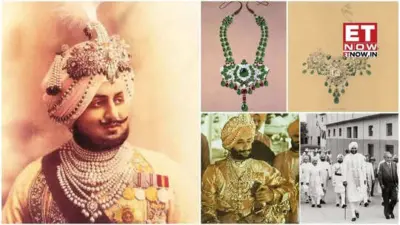

Maharaja Bhupinder Singh History: There are some stories from India's princely past that feel almost cinematic-too grand, too layered, too dazzling to belong to a world that no longer exists.
Among them, few shine as brightly as the legacy of Maharaja Bhupinder Singh and the legendary Patiala Necklace-an extraordinary creation by Cartier that redefined what royal luxury could look like.
At a time when Indian princely states operated under British rule yet retained their cultural authority, jewels became more than adornment-they were declarations. And this particular necklace, commissioned in 1928, did not whisper wealth; it announced it with breathtaking clarity. Nearly a century later, its story-of opulence, disappearance, and partial rediscovery-continues to fascinate historians, collectors, and anyone drawn to the theatre of royal India.
Maharaja Bhupinder Singh History: A necklace that changed the rules of luxury
When Bhupinder Singh approached Cartier, he did not arrive with a vague idea or a modest brief. Instead, he brought with him chests filled with precious stones from his treasury-diamonds, rubies, and gems accumulated over generations. What he wanted was not jewellery. He wanted a statement that would rival the greatest treasures of Europe. The result was the Patiala Necklace-Cartier's largest single commission to date. It took nearly three years to complete and featured close to 3,000 diamonds, arranged in cascading geometric patterns that reflected both Indian grandeur and European craftsmanship.
At its heart sat the showstopper: the 234.65-carat De Beers diamond, one of the largest diamonds ever recorded at the time. Roughly the size of a golf ball, it gave the necklace a presence that was impossible to ignore. Contemporary accounts even suggest that when worn during royal processions, its brilliance could be seen from a distance, glinting under the sun as elephants carried the Maharaja through ceremonial routes.
Did you know?
At the time of its creation, the necklace was considered so elaborate that even seasoned European jewellers regarded it as a once-in-a-lifetime masterpiece.
Maharaja Bhupinder Singh History: Jewellery as power in a colonial world
The early 20th century was a complicated period for Indian royalty. While princely rulers retained ceremonial authority, British oversight often curtailed their political power. In such a landscape, visual symbols-especially jewels-became powerful tools of assertion.
The Patiala Necklace was not merely decorative; it was strategic. It conveyed that Indian rulers were not just wealthy but culturally formidable. It bridged two worlds-Indian opulence and European design-and in doing so, subtly challenged colonial hierarchies. In essence, the necklace served as a form of diplomacy, expressed through diamonds.
The disappearance that still puzzles historians
For all its grandeur, the Patiala Necklace's story took a mysterious turn after Indian independence. As princely states merged into the Indian Union, royal treasuries underwent upheaval, dispersal, and in many cases, quiet loss. The necklace vanished sometime after 1948, leaving behind more questions than answers. Decades later, fragments of it were discovered in a second-hand jewellery shop in London-an almost unbelievable twist that revived interest in its legacy. Cartier painstakingly reconstructed a version of the necklace using surviving pieces, but its most iconic element-the De Beers diamond-was never recovered.
A part of the original treasure, the Patiala Choker, resurfaced years later and was auctioned at Christie's in New York in 2019 for nearly a million dollars, offering a rare glimpse into what once was.
The man behind the magnificence
To understand the necklace, one must also understand Bhupinder Singh himself. He ruled Patiala from 1900 to 1938 and quickly built a reputation as one of India's most flamboyant and forward-looking monarchs. Patiala's prosperity had roots in its loyalty to the British during the Revolt of 1857, which earned it political favour and economic advantage. By the time Bhupinder Singh took the throne, the state was among the richest in India-and he embraced that wealth with unapologetic flair.
- He is widely believed to have owned one of India's earliest private aircraft as early as 1910
- His polo teams competed internationally, placing Patiala firmly on the global sporting map
- His wardrobe was as carefully curated as his court-layered with pearls, diamonds, sarpechs, and intricate turban ornaments
He did not merely live like a king; he performed kingship.
A royal obsession with jewels
Bhupinder Singh's fascination with jewellery extended beyond a single necklace. During a visit to Paris, he famously carried boxes of gemstones to leading jewellers, commissioning over a hundred pieces in one go. Among these was the striking Patiala Ruby Choker-crafted in layers and later gifted to Maharani Bakhtawar Kaur. This piece, much like the larger necklace, resurfaced decades later, once again igniting interest among collectors and historians.
Another lesser-known yet fascinating creation linked to the Patiala court was the Royal Family Order, designed by Garrard & Co.. Featuring blue enamel and inscriptions in Gurmukhi, it symbolised a unique blend of Sikh identity and European courtly traditions.
The women who shaped Patiala's legacy
Behind the spectacle of jewels and royal processions stood women who played significant roles in diplomacy, governance, and cultural continuity. Maharani Bakhtawar Kaur represented Patiala at major imperial events and famously presented a jewel to Queen Mary at the Delhi Durbar of 1911-a moment rich in symbolism. Later, Maharani Mehtab Kaur carried forward the legacy during a time of transition, focusing on social initiatives and philanthropy after the princely era had formally ended. Their influence ensured that Patiala's story was not just one of wealth, but also of continuity and adaptation.
The last Maharaja and a changing India
After Bhupinder Singh's death, his son Yadavindra Singh inherited both immense wealth and a rapidly transforming political landscape. Unlike many princely successors, he embraced change. He played a key role in integrating Patiala into the Indian Union in 1948 and later served as Rajpramukh of PEPSU. His contributions to Indian cricket-through patronage and infrastructure-also had a lasting effect on the sport. His era marked the shift from royal authority to public service-a transition that defined the fate of many princely families in independent India.
What remains today: legacy, loss and identity
The story of the Patiala Necklace mirrors a broader reality faced by former royal families in India today. Without state patronage or royal privileges, maintaining vast estates and preserving heritage has become a complex challenge.
- Many heirlooms have been lost, sold, or fragmented over decades due to legal and financial pressures
- Palaces and properties now require innovative models-heritage hotels, museums, or private trusts-for survival
Yet, despite these challenges, the descendants of these families continue to safeguard their history-through archives, storytelling, and cultural engagement.
There is something undeniably compelling about the Patiala legacy. It is a story of excess, yes-but also of transformation. From the dazzling presence of a 234.65-carat diamond to its unexplained disappearance, from royal courts to modern India, it captures a world constantly in flux. Perhaps that is why it endures. The Patiala Necklace is not just a piece of jewellery; it is a reminder that history, much like a diamond, refracts light differently depending on how you look at it. And somewhere in that shifting light lies the enduring allure of a kingdom that once measured power not just in land or armies-but in brilliance.
Read more news like this on www.etnownews.com