
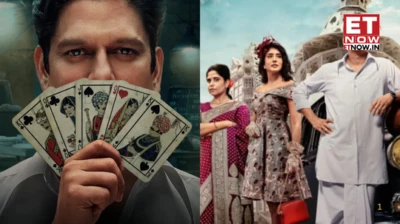

There is a particular kind of ambition that flourishes in the gaps - in the spaces between what the law permits and what human desire demands.
In 1960s Bombay, one of those gaps was wide enough to swallow an entire city. Matka King, the upcoming Prime Video series starring Vijay Varma, arrives on April 17, and its trailer suggests that the show understands exactly what made that era so volatile, and so compelling.
The trailer dropped this week, and it does what the best teasers for period dramas should do - it places you somewhere specific. Bombay in the sixties was a city in motion, shedding its colonial skin and reaching for something newer, louder, and considerably more dangerous. It is against that backdrop that Brij Bhatti, a cotton trader with larger appetites than his trade can satisfy, decides to take a chance on something that will eventually take on a life entirely its own.
The Man at the Centre
Vijay Varma has spent the better part of the last several years building one of the more interesting careers in contemporary Hindi streaming content. From Dahaad to Mirzapur, he has demonstrated a particular gift for characters who operate in moral grey zones without ever becoming cartoons. Brij Bhatti appears to be his most ambitious role yet, a man whose singular idea grows into a nationwide gambling network called Matka, pulling in everyone from street-level players to the most powerful figures in the city.
Varma spoke about the experience of building the character from the ground up. He described working in a historical period he had never previously explored as both challenging and deeply fulfilling, and credited directors Nagraj Manjule and Abhay Koranne with giving him the creative freedom to inhabit Brij's world fully rather than simply perform it. For an actor who has consistently pushed against the limits of what commercial streaming allows, that kind of creative latitude clearly mattered.
What the trailer captures is a man in transformation, not a villain fully formed, but someone becoming one gradually, driven by a desire for respect as much as wealth. That distinction is what separates genuinely interesting crime drama from the kind that simply celebrates its protagonist's brutality.
The Women Who Refuse to Be Peripheral
One of the more striking aspects of the trailer is the weight given to its female characters. In lesser hands, a story about a man building an empire tends to reduce the women around him to decorative background. Matka King appears to be making a deliberate choice in the opposite direction.
Kritika Kamra, who has spent years in the industry without quite finding the vehicle that matches her range, describes her character as unlike anything she has previously attempted. She spoke about the opportunity to explore a woman defined by her own choices, ambitions, and resilience, a character whose inner life the show takes seriously rather than subordinating to the male lead's journey.
Sai Tamhankar's contribution may be the most intriguing of all. Her character Barkha is introduced superficially as a middle-class housewife, the exact archetype that period dramas tend to use as wallpaper. Tamhankar pushed back firmly on that reading. Barkha, she said, is a forward-thinking and independent woman who is not walking in her husband's shadow but actively carving her own path. In a show set in an era when that kind of independence was genuinely difficult for women to claim, that characterisation carries real dramatic weight.
Nagraj Manjule Behind the Camera
The director's chair for Matka King belongs to Nagraj Popatrao Manjule, a filmmaker whose Marathi-language work, particularly Fandry and Sairat, established him as one of the most socially perceptive voices in Indian cinema over the last decade. His transition to a large-scale Hindi streaming production is itself a story worth following.
Manjule framed the show as something beyond conventional period crime drama. He described Brij Bhatti as a man fighting for respect as much as success - someone whose ambition is rooted in a desire to be seen and counted rather than simply to accumulate. That reading of the character adds a layer of social commentary to what might otherwise be a straightforward rise-and-fall narrative. The attention to period detail - interiors, costumes, props, and lighting all calibrated to the 1960s - suggests a production that took the setting seriously as more than mere aesthetic backdrop.
The Ensemble Around the Lead
Beyond the three principal actors, the cast includes Siddharth Jadhav, Bhupendra Jadawat, and Gulshan Grover - the last of whom brings decades of experience playing figures who inhabit exactly the kind of dangerous world Matka King is depicting. A supporting ensemble of this calibre rarely assembles itself around a project without good reason, and the breadth of talent on display here is one of the stronger signals that the show has something substantial to offer.
The series was created and written by Abhay Koranne, produced through a collaboration between Roy Kapur Films, Aatpat, and SMR Entertainment, and will stream on Prime Video across India and more than 240 countries and territories from April 17.
Why This Story, Why Now
The real Matka gambling network that swept through Bombay and eventually across much of India is one of those chapters of post-independence history that has been referenced frequently but rarely examined with genuine depth. It was a system born from a simple idea - betting on the opening and closing rates of cotton traded on the New York Cotton Exchange - that mutated into something vast, interconnected, and deeply embedded in the social fabric of working-class urban India.
At its peak, Matka was not simply a gambling operation. It was an informal financial ecosystem that gave ordinary people - people with no access to stock markets or formal investment vehicles - a way to participate in something that felt like economic agency, however illusory that agency ultimately was. The men who ran it were not simply criminals in the conventional sense. They were, in many cases, neighbourhood figures who provided credit, settled disputes, and occupied a social role that the formal economy had no interest in filling.
That complexity is what makes the story worth telling properly. Whether Matka King has the patience and the courage to sit with that complexity rather than flatten it into a more familiar gangster arc is the question the trailer raises without fully answering. The cast, the director, and the subject matter all point toward something ambitious.
April 17 will tell the rest of the story.
Read more news like this on www.etnownews.com