
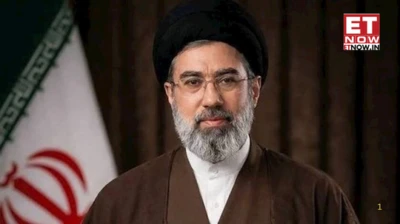

Iran has always been a state built on layers. The Supreme Leader sits at the top, but beneath that singular title lies an intricate web of institutions, commanders, clerics, and councils with each holding a piece of the country's vast machinery of power.
For decades, that architecture functioned with Ali Khamenei as its anchor. Now, with his son and successor Mojtaba reportedly incapacitated in the holy city of Qom, that same architecture is being tested in ways its designers may never have fully anticipated.
The Islamic Republic, by design, was never meant to depend on any single person. What is becoming clear in the weeks since the February 28 airstrike is that this design may be the regime's greatest strength and its most dangerous uncertainty.
The Situation at the Top
Intelligence memos cited by The Times, believed to draw on American and Israeli sources shared with Gulf allies, paint a stark picture. Mojtaba Khamenei, 56, is reportedly unconscious and receiving treatment in Qom, approximately 140 kilometres south of Tehran. The document states he is unable to participate in any governmental decision-making, raising a question that cuts to the heart of Iran's political structure: if the Supreme Leader cannot lead, who does?
Iranian authorities have insisted repeatedly that Mojtaba remains in charge. Yet since the war began, he has not appeared publicly in any verified form. Two statements attributed to him have been read on state television by presenters, not by the man himself. An AI-generated video purporting to show him entering a military command room was released earlier this week, a move that prompted more questions than it answered. No live recording of his voice has been released to date.
Russia's ambassador to Iran offered perhaps the most candid outside assessment, telling broadcaster RTVI that the new Supreme Leader is in the country but avoiding public appearances for what he called "understandable reasons." Coming from Moscow, which has deep and current ties to Tehran, those two words carried considerable weight.
Five Men Who May Hold the Real Power
In the absence of a functioning Supreme Leader, Iran's institutions have not collapsed and they have simply continued operating under the individuals who run them. And those individuals, taken together, represent some of the hardest-line, militarised, and internationally sanctioned figures the Islamic Republic has produced.
Mohammad Bagher Ghalibaf - Parliament Speaker
If there is one figure currently engaging most visibly with the outside world on Iran's behalf, it is Ghalibaf. A career IRGC officer who rose through its Air Force before taking command of the national police, he has been leading negotiations with Washington, a remarkable position for a man whose history includes overseeing the violent suppression of the1999 student protests, a period he has spoken about without regret.
As Tehran's mayor for over a decade, his tenure was marked by corruption scandals involving the diversion of municipal resources to IRGC-linked entities. In the current conflict, he has been publicly resistant to compromise, stating that Iran has no interest in a ceasefire and intends instead to strike back harder. That he is simultaneously the man talking to American officials reveals something important about the nature of those talks.
Mohammad Bagher Zolghadr - Supreme National Security Council Chief
The SNSC is where Iran's military strategy, intelligence operations, and foreign policy formally converge. Zolghadr, a veteran IRGC commander, now heads it. His career stretches back to the early construction of Tehran's extraterritorial proxy network and the architecture that eventually became the Quds Force who later served as IRGC deputy commander-in-chief for nearly a decade.
He carries sanctions from the United Nations, the European Union, the United Kingdom, and Canada. The UN designated him in 2007 specifically for links to Iran's nuclear and missile programs. Canada added him in 2022 for gross human rights violations. In a functional sense, he may currently be the single most powerful decision-maker in Iran's military and security apparatus.
Ahmad Vahidi - IRGC Commander
Vahidi commands the Islamic Revolutionary Guard Corps, the force that is both prosecuting the current war and maintaining internal order. His record is among the most troubling of any active commander in the region. He carries an INTERPOL red notice for alleged involvement in the 1994 bombing in Buenos Aires that killed 85 people. He has also been linked to the 1983 Beirut barracks attack that killed 241 American servicemembers.
As Iran's interior minister during more recent protests, he oversaw internet blackouts and directed security forces against demonstrators - actions that earned him fresh US sanctions in 2022. He is now the man directing both the war effort abroad and the suppression campaign at home.
Gholam-Hossein Mohseni-Ejei - Judiciary Chief
Following Ali Khamenei's death, Ejei sat on the three-member interim leadership council that governed Iran until Mojtaba's appointment. That alone underlines his institutional weight. As chief justice since 2021, he oversees a judicial system that has accelerated executions significantly under his tenure. Protesters detained during recent unrest have faced public hangings, a course of action he had explicitly threatened in advance.
His earlier role as intelligence minister during the 2009 protests brought him sanctions from the United States, the United Kingdom, and the European Union for overseeing arbitrary arrests and the torture of detainees. He remains one of the regime's most powerful enforcers of internal discipline.
Ahmad-Reza Radan - Law Enforcement Command Chief
Radan commands the forces most directly confronting ordinary Iranians daily. Since the current conflict began, his forces have arrested more than 500 people in addition to the over 21,000 detained during the earlier twelve-day war period. He has warned publicly that his officers have their "fingers on the trigger", a statement directed at potential demonstrators.
He carries sanctions from the United States, the European Union, the United Kingdom, Canada and Australia, a range that reflects both the duration and consistency of concerns about his conduct. His role is not strategic in the military sense but in many ways more immediately consequential: he controls the streets.
The IRGC Question
Running beneath all of these individual figures is a broader institutional reality. The Islamic Revolutionary Guard Corps is not simply Iran's military, it is a political force, an economic empire, and an ideological apparatus rolled into one. With the Supreme Leader incapacitated and formal governance in a state of ambiguity, the IRGC's operational autonomy becomes more significant with every passing week.
The Associated Press has reported that Iran's military branches are currently functioning without a clearly unified central command structure. That observation has major implications for any ceasefire negotiations, hardline factions within the IRGC may not feel bound by agreements reached by more pragmatic officials, and their capacity to act independently of any diplomatic framework remains intact.
The Funeral That Has Not Happened
One of the more telling signals of the regime's current fragility is the delay in burying Ali Khamenei himself. Iranian authorities have cited the expectation of enormous crowds as the reason for postponement, a plausible explanation, though one that sits awkwardly against Shia tradition, which strongly favours prompt burial after death.
Intelligence reports indicate that his body is being prepared for interment in Qom, with construction underway for a large mausoleum designed to hold multiple graves. The scale of that mausoleum and the diplomatic memo's suggestion that Mojtaba Khamenei could himself be buried there, points to a regime managing possibilities that officials publicly refuse to acknowledge.
There are also security considerations. The 1989 funeral of Ayatollah Khomeini drew millions and became chaotic in ways the regime struggled to contain. The current leadership appears determined not to repeat that experience, particularly during an active war.
What Washington Is Saying
The United States has not been subtle about its doubts. President Trump stated publicly that Mojtaba Khamenei had either died or was in serious condition, a claim Iran rejected. Negotiations between Washington and Tehran are reportedly being conducted not with the Supreme Leader but with other officials, which implicitly acknowledges the questions surrounding Mojtaba's capacity to engage.
Secretary of State Marco Rubio described Iran's leadership trajectory before the Senate Foreign Relations Committee as an "open question", diplomatic language for a situation that nobody in Washington appears to fully understand.
The Regime's Built-In Resilience
Perhaps the most important thing to understand about the current situation is that the Islamic Republic was specifically designed to outlast any individual leader. Its institutions, the IRGC, the judiciary, the SNSC, the parliament, and the internal security apparatus - do not require a functioning Supreme Leader to continue operating. They require only that no single institution challenge another's domain too directly.
That balance is currently being maintained, at least on the surface. Whether it holds depends on how long the uncertainty at the top continues, how the war develops, and whether the Iranian population - already deeply sceptical of the regime, finds an opening in the confusion.
With Mojtaba Khamenei reportedly unconscious in Qom, power has quietly shifted to a network of hardliners, military commanders, and judiciary chiefs, many of them sanctioned by Western governments. For now, Iran is being run by committee, even if no one in Tehran will say so out loud.
Read more news like this on www.etnownews.com