
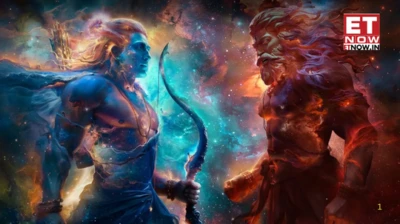

The city of Burbank is not easily impressed. It is, after all, the backyard of Hollywood - a town built on spectacle, where even jaded industry veterans have seen everything twice.
So when a screening room fell completely silent watching a 2-minute, 38-second teaser for an Indian film, it meant something.
That film was Ramayana.
Attendees who caught the preview ahead of the official April 2 unveiling described the experience in terms that felt almost involuntary, less like film criticism, more like confession. One viewer wrote on Instagram that a single shot of Ram sitting in a boat, slowly turning as his name is called, brought tears to her eyes. "Whether from joy or a sense of belonging," she wrote, "I just felt it." That is the weight Nitesh Tiwari has chosen to carry. And by all early accounts, he is not buckling under it.
The Director Who Earned the Right
Nitesh Tiwari is not an accidental choice for a project of this magnitude. The man who gave India Dangal and Chhichhore, films that understood how to make the personal feel universal, has spent years quietly preparing for this. Where others might have rushed the mythology onto screen, Tiwari has treated the source material with the seriousness of a scholar and the instincts of a storyteller.
Produced by Namit Malhotra's Prime Focus Studios in partnership with Yash's Monster Mind Creations, Ramayana is not being positioned as just a film. It is being built as a cultural event - one that the makers believe belongs not just to India, but to the roughly two billion people worldwide for whom the Ramayana is a living text, not a historical curiosity.
At the Los Angeles Q&A, attendees noted how grounded both Malhotra and Tiwari appeared despite the enormity of the production behind them. That groundedness, one suspects, is what has kept this ship steady through what must have been an extraordinarily complex shoot.
The Cast: Ambition Made Flesh
No single decision about this film has been more scrutinised than the casting of Ranbir Kapoor as Lord Ram. The discourse was inevitable. Ram is not merely a character but a moral ideal, a civilisational anchor. Choosing a contemporary actor for the role invites comparison not just with previous screen portrayals but with something far older and more deeply felt.
Kapoor appears to have understood the assignment at a level beyond performance. At the Los Angeles event, when greeted by an audience member, he responded simply with Jai Siya Ram. And in his formal remarks, he spoke about Ram not in the language of an actor discussing his craft, but in the language of someone genuinely reckoning with a responsibility.
"Lord Ram has been the conscience keeper of billions of people around the globe for centuries," Kapoor said. "He enlightens us about the triumph of the human spirit in adversity. He stands for compassion, courage, righteousness, and forgiveness." Those are not lines from a press note. They are the words of a man who has done the homework.
Opposite him, Sai Pallavi takes on Sita, a role that demands extraordinary emotional range within the constraints of classical dignity. Early whispers from the Los Angeles screening suggest her portrayal is among the most discussed elements of what was shown.
Then there is Yash as Ravana. The Kannada superstar, who became a pan-India phenomenon through the KGF franchise, brings an inherent gravity to villainy that few contemporary actors can match. That Ravana is also a co-producer on the project speaks to his investment in its success beyond the purely financial.
Sunny Deol as Hanuman is perhaps the most emotionally resonant piece of casting in the entire ensemble, a choice that connects to decades of personal devotion that Deol has publicly expressed toward the deity. The Rama Glimpse teaser is expected to offer the first full look at his portrayal.
The supporting cast reads like a roll call of Indian cinema across generations: Amitabh Bachchan as Jatayu and narrator, Arun Govil - himself the definitive television Ram from the 1987 Ramanand Sagar serial - as Dashrath, Lara Dutta as Kaikeyi, Kajal Aggarwal as Mandodari, Rakul Preet Singh as Shurpanakha, and Ravi Dubey as Lakshman. Vivek Oberoi, Kunal Kapoor, and Ajinkya Deo round out a cast that leaves almost no significant character unoccupied by a recognisable face.
The numbers behind the vision
Let us be direct about the scale of what is being attempted here. Namit Malhotra has confirmed a combined budget of approximately $500 million - roughly Rs 4,000 crore - across both parts of the series. That figure places Ramayana in the same financial territory as major Hollywood tentpole productions, and considerably beyond anything Indian cinema has previously committed to a single franchise.
Part 1 arrives on Diwali 2026. Part 2 is planned for 2027.
Ranbir Kapoor's reported fee of Rs 150 crore across both parts and Yash's Rs 100 crore reflect not just star power but a recognition that this film will live or die on the believability of its central performances. Those are not vanity numbers - they are investments in the credibility of the project.
The film has been shot primarily at a purpose-built studio in Mumbai, with additional work done in London. A significant portion of the visual world is constructed through VFX, which early viewers in Los Angeles described as "opulent and immersive" - language that suggests the production has cleared the considerable bar of making the mythological feel genuinely real rather than merely elaborate.
The Music: When Two Worlds Meet
Perhaps the most quietly extraordinary creative decision in Ramayana is the pairing of A.R. Rahman with Hans Zimmer for the score.
Rahman needs no introduction to Indian audiences. His work on films from Roja to Lagaan to Slumdog Millionaire has demonstrated an almost supernatural ability to locate the emotional truth of a story and translate it into sound. Zimmer, meanwhile, is the architect of some of the most viscerally powerful film scores of the past three decades - The Lion King, Gladiator, Interstellar, Dune.
For Zimmer, Ramayana marks his first collaboration with Indian cinema. The instinct to bring him in is understandable: this is a film that needs to feel simultaneously intimate and cosmic, rooted and expansive. Whether the two composers have found a shared language or have divided the film's sonic landscape between them remains to be heard. But the potential in that pairing is almost unreasonable.
Why This Moment, Why This Film
India has told the story of Ram many times. Ramanand Sagar's television serial of the 1980s achieved a cultural penetration so complete that it remains the definitive visual reference for an entire generation - and several generations that followed. State Doordarshan's broadcast schedules would empty streets. The show was not entertainment; it was a ritual.
What Tiwari and Malhotra are attempting is different in kind, not just in scale. They are making a version of the Ramayana for an India that is simultaneously more globally connected and more actively engaged with its own civilisational identity than at any point in recent memory. The April 2 teaser release was deliberately timed to Hanuman Jayanti. The announcement was made on Ram Navami. These are not marketing decisions - they are statements of intent.
The international response suggests the gamble may be paying off. Foreign media receiving an exclusive preview in Los Angeles, attendees describing the experience as "unreal," the phrase "the world is officially waiting" circulating through fan communities - these are signals of something beyond routine Bollywood buzz.
Ranbir Kapoor has noted that the film's Diwali release coincides with his daughter Raha's third birthday. It is the kind of detail that might ordinarily be dismissed as a publicity footnote. But in the context of a film about Ram - about dharma, family, sacrifice, and the complicated love between parents and children - it carries unexpected weight.
What Comes Next
The April 2 global fan celebration will release the teaser simultaneously across multiple worldwide locations. The CBFC has certified the 2-minute, 38-second teaser with a universal U rating, meaning it is cleared for all audiences.
What remains ahead: the full trailer, the music, and eventually the film itself on Diwali 2026. The ensemble looks - Rakul Preet Singh's Shurpanakha, Lara Dutta's Kaikeyi, Vivek Oberoi's Vidyutjihva - are expected to be part of the April 2 reveal as well.
Somewhere in Mumbai, in a specialised studio built for the purpose, Nitesh Tiwari has constructed a version of an ancient world. Whether it holds - whether it can bear the weight of what this story means to the people who love it - will only become clear on Diwali night.
But a room going silent in Los Angeles is, at the very least, a beginning.
Ramayana Part 1 releases worldwide on Diwali 2026. The teaser drops April 2.
Read more news like this on www.etnownews.com