

Tamil Nadu has seen many things in its long political history - film stars who became chief ministers, populist schemes that reshaped voter expectations, and coalition mathematics that defied every prediction.
But April 23, 2026 will mark something genuinely new: the first time Tamilaga Vettri Kazhagam steps onto a ballot.
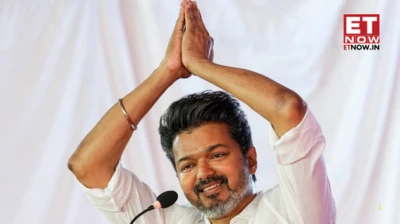
And its chief, Vijay - still called Thalapathy by supporters who lined the roads from his Neelankarai home to Chennai airport just to catch a glimpse of him - is not easing into this quietly.
The Tiruppur Moment
Tiruppur was not a random choice for a major pre-election rally. The city is the beating heart of Tamil Nadu's textile industry, home to thousands of knitwear units, hundreds of thousands of workers, and a weaver community that has watched its fortunes rise and fall for decades. Addressing a crowd there, Vijay made announcements clearly designed for that specific audience - and then some.
The headline numbers were significant. A Rs 15,000 crore state guarantee fund for struggling MSMEs. Peak hour electricity charges scrapped entirely for small businesses. Tax-free electricity for five years. A 50 per cent raw material subsidy for weavers. Monthly pension for weavers raised to Rs 3,000. An insurance policy of Rs 10 lakh for each weaver family. Direct financial assistance of Rs 30,000 paid into weavers' accounts.
For a community that has spent years absorbing rising input costs and shrinking margins, these were not small promises.
He also went after the DMK directly. Tamil Nadu, he argued, once led the country in MSME numbers. Under the current government, he claimed, the state now ranks second in MSME closures. "This is the achievement of the DMK," he said, the sarcasm sharp and deliberate.
The Farmer Package
Beyond textiles, Vijay's rally addressed the farming community with a set of promises that follow a familiar but politically potent template in Tamil Nadu.
A complete waiver of crop loans for farmers owning less than five acres. A 50 per cent waiver for those with larger holdings. Paddy procurement at Rs 3,500 per quintal - above current support prices. Sugarcane at Rs 4,500 per tonne. And 100 per cent crop insurance coverage.
Loan waivers have been a staple of Tamil Nadu election promises going back years. Both DMK and AIADMK have used them effectively. TVK's entry into this space is a signal that the party is competing for the same rural voter base rather than carving out an entirely different constituency.
The question that follows every such announcement remains the same: how would a first-time party in government actually fund these commitments? That answer is promised in the full manifesto, scheduled for release on April 16.
Government Employees and the Police
Two other significant voter blocs received specific attention at Tiruppur. For government employees, Vijay announced consideration of the Old Pension Scheme - a demand that has gained traction among state government workers across India over the past few years. He also promised to regularise temporary teachers, nurses and administrative staff who have served for more than five years, and pledged to end what he called the bribery culture surrounding promotions and transfers.
For the police force, the promises were unusually specific. Basic salary raised from Rs 18,200 to Rs 25,000. Washing allowance doubled from Rs 500 to Rs 1,000. A dedicated Police Welfare and Working Conditions Act to regulate duty hours. Welfare hospitals in six major cities - Madurai, Coimbatore, Trichy, Salem, Tirunelveli and Vellore. Separate restrooms for female personnel. Mobile toilets at duty posts. Rotation-based weekly offs for personnel working beyond stipulated hours.
Addressing police welfare in such granular detail is unusual for a party releasing its first manifesto. It suggests either genuine policy thinking or a deliberate attempt to win over an influential section of state employees - possibly both.
The Electoral Arithmetic
Tamil Nadu goes to polls in a single phase on April 23, with counting on May 4. TVK is contesting for the very first time, entering a state political landscape dominated by two entrenched forces - DMK and AIADMK - that have traded power between themselves for decades, with the BJP occupying a distant but growing presence.
Vijay himself is contesting from two constituencies: Perambur and Tiruchirappalli East. The dual candidacy is a known political strategy - it signals confidence while also hedging against the unpredictability of a debut election.
The Kanniyakumari seat offers a useful preview of what TVK's entry does to the math elsewhere. What was a traditional two-party contest between DMK and AIADMK has become a three-cornered fight, with TVK's Madhavan S R joining the fray against sitting AIADMK MLA Thalavai Sundaram and DMK candidate Mahesh R. That seat has alternated between the two established parties since 1989. TVK's presence there does not guarantee a win - but it guarantees disruption.
That disruption, multiplied across dozens of constituencies, is the real story of this election for the established parties.
The Crowd and What It Means
When Vijay left his home in Neelankarai ahead of the Tiruppur rally, supporters had gathered outside in large numbers. As his vehicle moved toward the airport, crowds lined the entire route. The chants of Thalapathy echoed the kind of street-level energy that political strategists spend years trying to manufacture.
Star power translating into votes is never guaranteed in Tamil Nadu - the state has seen it work spectacularly and fail quietly. MGR built a political empire on it. Kamal Haasan's Makkal Needhi Maiam launched with enormous fanfare before struggling to convert enthusiasm into seats.
Vijay's own message to his party workers ahead of the campaign was telling. He asked them to go house to house, meet people, and explain that this election is not just for TVK - it is for a generation. It is the language of a movement rather than a party, calibrated to make voters feel they are part of something larger than a ballot.
Whether that framing holds up under the pressure of a real election, against two parties with decades of organisational depth, cadre networks and government machinery - that is the question Tamil Nadu will answer on May 4.
Tamil Nadu Assembly Elections are scheduled for April 23, 2026. Vote counting begins May 4.
Read more news like this on www.etnownews.com