




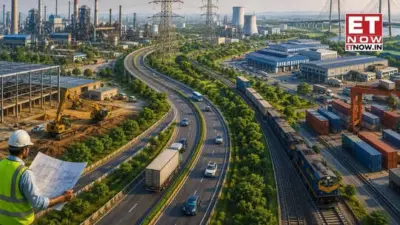

Finally, foreign investment in West Bengal, about $425 million (over Rs 4,000 crore) to build infrastructure that highly placed sources said, is to "create a conducive ecosystem for industrial expansion by enabling private sector participation, improving infrastructure...strengthening industrial and logistics connectivity, infusing new and innovative technology" and probably, most importantly, "employment generation." After decades of de-industrialisation beginning in the late Sixties, and decay, employment levels are very high.
The Industrial and Economic Corridor Sector Development Programme," as it is being called, is a $532 million project, amounting to roughly Rs 5,000 crore. The projects should begin by mid-2027. The infrastructure development will facilitate private sector investment, including FDI in the future is the assessment.
The investment is by:
- A. The Asian Development Bank or ADB of $350 million
- B. The Export-Import Bank of Korea (KEXIM) of $75 million.
- So, total foreign financing is $425 million.
The West Bengal government will provide "counterpart financing" amounting to $107 million, roughly 20 percent of the investment.
The ADB's money will be in two parts:
A. $100 million to ensure "institutional and governance reforms" to improve the "industrial and investment ecosystem" in West Bengal.
B. $250 million for financing infrastructure projects and investments in industry, transport, logistics and energy development.
C. Besides, the ADB will provide $500,000-- roughly Rs 5 crores--as technical assistance for programme implementation, institutional strengthening and capacity-building.
There will hopefully not be much acrimony about the project as the previous state government of Mamata Banerjee had in principle approved the loan-proposal last year as had the union Finance ministry. Infrastructure development could help the new Suvendu Adhikari government as additional FDI comes after infrastructure is in place. The ADB and KEXIM investment comes as a soft loan with a minimal investment of about 4 to 4.5 percent.
The investment will be to ready two industrial corridors where the private sector will be invited to invest. These are:
A. Raghunathpur- Tajpur. This goes via Asansol, Raniganj (the coal belt), Durgapur (site of an iron-and-steel plant), Bardhaman, Dankuni (a logistics centre) and Uluberia.
B. Dankuni-Jhargram. This will be via Uluberia(close to Howrah), Kharagpur (where an Indian Institute of technology is located) and Jhargram.
Apart from these corridors the investment will also develop Siliguri-Jalpaiguri area.
These areas will see the development of power sub-stations, approach roads, land bank portals to promote investment, a single window clearance mechanism for faster approval and a land use development control plan.
How were these corridors decided upon?
This was done on the basis of an earlier study by the ADB based on where manufacturing and services sites were, where roads were located and were being built and how close they were to towns. Initially, Andal, Panagarh, Kharagpur, Goaltore and Salboni were chosen. Later, keeping in mind its potential in terms of connectivity, industry, land availability and infrastructure, Raghunathpur, near Asansol was added.
Finally, six special areas have been identified. They are
- A. Siliguri
- B. Raghunathpur
- C. Asansol-Durgapur-Panagarh
- D. Dankuni
- E. Howrah-Panchla-Uluberia
- F. Kharagpur.
Initial plans speak of logistics parts in Siliguri and Dankuni, last-mile roads linking the industrial nodes to state and national highways, upgrading the brownfield industrial park and building greenfield projects in Raghunathpur.
Land acquisition has often been an issue in the past, but "64 government land parcels, covering approximately 2962 acres" have been identified and the work in Raghunathpur, Asansol and Dankuni is in advanced stage, while in Durgapur, Howrah and Kharagpur, it is work in progress. After all the paperwork is done, ADB and KEXIM is likely to begin handing over the loan money to the West Bengal government in May 2027.
As part of the economic development of West Bengal, the Centre has spoken of the "re-industrialisation" of the Durgapur area. Also, with a BJP government in power in Kolkata, the Centre will work more closely with the state for swift economic development.
Read more news like this on www.etnownews.com