

Who was Dawood Ibrahim's brother: There are some stories where cinema and crime don't just intersect-they blur into one another so seamlessly that it becomes difficult to separate myth from reality.
The tale of Dawood Ibrahim's brother, Noor Ul Haq Kaskar, better known as Noora, sits right at that uneasy crossroads. While Dawood's name has long been synonymous with the shadowy underbelly of Mumbai's crime world, what remains lesser known-and almost cinematic in itself-is that one of his own blood quietly pursued poetry, lyrics, and the dream of Bollywood stardom.
This is not just a story about crime. It is also about contradiction: A man born into one of India's most feared families who, away from the glare of notoriety, chose to write songs that spoke of love, longing, and romance.
Who was Dawood Ibrahim's brother: The brother who chose words over weapons
Noor Ul Haq Kaskar was not the most visible name in the Ibrahim family, but he remains one of the most intriguing. Known within circles as "Noora", he carved out a curious identity-part insider to one of India's most powerful crime syndicates, part creative mind drawn to Urdu poetry and film music.
While Dawood Ibrahim was building a vast network that would eventually stretch across continents, Noora reportedly leaned towards writing. According to journalist S Hussain Zaidi, who has extensively documented Mumbai's underworld, Noora was a "shayarmizaaj aadmi"-a man with a poet's temperament.
Yet, the pull of family loyalty was never far. Despite his creative leanings, he remained deeply connected to his brothers, often prioritising them above everything else.
Who was Dawood Ibrahim's brother: The Bollywood connection few knew about
What makes Noora's story particularly compelling is his quiet entry into the Hindi film industry. Unlike many others who chased visibility, he is believed to have written songs discreetly, without drawing attention to his identity.
Some of the songs attributed to him include:
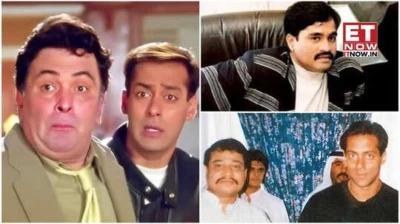
- "Choom Loon Honth Tere Dil Ki Yahi Khwahish Hai" from Shreemaan Aashique, featuring Rishi Kapoor
- "Tumse Jo Dekhte Hi" from Patthar Ke Phool, starring Salman Khan and Raveena Tandon
These weren't obscure tracks. They were part of mainstream Bollywood albums, sung by celebrated voices like Kumar Sanu, Alka Yagnik, S P Balasubrahmanyam, and Lata Mangeshkar-names that defined an era of Hindi film music.
Did you know?
Despite being linked to such prominent projects, Noora never built a public-facing identity as a lyricist. His work largely remained under the radar, adding to the mystery surrounding his life.
Who was Dawood Ibrahim's brother: A poetic mind with a 'tapori' edge
Interestingly, Noora's writing style wasn't limited to traditional romantic poetry. According to accounts cited by S Hussain Zaidi, he had a flair for what was described as "tapori-style" lyrics-street-smart, raw, and reflective of Mumbai's gritty underbelly.
This duality-refined poetry on one hand and street language on the other-perhaps mirrored the world he inhabited. It was a space where elegance and danger coexisted, where film sets and crime networks often overlapped in unexpected ways.
IMDb credits and a life in the shadows
Even the digital record of Noora's work remains sparse. His name appears as a lyricist in the 1992 film Mehboob Mere Mehboob, starring Mohnish Bahl. Beyond that, there is little formal documentation of his creative contributions. For years, reports suggested that he had died of a heart attack in 2009 in Karachi. The narrative seemed almost understated for someone tied to such a powerful family.
But the truth, when it surfaced, was far more disturbing.
The chilling truth behind his death
Two weeks after initial reports of a natural death, a different story began to emerge-one that read more like a crime thriller than real life.
According to media reports, Noora was:
- Abducted and held for ransom, with demands reportedly reaching 50 million
- Shot and later dumped outside Dawood's residence in Karachi
- Linked to multiple criminal cases, including extortion, kidnapping, and the murder of a customs officer
The revelation sent shockwaves through those familiar with the Ibrahim network. It also underscored a harsh reality: even within powerful crime families, vulnerability and betrayal were never far away.
The Rehman Dakait angle and a revenge trail
Another layer to this story involves Rehman Dakait, who, according to reports, was later killed in what was widely believed to be a revenge attack in 2009. While the exact details remain contested and layered with speculation, the sequence of events reinforced the violent ecosystem in which Noora's life-and death-was entangled.
A life that reads like a film script
Noor Ul Haq Kaskar's story is difficult to place neatly into one category. He was neither fully a criminal mastermind nor merely a creative outsider. Instead, he existed somewhere in between-a man who wrote love songs while being surrounded by violence, who remained loyal to family even as he pursued a quieter artistic calling. In many ways, his life reflects the complicated relationship between Bollywood and the underworld during a certain era-an uneasy alliance that produced both iconic films and deeply troubling realities. And perhaps that is what makes Noora's story linger. Not just because of how it ended, but because of what it reveals: that even in the darkest corners of power and crime, there can exist a voice that writes about love.
Read more news like this on www.etnownews.com