

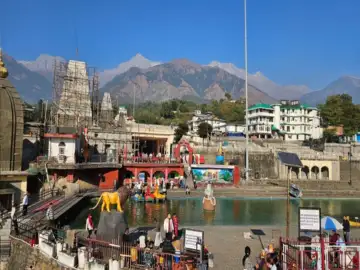
Nestled in the lap of Himachal Pradesh, the Chamunda Devi Temple stands as one of the most prominent shrines dedicated to the Goddess.
It is situated approximately 19 kilometers away from Palampur. This temple represents a unique confluence of unwavering faith and breathtaking natural beauty.
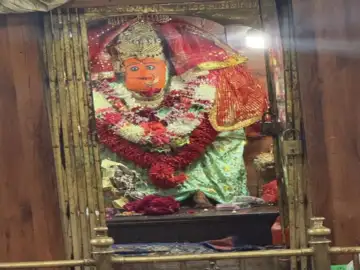
Several religious beliefs and legends are associated with this temple. On the auspicious occasion of Chaitra Navratri, let us explore the legends linked to the Chamunda Devi Temple and learn how to reach this sacred site for *darshan* (worship).
**Key Highlights of the Chamunda Devi Temple**
The Chamunda Devi Temple was constructed in the 16th century. Situated on the banks of the Baner River, the temple offers a magnificent backdrop featuring the snow-capped peaks of the Dhauladhar mountain range. Behind the temple lies a natural cave, which is revered as the abode of Lord Shiva and Goddess Shakti.
Within this cave resides the *Shivling* (sacred emblem) of Nandikeshwar Mahadev, attracting devotees from far and wide who come to seek his blessings. Consequently, the temple is also known as Chamunda Nandikeshwar Dham. Statues of Lord Hanuman and Lord Bhairav adorn the temple on either side; they are believed to serve as the divine guardians and representatives of Goddess Chamunda.
**The Chamunda Devi Temple Was Not Always Located at This Site**
Originally, the temple was situated atop the Dhauladhar mountain range, requiring a strenuous 16-kilometer uphill trek that was extremely difficult for devotees to undertake. To alleviate these hardships faced by the devotees, the local King and a priest prayed to the Goddess, seeking her permission to relocate the temple to a more accessible site.
The Goddess granted her divine consent to the priest in a dream. She instructed him to excavate the current site to unearth her idol. The priest conveyed this divine message to the King. Upon initiating the excavation, the idol was indeed discovered; however, the King's soldiers were unable to lift it. The Goddess then appeared once again in the priest's dream and instructed him to go personally and install the idol himself. Thus, the Chamunda Devi Temple was established at its present location
**A Special Mythological Legend Associated with the Temple**
The most widely known legend associated with this temple originates from the *Durga Saptashati*. It is believed that thousands of years ago, two powerful demons named Chanda and Munda were wreaking havoc in this region. Consequently, the Goddess assumed the form of Kali and, after a fierce battle, slew both these demons. For this very reason, this manifestation of the Goddess is worshipped under the name Chamunda.
**Best Time to Visit the Temple**
While devotees visit throughout the year, the vibrant atmosphere here during Navratri is truly a sight to behold. During the winter season, due to snowfall, the temple gates remain open from 6:00 AM to 12:00 PM. The period between 12:00 PM and 1:00 PM is reserved for offering *Bhog* (sacred food) to the Goddess. Subsequently, the temple remains open from 1:00 PM until 9:00 PM. In the summer season, the temple doors open at 5:00 AM. To participate in the morning *Aarti* (prayer ceremony), one should reach the temple by 8:00 AM, while the evening *Aarti* is scheduled to begin at 7:00 PM.
**How to Reach Here?**
Reaching the Chamunda Devi Temple is quite easy, as it is well-connected to the major tourist hubs of Himachal Pradesh:
**By Air:** The nearest airport is Kangra Airport, located approximately 25-28 kilometers away from the temple. From there, you can take a taxi or a bus.
**By Rail:** The nearest broad-gauge railway station is Pathankot. From there, you can take a narrow-gauge 'Toy Train' to reach Kangra or Nagrota-a truly thrilling experience.
**By Road:** Situated between Dharamshala and Palampur, the temple is well-served by Himachal Transport buses. Direct bus services are also available from Delhi, Chandigarh, and Shimla.
PC Social Media