





Images: Shutterstock
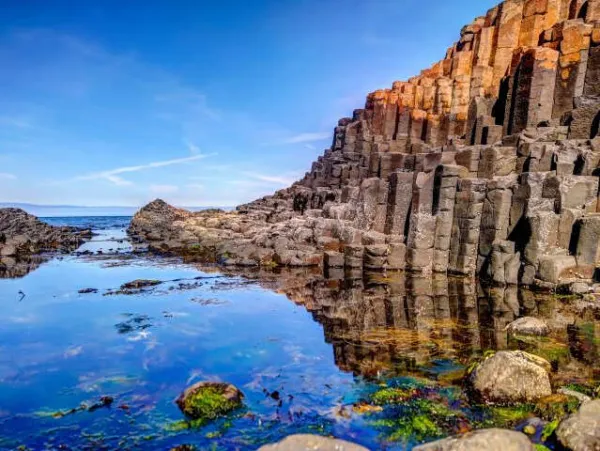
With 40,000 interlocking basalt columns marching from the cliffs into the sea, the Giant's Causeway is one of the most visually stunning geological spectacles in the world - largely because most of them are strikingly hexagonal.
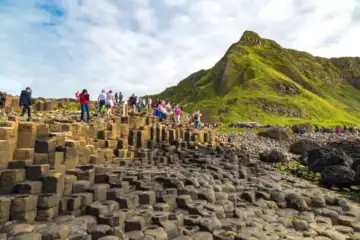
One of the site's greatest attractions is that visitors can walk directly across the stepped basalt platforms at sea level.
For centuries, locals have attributed the formation rising from the North Antrim coast of Northern Ireland to a legend that gave it its name: that the giant Finn McCool built the causeway as a bridge to battle a rival in Scotland. Now, science offers an explanation that seems as extraordinary as the myth.
A Volcanic Origin: The Lava That Started It All
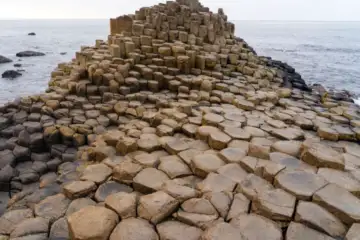
During the Paleogene Period, about 50 to 60 million years ago, intense volcanic activity tore open the land across what is now northwestern Ireland and western Scotland. Huge quantities of molten basaltic lava (known to be extraordinarily fluid compared to other lava types) flooded the landscape and pooled in thick sheets - nearly 90 metres deep in some places. This was part of a prolonged outpouring (rather than a dramatic eruption) that smothered the ancient chalk beds beneath a dense, uniform blanket of lava. It is crucial to note this uniformity: because the lava was chemically consistent and spread evenly, it went on to cool and contract in a strikingly regular way - paving the way for the geometric wonder to come.
The Physics Of Cracking: Why Hexagons And Not Squares?
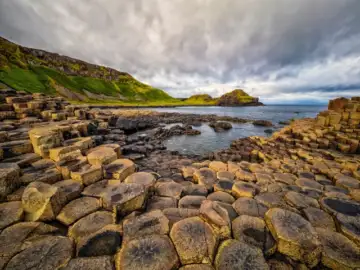
The thick lava sheet began to cool from the top downward, and - just as mud cracks as it dries - started contracting. Stress built up across the surface, and the rock fractured to relieve that stress. Scientists have always asked the question: why hexagons? When a material that is uniformly contracting cracks, it seeks to distribute stress as evenly as possible across its surface. In terms of geometry, the shape that achieves this distribution most efficiently is the regular hexagon (this also explains why the cells in a beehive are in a honeycomb pattern). Nature uses the hexagon to minimise energy in a cracking system, making it less a coincidence and more an inevitable geometric outcome written into the laws of physics.
Columnar Jointing: How The Cracks Went Vertical
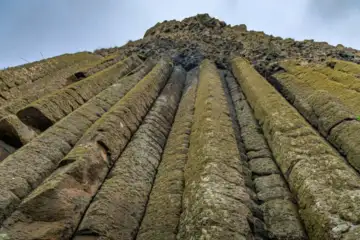
The fractures did not limit themselves to across the surface; as cooling advanced from the top toward the base, they propagated downward through the lava in a process called columnar jointing. As each crack extended deeper, it followed the cooling front, always moving perpendicular to it, producing long, continuous vertical fractures. The result of this was a set of columns, each defined by the network of cracks around it. The slower the cooling was, the deeper and more uniform the joints formed, and, consequently, the taller and more regular the columns were. At the Giant's Causeway, the cooling was slow enough to produce columns ranging from about 15 centimetres high to nearly 50 centimetres across, and reaching heights of up to 12 metres in the cliff faces above.
Why the Giant's Causeway Is So Exceptional
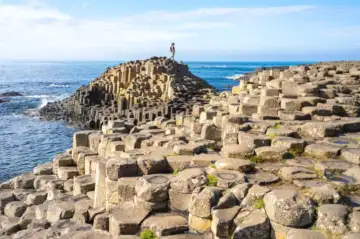
Every continent has examples of columnar basalt formations. Notable ones are the Devil's Tower in Wyoming, Fingal's Cave in Scotland, and Svartifoss in Iceland - all with the same origin story. The Giant's Causeway is exceptional even among these for its combination of scale, accessibility, and near-perfect regularity. The lava in this site in Northern Ireland cooled at an unusually consistent rate, producing columns that are remarkably uniform in width and alignment. Over millions of years, the Atlantic Ocean has eroded and sculpted the columns into stepped platforms at sea level, creating a walkable pavement of stone polygons - the famous 'causeway' effect.
The Giant's Causeway was designated a UNESCO World Heritage Site in 1986 and remains one of the clearest natural demonstrations of geometry emerging spontaneously from geology.
Frequently-Asked Questions (FAQs)
Q. How old is the Giant's Causeway?
A. The columns that make up the causeway formed approximately 50 to 60 million years ago during a period of intense volcanic activity in the North Atlantic.
Q. Are all the columns hexagonal?
A. Most of the columns are hexagonal, but you will also find columns with four, five, seven, or even eight sides. Most of the columns are hexagons simply because that is the most energetically efficient shape for stress distribution.
Q. How many columns make up the Giant's Causeway?
A. Estimates put the number at around 40,000 interlocking basalt columns in total.
Q. How tall are the columns?
A.The columns at the water's edge are relatively short, but they can reach up to 12 metres in height in the cliff faces above - particularly at the 'Organ' formation.
Q. Is the Giant's Causeway a UNESCO World Heritage Site?
A.Yes. It was added to the UNESCO World Heritage List in 1986 and is also a National Nature Reserve.
Q. Can you walk on the columns?
A.Yes, visitors can walk directly across the stepped basalt platforms at sea level - this is one of the site's great attractions.
Also Read: How The Pink Sand Beach Of Harbour Island Gets Its Unique Colour