
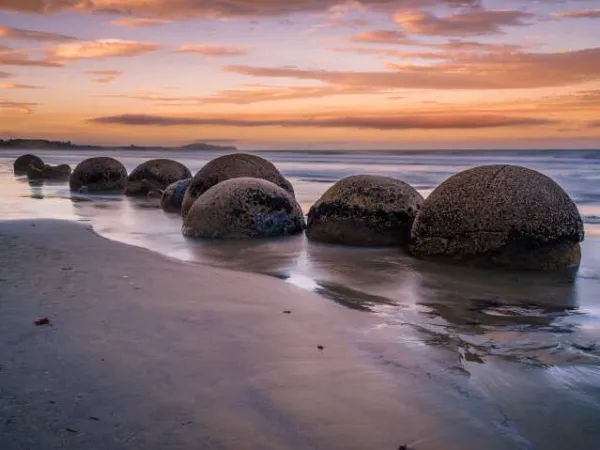

Between the towns of Moeraki and Hampden on the wave-cut Otago coast of New Zealand, the Moeraki Boulders are some of the world's most extraordinary natural curiosities.
These giant stone spheres have captivated visitors, scientists, and storytellers for centuries.
Located on Koekohe Beach on the east coast of South Island, the near-perfect boulders can be found roughly 78 kilometres north of Dunedin and 40 kilometres south of Oamaru. Getting to see them involves an easy, scenic drive along State Highway 1 from either direction.

The Moeraki Boulders Are A Photographer's Dream
The boulders are large, grey, and perfectly spherical. Their surfaces bear a distinctive pattern, concealing honeycombed centres - visible in some broken boulders. About one-third of the boulders range from 0.5 to 1 metre in diameter, the other two-thirds from 1.5 to 2.2 metres, and they are all at different levels of immersion. These ancient stone spheres set on a beach with waves crashing around them are easily one of New Zealand's most photogenic spots.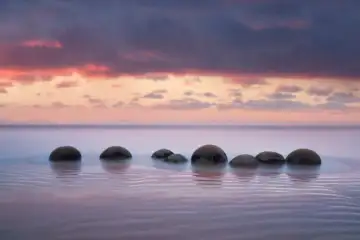
The Moeraki Boulders Are Ancient Wonders
Scientists estimate that these concretions began to be formed approximately 60 million years ago within the muddy Paleocene marine sediments of the Moeraki Formation. The larger boulders are thought to have taken 4 to 5.5 million years to grow while 10 to 50 metres of marine mud accumulated on the seafloor above them.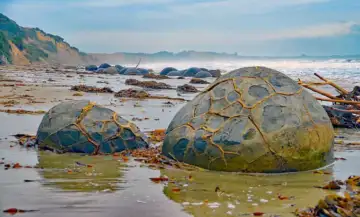
The Moeraki Boulders Are Part Of A Complex Formation Process
Each boulder began with an organic nucleus, such as a leaf, cone, shell, fish bone, or other plant or animal relic. Sedimentary particles and minerals, particularly calcite, collected around this organic matter in concentric layers; think of how a natural pearl forms inside an oyster. The remarkable stone spheres we see today are the result of millions of years of this process.
How The Boulders Got Onto The Beach
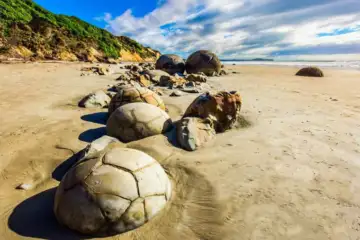
After the uplift onto the landmass of New Zealand during a period of mountain building, erosion exposed the Palaeocene mudstone beds that contained the boulders, and caused the perfectly-smooth boulders to fall off the mudstone cliffs onto the beach. Continuing erosion exposed the network of veins on the boulders' surfaces.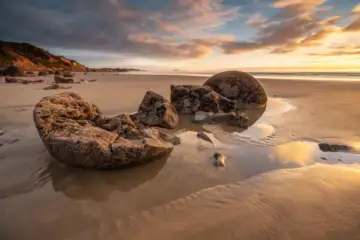
The Place Of The Moeraki Boulders In Māori Legend
The Māori name for the boulders is "Te Kaihīnaki," which translates to "food baskets." In Kāi Tahu tradition, the boulders are the round food baskets and gourds washed ashore from the famous Araiteuru waka. The canoe had travelled to the ancient homeland of Hawaiki to gather kūmara seed, and encountered heavy seas just north of the site on its gruelling return journey, causing its cargo to wash ashore. 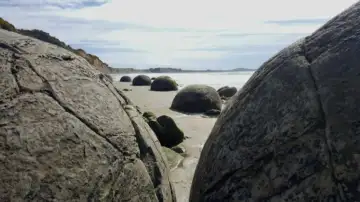
The Moeraki Boulders Are Protected
Protected as part of the Moeraki Boulders Scenic Reserve to ensure their preservation for future generations, the boulders are managed by the New Zealand Department of Conservation. Although many smaller boulders are believed to have been earlier removed, it is now a crime to remove, damage, or graffiti them since they enjoy legal protection.
Frequently-Asked Questions (FAQs)
Q. What does "Moeraki" mean?
A. The name "Moeraki" (Moerangi) means "drowsy day."
Q. What are the Moeraki Boulders made of?
A. The Moeraki Boulders are made of cemented mudstone with large cracks radiating outward from a hollow core, typically filled with layers of brown and yellow calcite.
Q. How much do the Moeraki Boulders weigh?
A. Each weighs several tonnes and can be up to two metres high.
Q. Are there similar boulders elsewhere?
A. The Koutu Boulders, found on the shores of Hokianga Harbour on New Zealand's North Island, are virtually identical spherical boulders. Similar concretions can also be found in England, Canada, the United States, and other countries worldwide.
Q. What is the best time to visit the Moeraki Boulders?
A. Visit at low tide, when the boulders are fully exposed. It makes sense to check local tide charts before starting out.