




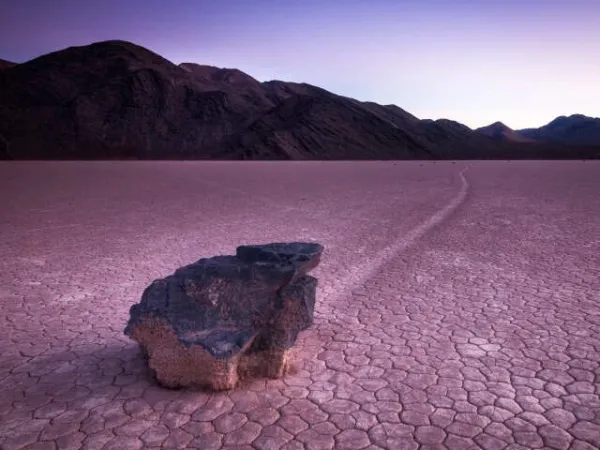

One of the most beguiling puzzles in nature lies deep in the scorching expanse of Death Valley in the Mojave Desert, straddling the borders of California and Nevada in the United States.
There, on Racetrack Playa, rocks move on their own, earning themselves the name 'sailing stones' for the way they glide across the sunbaked mud. Some of these stones weigh hundreds of pounds and leave long trails etched in their wake in the cracked earth as evidence of their journeys. No one, down decades, had actually witnessed the movement, which led to wild speculation that spanned everything from magnetic forces to alien intervention. It has taken modern science, patient research, and a stroke of luck to finally crack one of the most enduring mysteries in geology.
The Landscape: Racetrack Playa
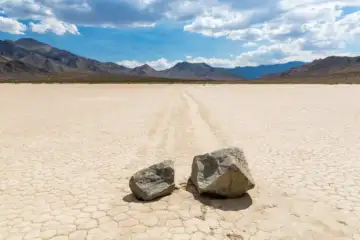
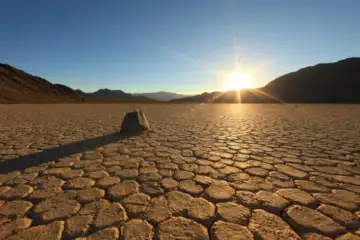
Almost perfectly flat, Racetrack Playa is a dry lakebed sitting at an elevation of 1,128 metres in a remote corner of Death Valley National Park. It's about 4.5 kilometres long and two kilometres wide, and its cracked clay surface bakes under the extreme desert heat. This landscape forms an almost-otherworldly stage for the stones' strange performances.
The Stones Themselves
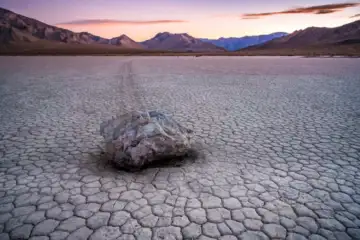
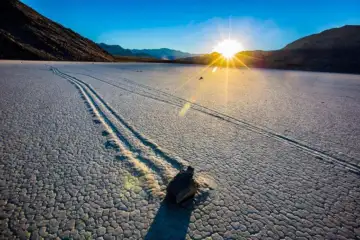
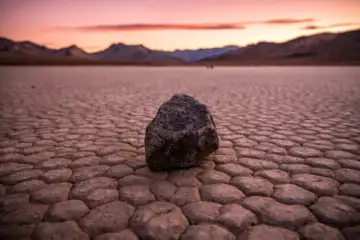
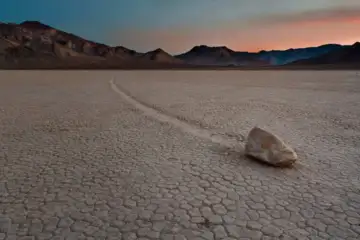
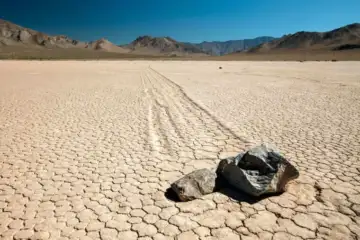
Varying enormously in size, the sailing stones range from small pebbles to boulders that could weigh up to 320 kilograms. Most start life on a rocky hillside at the southern end of the playa. The trails they form - sometimes straight, sometimes curved, occasionally looping - can stretch hundreds of metres, and it always seems as if each stone is charting its own independent course.
Decades Of Speculation
From the 1940s onward, scientists have proposed dozens of explanations for how and why the stones move. These include theories around hurricane-force winds, dust devils, algae-slicked surfaces, even ice rafts carrying the stones - none of which fully held up to scrutiny. Because the playa is extremely remote and the stones moved only occasionally under unpredictable conditions, the phenomenon was very elusive.
The Breakthrough Study
In 2013-'14, Richard Norris and James Norris cracked the case using GPS trackers, weather stations, and time-lapse cameras. The researchers actually observed stones moving for the first time. They found that the phenomenon was the result of a surprisingly delicate mechanism - a rare and fragile combination of natural events working together in perfect sequence.
The Real Mechanism - Ice, Wind, and Water
The process begins when winter rains flood the playa with a shallow layer of water. This layer freezes overnight into thin sheets of "windowpane" ice. The ice melts and breaks apart as the sun rises the next morning. Gentle winds - as light as 3 to 5 metres per second - then push these ice sheets across the lubricated mud surface, carrying the stones along like passengers on a slow, silent raft.
Why It Still Feels Magical
Despite the science being now explained, the sailing stones retain their wonder. Given that the conditions required are so precise and so rare, the phenomenon remains an uncommon event. Even as you stand at Racetrack Playa, staring at a trail carved by a boulder that crept imperceptibly across the desert, the explanation inexplicably makes the whole phenomenon feel more extraordinary, not less.
Frequently-Asked Questions (FAQs)
Q Where exactly is Racetrack Playa?
A. Racetrack Playa is located in the northwestern part of Death Valley National Park, California, and it is accessible via a rough 44-kilometre unpaved road from Ubehebe Crater.
Q. How fast do the sailing stones move?
A. The sailing stones move extremely slowly - a few metres per minute at most. So slowly, in fact, that their movements are imperceptible to the naked eye in real time.
Q. Has anyone ever seen the stones move in person?
A. Yes, the Norris research team actually observed and filmed the stone movement in December 2013; it was the first documented eyewitness account.
Q. How long are the trails left by the stones?
A. The trails can vary widely, ranging from a few metres to over 250 metres in length, all depending on how often a stone moves and other conditions.
Q. Can visitors touch or move the stones?
A. No, touching, moving, or disturbing the stones is prohibited under National Park Service regulations.