
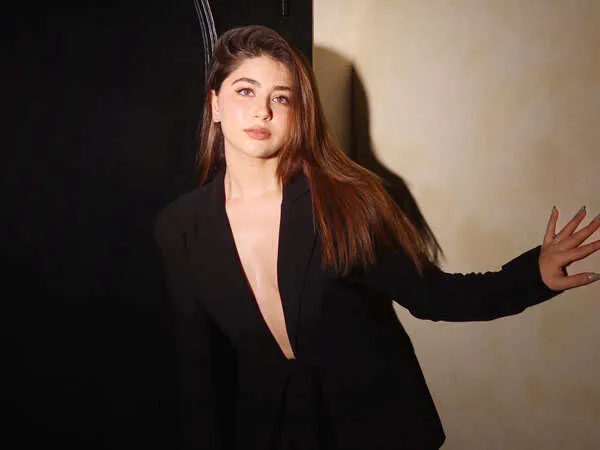

In an exclusive conversation with Filmfare, Aditi Bhatia opens up about working as a child actor, the lessons she learned on the sets of classics like Vivah, and her conscious decision to step away from the small screen to carve a niche in cinema.
Having started your journey as a child actor in films like Vivah and Shootout at Lokhandwala, what were the most significant lessons you carried forward from those early experiences?
I grew up on film sets before I even fully understood what acting meant, so in many ways the camera has always felt like home to me. Being part of ads and films so early in life exposed me to the rhythm and discipline of cinema at a very young age. What stayed with me most was observation. I watched actors, directors, technicians, the way everyone worked in harmony to make the magic happen. I think those years quietly shaped my understanding of longevity. Talent matters, of course, but consistency, emotional honesty, and professionalism are what truly sustain you in this industry. Looking back, I feel lucky that my foundation was built inside real film environments. It gave me instinct before it gave me ambition.

As a prominent face in the television industry, did you ever harbour a fear of being typecast or boxed into a specific image when transitioning to lead roles in cinema?
I think one conscious decision that helped me was that I chose not to play characters far older than my actual age on television. I was mindful of not getting locked into an image too early, so while television gave me immense visibility and discipline, I don’t think I got typecast in the most traditional sense. That said, every medium comes with perceptions attached to it. Television gives you familiarity with audiences, but cinema asks people to look at you differently. That shift takes time and conviction. For me, it was never about distancing myself from television. It was about evolving beyond what people had already seen me do. It was about making sure I wasn’t creatively predictable. I’ve always wanted to keep evolving in a way where every phase of my career reveals a different side of me as an actor.
During your hiatus from television to focus on film opportunities, where did you draw your strength and inspiration from?
Stepping away from television gave me silence for the first time in years, and silence can be very revealing for an actor. That phase wasn’t just about waiting for films; it was about reconnecting with myself creatively, and it was a conscious decision. When you’ve worked constantly from a young age, you sometimes move from one project to another without pausing long enough to ask yourself what truly excites you anymore. I found inspiration in actors who reinvented themselves fearlessly in cinema that stayed with me long after it ended and, honestly, in the discomfort of starting over. There’s something powerful about choosing uncertainty because you believe there’s more waiting for you on the other side of it. That period gave me perspective. It made me more intentional, not just about the work I wanted to do, but about the artist I wanted to become.
How do you maintain your composure while navigating both praise and critical scrutiny that follows a major release?
I think when a film enters public conversation on such a large scale, strong reactions become inevitable. As actors, you learn very quickly that once a film is released, it belongs to people and everyone will experience it through their own lens. What has felt deeply reassuring to me, though, is the amount of love I’ve received and the growing recognition for my craft. That means a lot because, at the end of the day, that’s what I’ve always wanted to be seen for. I’ve learnt to stay centred through both praise and criticism. Applause can be intoxicating and noise can be distracting, but neither can become your identity. The work has to remain the anchor.
You’ve been vocal about the role of connections and access in the industry. Given your lifelong experience in the field, what is one fundamental change you’d like to see in Mumbai’s current casting culture?
I think the industry sometimes confuses familiarity with inevitability. There’s immense talent outside established circles, but not everyone is given the same continuity of opportunity. Access plays a much bigger role than people like to admit, and I say that as someone who has worked in this industry since childhood and still understands what it means to constantly make space for yourself. I would love to see a casting culture that is more genuinely open to discovery, where actors are allowed to surprise people beyond perception, networks, or preconceived ideas of where they belong. Because sometimes all an actor needs is one real opportunity and the right filmmaker to truly be seen.
Having collaborated with industry veterans from a young age, is there a specific piece of advice from a senior that has particularly guided you during your recent film projects?
One thing I’ve carried with me over the years is the understanding that the camera sees far more than performance - it sees truth. You can say lines perfectly, hit every mark, and still not move people if there’s no emotional honesty underneath it. That’s something I understood very early simply by observing actors I admired. I’ve also realised that the people who truly endure in this industry are deeply disciplined. There’s a quiet seriousness to great actors. That stayed with me while working on various projects because emotionally demanding stories require you to be very present, very grounded, and very honest with yourself.
After an intense and demanding project, which genres are you most eager to explore next to showcase your range?
I want to surprise people now. After doing something emotionally intense, I’m excited by the idea of exploring completely different emotional worlds, whether that’s romance, psychological drama, slice-of-life storytelling, or even something with a strong comedic rhythm. I think the most exciting actors are the ones you can’t fully predict. I never want audiences to feel like they’ve already seen every shade I have to offer. Right now, I’m drawn to characters that feel layered, feminine, flawed, emotionally intelligent, and deeply memorable. More than genre, I’m chasing complexity.
If you could pick one actor to share the screen with in the near future, who would be at the top of your list?
It’s so difficult to choose one! But I would love to work with Ranbir Kapoor. I think he has a very rare emotional fluidity as an actor. There’s vulnerability, spontaneity, and restraint all existing together in his performances, which makes him incredibly compelling to watch. As an actor, you always hope to share screen space with people whose energy pushes you to become even better in the moment. I feel like that kind of collaboration will not only help me grow but would be a dream come true.
What does the road ahead look like for you ? Are there any upcoming projects you can share details about?
There are conversations happening, but I’m in a phase where I’d rather wait for the right part than rush into the next release. After a certain point, you realise that every choice begins shaping not just your career, but your identity as an actor. I want the work I do next to deepen the way audiences see me. So yes, there are exciting things taking shape, but right now, I’m more focused on building a body of work than simply building a filmography.