
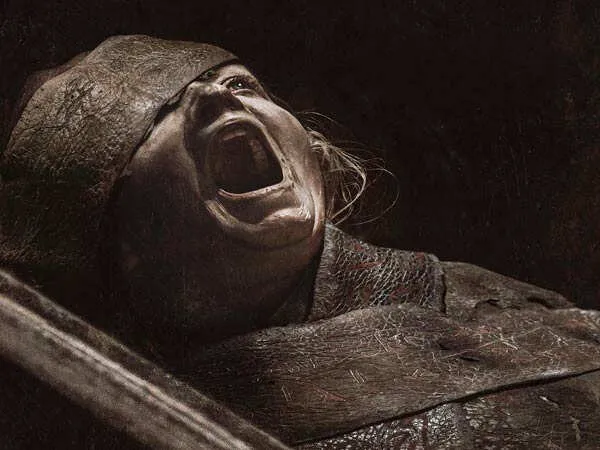

There is a version of Lee Cronin's The Mummy that is an absolute triumph. You can feel it in the atmosphere, in the dread that settles into your bones during its finest sequences, in the body horror that recalls the gleeful nastiness of Peter Jackson's Braindead and the original Evil Dead.
You can hear it in Stephen McKeon's score, which is perhaps the film's most consistent achievement. There's a relentless, tightening presence that doesn't announce itself so much as slide under your skin and refuse to leave. And then, somewhere in the third act, Lee Cronin loses his nerve, and that version of the film vanishes. What remains is still worth your time, but only just.
Let's begin with what Cronin gets right, because he gets quite a lot right. This is a director who has made a deliberate, admirable choice to sidestep the conventional architecture of modern horror. Where franchise staples like The Conjuring and Insidious traffic in jump scares and carefully choreographed dread, Cronin goes for something uglier and more visceral, a sustained nastiness that grinds you down rather than startles you. Genre faithfuls weaned on the polished mechanics of those films may find themselves disoriented here, perhaps even alienated. That is, largely, the point. Cronin is not interested in your comfort.
The film wears its cinematic influences proudly. There are visual gestures toward old Hollywood grandeur; in its desert compositions, its architectural gloom, its operatic framing of domestic spaces turned grotesque. You sense a director who has spent serious time with the classics, and who wants you to know it. When the film leans into its body horror, the homage feels genuinely earned. The funeral scene, in particular, is a masterstroke. A sequence where horror tips into the macabre with a kind of deranged glee, food and blood and bodily horror converging into something that sits squarely in the tradition of Braindead, Evil Dead, and even the outrageous practical effects of Death Becomes Her. In those moments, the film is genuinely alive.
The performances are similarly strong, mostly. Laia Costa as Larissa brings a fierce, anguished credibility to the role of a mother refusing to accept what her daughter has become; it is a performance of quiet, devastating force. Veronica Falcón, as Larissa's mother, matches her at every turn, all steely warmth giving way to something primal and terrified. And young Natalie Grace, buried beneath layers of prosthetics and restraint, delivers something extraordinary, a performance that communicates through physical contortion and fractured humanity in ways that dialogue never could. Emily Mitchell, too, in her brief appearance as the younger Katie, leaves a mark that lingers well beyond her screen time.
Jack Reynor, cast for his physicality and a certain everyman intensity that serves the material well on paper, is a more complicated case. The instinct in the casting room was correct. But the performance, ultimately, does not fully cohere. Something in the emotional throughline of his character never quite lands with the conviction the role demands, leaving a slightly hollow centre in scenes that need an anchor.
The film is also, to its considerable credit, genuinely frightening in stretches. Not in the way The Conjuring is frightening, not through mechanics and timing, but through sheer unrelenting accumulation of dread. Cronin's approach to body horror is remarkable. Where the film stumbles is in its deployment of CGI during key gore sequences. Peter Jackson understood, shooting Braindead on a shoestring, that practical effects have a texture and a weight that digital work struggles to replicate. When Cronin reaches for the big visceral swings and relies on CGI to carry them, the illusion fractures. The effect is not revulsion, it is distance. And distance is the one thing horror cannot afford.
The script is where the film's ambitions most conspicuously outpace its execution. Cronin clearly wants to build something more layered than a shock machine, a meditation on parental love, on grief, on what we accept in the people we cannot bring ourselves to let go of. The emotional architecture is sound. But the granular detail of the writing repeatedly undermines it. The mythology is poorly integrated; the exposition arrives in clumsy, laborious waves; the plot logic buckles under the weight of its own twists. A braver screenplay would have trusted its own emotional core over its elaborate machinery.
And then there is the ending, which is where Cronin, to put it plainly, overthinks himself into a corner. There is a moment late in the film that carries the quiet, aching power of everything the movie has been building toward, a moment of restrained, almost wordless connection between Katie and her father that would have served as a perfect, haunting final image. Instead, Cronin pushes past it. What follows feels like the product of too many late-night conversations, too many competing notes, too much second-guessing of an instinct that was correct the first time. The best creative decisions are usually the first ones. Cronin should have listened to his.
It is worth pausing here to acknowledge what this film is attempting against the grain of history. The Mummy as a franchise has a gravitational pull that is hard to escape. Stephen Sommers' 1999 adventure, Brendan Fraser grinning through the desert, Rachel Weisz clutching her books, John Hannah being terrifically useless, it was not a great film, but it was an irresistibly entertaining one. Its alchemy of action, romance, spectacle and light horror produced something that felt genuinely alive on screen. It is not the film Cronin set out to make, and it would be unfair to penalise him for that. But there is an ease and a warmth to that original that this film conspicuously lacks, and you find yourself missing it during the longer stretches of gothic exposition.
What Cronin has made instead is a film of the current moment, heavy with atmosphere, fluent in the language of elevated horror, unafraid of ugliness. He deserves real credit for that. This is a genuine attempt to reinvent a monster for an era that demands more of its monsters. It doesn't entirely succeed. The writing lets the direction down, the ending overreaches, and the mummy mythology itself remains frustratingly decorative, but the attempt is bracingly serious.
Lee Cronin's The Mummy is a film of genuine ambition and real craft let down by its own screenplay. It will frustrate you, occasionally disgust you, sometimes genuinely unsettle you, and leave you wondering, with no small amount of regret, what it might have been with a tighter script and more disciplined final cut. That is both its failure and, in a strange way, its distinction. A note to Lee Cronin: the next time your instincts tell you to stop, stop.