
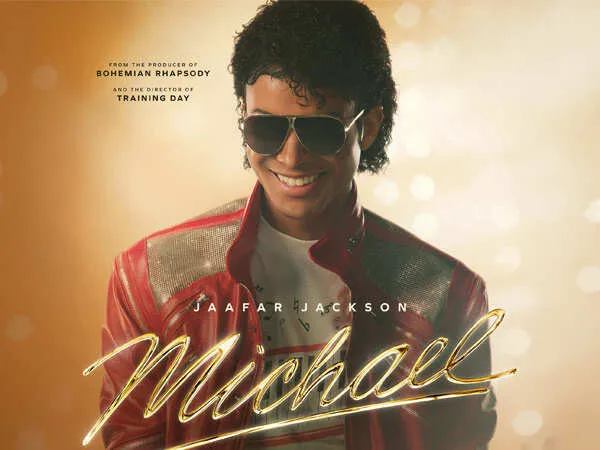

There's a moment early in Michael when the camera lingers not on the spectacle, not on the choreography but on a pair of watchful, wounded eyes.
It’s a cue for what Michael ultimately chooses to be: less a conventional cradle-to-grave biopic and more an emotional excavation of a man who never quite outgrew the child he once was.
The film leans heavily into the mythology of Michael Jackson, the boy genius who gave the world Billie Jean, Beat It, Smooth Criminal, and Black or White, the artist behind Thriller (1982), still the best-selling album of all time. But rather than simply stringing together greatest hits, director Antoine Fuqua frames Jackson’s life as a paradox: a global superstar who remained emotionally stunted, shaped by a childhood defined more by discipline and exploitation than affection.
At the centre of it all is Michael Jackson’s nephew Jaafar Jackson in his debut role, delivering a performance that feels less like imitation and more like possession. He doesn’t merely replicate the voice and movement; he inhabits them. The film smartly blends Jaafar’s vocals with archival recordings, especially during high-voltage musical set pieces, creating an uncanny effect where past and present collapse into one. When he slips into the familiar rhythms of Billie Jean or the defiant swagger of Beat It, it’s not nostalgia, it’s resurrection.
But where Jaafar truly excels is in the quieter moments. His Jackson is a “man-child,” deeply influenced by the mythology of Peter Pan, a figure who builds his own Neverland, both literally and psychologically. In this telling, MJ’s obsession with exotic animals becomes less an eccentric indulgence and more a desperate act of self-preservation. Jaafar conveys this duality, the wonder and the wound, with striking precision. The eyes carry it all: pain, defiance, loneliness and an almost aching need to be loved and accepted.
If Jaafar is the soul of the film, Colman Domingo provides its shadow. As MJ’s controlling father Joe Jackson, he is terrifyingly effective. His performance is built on controlled physicality, clipped speech and an ever-present undercurrent of menace. The film does not soften its portrayal of the patriarch; instead, it positions him as the architect of both Michael’s greatness and his fractures. Domingo ensures that every scene he inhabits feels charged, often uncomfortably so.
In contrast, Nia Long’s portrayal of MJ’s mother Katherine Jackson is all quiet conflict. She is the mother who understands but cannot intervene, who nurtures in private but submits in public. There’s a cultural familiarity to this dynamic for Indian audiences. Her silences speak volumes and Long fills them with restraint and dignity. Nirupa Roy must be smiling her approval from heaven.
The supporting cast adds texture without overwhelming the narrative. Kendrick Sampson’s take on music producer Quincy Jones captures the creative synergy behind Thriller and Bad, while Miles Teller lends credibility to John Branca, MJ’s longtime lawyer and agent, portraying him as a steady, pragmatic presence in Jackson’s chaotic orbit. KeiLyn Durrel Jones, as bodyguard Bill Bray, brings an understated warmth, while young Juliano Krue Valdi, who has made a name for himself doing MJ’s impressions, provides the film’s emotional bedrock. His portrayal of a young Michael is disarmingly natural, grounding the first half in a sense of lived-in vulnerability.
Fuqua’s direction is characteristically muscular yet intimate. He juxtaposes tight, almost suffocating close-ups within the Jackson household against sweeping, kinetic crowd sequences that capture the hysteria of global fame. It’s a visual language that mirrors Michael’s own life, claustrophobic in private, explosive in public.
However, Michael is also a carefully curated narrative. The film touches upon Jackson’s rise from Gary, Indiana beginnings with the The Jackson 5 to his creative emancipation with Off the Wall and the seismic cultural impact of Thriller. It acknowledges his health struggles, including vitiligo and lupus, as well as the physical transformations that kept tabloids in a perpetual frenzy.
Yet, conspicuously, it sidesteps the most contentious chapters, particularly the allegations of child sexual abuse and the ensuing legal battles, including the 2005 trial in Santa Maria, California where Jackson was acquitted. These omissions are hard to ignore, given how profoundly they shaped public perception and his later years. Reports suggest a follow-up film may delve into these aspects but within this instalment, the absence creates a version of Jackson that feels intentionally incomplete. Also, why’s Janet Jackson missing from this narrative? The only sister we see is La Toya. Even Rebbie is absent.
Still, what the film does capture, quite powerfully, is the psychology of longing. This is a Michael Jackson who is perpetually reaching: for love, for validation, for a sense of belonging that eluded him in his own home. In that sense, his ambition to make the world his family doesn’t feel grandiose, it feels necessary.
And perhaps that’s where Michael ultimately lands its emotional punch. It doesn’t ask you to reconcile the contradictions or pass judgment. Instead, it invites you to witness the making of a phenomenon and the unravelling of a person in tandem.
The magic and the madness coexist here, inseparable. And through Jaafar Jackson’s remarkably assured performance, you don’t just see them, you feel them. He has the potential to be a great actor, though only his later films would be the true judge of that.