




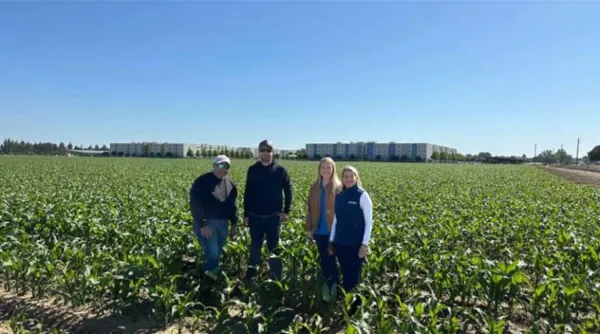

12 May 2026, US: Once fallow tomato fields on the UC Davis campus are now home to irrigated corn fields growing silage that will help feed dairy cows.
The project is part of a new initiative bolstering sustainability and research efforts in the College of Agricultural and Environmental Sciences by bringing dormant fields back in action in support of campus research and facilities.
Adding silage to the feed used at the Dairy Teaching and Research Facility makes the cows' diets more in line with commercial operations, boosting the validity of research findings, said Frank Mitloehner, director of the CLEAR Center and an air quality Cooperative Extension specialist.
"At UC Davis, we haven't fed silage in 60 years," said Mitloehner, a professor in the Department of Animal Science. "We always fed hay, and because of that, the research that we had done was sometimes not deemed to be of practical use to our producers because we didn't do what the industry does."
After receiving a California Department of Food and Agriculture grant to study how feed additives could reduce methane emissions, Mitloehner sought to grow silage on campus. He connected with Israel Herrera, the college's field crops and facilities manager.
"We needed something to rotate into those fields, and the best thing would be silage," Herrera said. "The perfect thing about it is that it can be used on campus."
The fields were updated with new drip irrigation to reduce water use and the first corn silage was planted in March to be ready for harvest in July. Eventually, corn will cover 60 acres and could be used at other facilities on campus as well, Herrera said.
"We are thrilled about this, not just that we get to do something that we haven't done in the past and that is relevant to the industry, but we are also particularly thrilled about working across departments because this is what makes us really strong," Mitloehner said.
Silage is an efficient feed because the entire plant is harvested and chopped, then tightly compacted to remove oxygen and sealed under plastic. Within a few days, naturally occurring microbes ferment plant sugars into lactic acid, lowering the pH and preserving the feed, Mitloehner said.
"It's an acidic environment, one that does not allow other microbes to thrive," he added. "It can be stored for many months or even years without going bad. This is the way to preserve feed."
Once processed, the silage will be added to the dairy barn feed, which typically consists of hay and byproducts like almond hulls or cotton seeds that would otherwise go to landfills. The rumen in a cow's stomach can break down and digest the cellulose found in plant cells. "It's not digestible to pigs, to poultry, or to humans," Mitloehner said. "It breaks down the cellulose, and it makes other compounds from it that eventually end up becoming milk and meat. That's why ruminants are so special."
The silage project represents a sustainable agricultural practice that reuses land to benefit other crops, reduces harvesting waste and feeds livestock.
"For a sustainable agricultural system to work, the different players have to work with each other, and that's what we're trying to do in our college where we don't just want to talk about sustainability and circularity but show that it works and how it works," Mitloehner said.
Global Agriculture is an independent international media platform covering agri-business, policy, technology, and sustainability. For editorial collaborations, thought leadership, and strategic communications, write to pr@global-agriculture.com
12 May 2026, New Delhi: ITC said its ITCMAARS digital agriculture platform is helping farmers identify crop diseases and pest infestations through an
12 May 2026, Africa: Healthy plants are the foundation of agricultural productivity, food security, and resilient farming systems. According to the Food and
29 April 2026, New Delhi: The National Bank for Agriculture and Rural Development (NABARD) has acquired equity stake in 24×7 Moneyworks